August 2013
CONSTRUCTION WORLD
20
property
Ingredients for success
“What are the key ingredients which signal
the start of a precinct and what shapes this
cycle in its life? How does a precinct attain an
identity or sense of community of real inter-
est to stakeholders and how can developers
positively influence the direction or creation
of a precinct,”says Reid.
“Obvious success stories include Mabo-
neng Precinct with its popular Arts on Main
and Melrose Arch in Johannesburg, Century
City in Cape Town’s northern suburbs, Gate-
way’sNewtown centre inuMhlanga, KwaZulu-
Natal and St GeorgesMall inCapeTown’s CBD.
“Naturally there are different types of
precincts. A precinct may grow from natural
town planning parameters with a combina-
tion of shops and offices, such as, Rosebank,
Newtown and the CBD in Johannesburg. “
Reid says it could in a sense be consciously
superimposed on an area, such as Melrose
Arch, CanalWalk and Century City, andWater-
fall Estate – strategically positioned between
Johannesburg and Pretoria. “Those with
vision have identified a specific locale and
because of its unique qualities and proximity
tomotorways, public transport and amenities
have decided it has the potential to become
a different type of development within its
hub. It may arise from an assembling of land
opportunities or the purchase of old proper-
ties and redevelopment thereof, but with a
central vision and creation of its own identity.
“Take for example, Rivonia Boulevard,
which has retail – including anchor shops,
entertainment, residential, restaurants and
offices, all of which complement each other
to form an identifiable node. For some time
this area went through the doldrums, but
now appears to be re-emerging. One can see
that very often a precinct is driven by devel-
opers who recognise the potential positive
aspects of a precinct and that development
land is earmarked and gradually triggered by
incoming trends.
“It is also interesting to look at relatively
old shopping centres, which tend to have
all the necessary services required such as
supermarkets, banks, dry cleaners, post office
and the like and because they are in a densely
developed and trafficked area they continue
to thrive, such as Dunkeld West and the Val-
ley Centre in Craighall. However, it must be
pointed out that cost structures in respect of
older centres tend to be very different from
cost structures of the newer or refurbished
centres, and this is also a contributing factor
to their success.
“Aprecinctmay also arise froma particular
requirement, for example a student accom-
modation precinct has been created to cater
for the requirements of a young population
in proximity to educational facilities, such
as in Braamfontein in Johannesburg and
Hatfield in Pretoria. It is critical for developers
and financial institutions to understand the
nature of a precinct before they commence
planning. The aesthetics and ambience of a
precinct need to be considered as a whole.
For example Johannesburg’s Main Street
precinct between theMagistrate’s Courts and
Gandhi Square was created out of a desire to
preserve the value of the office buildings in
the neighbourhood – and so the street was
acquired by local landlords on a leasehold
basis and converted to a pedestrian mall.
In St Georges Mall in Cape Town’s CBD the
landlords similarly came together and formed
a city improvement district,”says Reid.“In ad-
dition, a precinct could be located at amining
town, such as Burgersfort, but instead of in
the town centre, the precinct is developed
on the outskirts, with shopping facilities, resi-
dential and all the ingredients for a precinct
but on the periphery of the town.”
Opportunities
So where are opportunities highlighted
for the potential creation of a successful
precinct? Reid says typically it would be in a
high traffic zonewith ageing buildings which
have the potential to be redeveloped. And it
would require thosewith the capability, drive
and vision to make it happen – such as Arts
on Main in Maboneng Precinct.
“Consider how Bryanston has evolved
fromresidential andoffices and a very upmar-
ket shopping centre to almost become a CBD
on its own. Randburg is also interesting as it
has evolved out of a transport hub and with
retail, commercial and government offices, is
becoming a key node of its own,”says Reid.
“Sandton is an interesting case in point,
as this area is going through another cycle
in its life. In the last 15 years it has seen
unprecedented development by a limited
number of developers on the back of a strong
tenant demand. Buildings here tend to have a
lifespan of 10 - 15 years before they become
dated and are replaced, and we are seeing
an inner movement within Sandton with
corporate and office tenants relocating just
500mdown the road to securemoremodern,
prime accommodation.
“For example, Alexander Forbes has
moved just twoblocks froma 26 000m
2
space
to the same size office accommodation a
short distance away.The reason is the dynam-
ics of the area have changed, and businesses
such as these are positioning themselves in
new, better quality offices in a financial dis-
trict at the ‘gateway’to Sandton and in close
proximity to the Gautrain station.”
Reid says this also raises the question
as to whether developers build according
to a lease formula – do developments have
an economic lifecycle longer than 10 years,
after which the developers then look to sell,
and what impact can this have – potentially
negative – on a building or buildings within
a precinct? How do you avoid the latter?
The fact is one has to acknowledge the finan-
cial undertowwhich has amajor influence on
the lifecycle of a precinct. And to also realise
that the stakeholders or landlords within a
precinct have amanagement rolewithin that
precinct, possibly in the form of an improve-
ment district.
●
What constitutes a successful precinct?
There is much to be said for the rejuvenation of decaying suburbs or
the creation of vibrant, thriving nodes within city areas, but what
precisely is it that makes for a successful precinct, and gives it a
clear and appealing identity of its own, asks David Reid, investment
sales broker for JHI Properties in Gauteng.
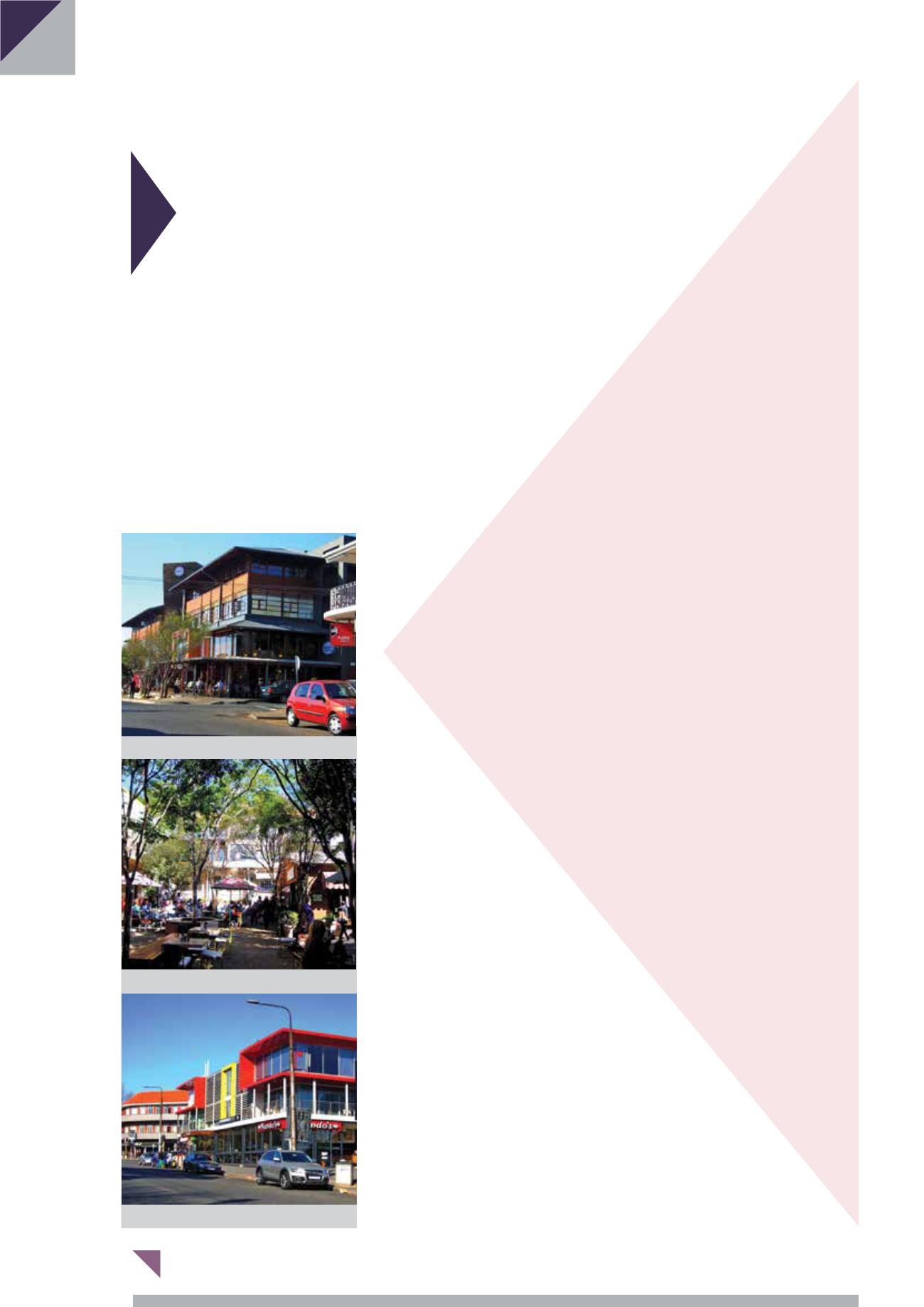
4
th
Avenue in Parkhurst, Johannesburg.
44 Stanley Avenue, Milpark.
Parktown North: a view of the shopping precinct.


