By: Urbain du Plessis of Verdantek*
On 28 September 1892, Mansfield, Pennsylvania, hosted what is widely regarded as the first outdoor sporting event broadcast under lights – a football game that marked the dawn of illuminated sport.
Exactly 116 years later, on 28 September 2008, Singapore staged Formula 1’s first night race. While the American football match had no South African connection, the story of F1 night racing most certainly does.
The spark of an idea
In mid‑2007, while managing Hella’s global mine lighting business, I was approached by a colleague with Formula 1 pedigree – an ex‑McLaren team member – to weigh in on whether F1 could ever run under lights. At first glance, the idea seemed audacious. Yet, like most things in motorsport, the driver wasn’t engineering but economics.
Broadcast rights and advertising revenue fuel F1’s business model. By the mid‑2000s, new circuits were emerging in regions whose time zones didn’t align with prime‑time viewing in Europe or North America. The solution? Shift races into prime‑time slots – even if that meant racing at night.
Why F1 was different
Night racing wasn’t new. Endurance events and rallies had long relied on headlights, and floodlit oval tracks in the United States were hugely popular. But Formula 1 posed unique challenges:
- No headlights: F1 cars rely entirely on external illumination.
- Unique circuits: Each track has its own geometry, requiring tailored lighting solutions.
- Broadcast quality: F1’s global audience demanded higher standards than any other motorsport.
- Safety uncompromised: Drivers and spectators could not be exposed to additional risk.
In short, this wasn’t just about lighting a track – it was about creating a system that could replicate daylight conditions without blinding drivers, marshals, or cameras.
Enter the FIA
The desire for night racing was that of Formula One Media (FOM), owner the famously demanding Bernie Ecclestone, but motorsport rules are created by the Fédération Internationale de l'Automobile (FIA), which long deemed it impossible and too dangerous. To move forward, I had to understand the F1 ecosystem: the FIA (rule‑makers), Formula One Media (broadcast producers), the teams, and the drivers.
Existing sports lighting codes were inadequate. But mining had taught us rigorous safety and risk management principles, and those proved transferable. The FIA listened when we proposed a “safety first” approach.
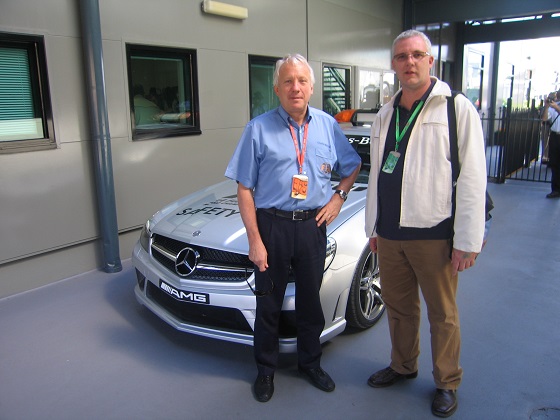
A pivotal meeting followed with Charlie Whiting, F1’s race director and safety delegate. Charlie, wise and pragmatic, agreed: if lighting posed no greater risk than daylight while delivering broadcast‑quality visuals, night racing could be considered.
Designing the impossible
The task was clear – create a repeatable, verifiable technical solution. That meant drafting specifications that the FIA could issue to circuits, ensuring compliance and safety.
To appreciate the scale: a soccer field lit for TV at 1,500 lux consumes about 65 kW. A 6 km F1 circuit, 10 m wide, requires around 1 MW. And while a footballer blinded for half a second might collide with a goalpost, an F1 car would cover the length of the soccer field in that same instant. The stakes were exponentially higher.
We shifted from illuminance (lux) to luminance (cd/m²), focusing on brightness in the driver’s field of view. We set strict limits on maximum brightness, prescribed uniformity across track and run‑off areas, and demanded redundancy at every level:
- Dual ring‑feed power supplies to each mast.
- Redundant lamp arrays, so failure wouldn’t alter lighting uniformity.
- Multiple mast coverage for every section of track, ensuring safety even if an entire mast failed.
Expensive? Certainly. But still cheaper than what a low‑ranking F1 team spends in a season.
From paper to practice
By June 2008, the specification was ready and presented to the FIA in Paris. But theory wasn’t enough – the system had to be demonstrated. My employer agreed to invest millions in what became a stress test of engineering, production, and supply chain ingenuity.
We designed custom floodlights, developed modular reflector systems to shape beams precisely to track geometry, and built the supporting electrical infrastructure. To prove it worked, we hired a FIA-certified race circuit outside Melbourne, installed the system, and ran race cars and MotoGP bikes in both wet and dry conditions.
The FIA Safety Committee, F1 broadcasters, and MotoGP’s governing body Dorna Sports scrutinised every detail. The verdict: success. The system met the stringent requirements and won approval.
A second South African contribution
The lighting system relied on 2 kW metal halide lamps – the same technology used in sports stadia before LEDs became viable. Crucially, the primary reflector was drawn from the StadiaLux floodlight, a product I designed in 1990 and manufactured in South Africa by Zumtobel, then Versalec and finally by BEKA Schréder. That connection gave the project a distinctly South African fingerprint on one of F1’s most groundbreaking innovations.
Legacy
When Singapore hosted the first F1 night race in 2008, it wasn’t just a spectacle of speed and glamour. It was the culmination of engineering rigour, safety‑driven design, and a willingness to challenge convention. And behind the dazzling lights was a story that linked global motorsport to South African ingenuity.
*About the author
Urbain du Plessis is a globally experienced lighting and technology leader with over 30 years of living and working abroad across Australia, Europe, and Asia. Beginning his career at Zumtobel in 1988, he went on to design lighting for Olympic stadia, develop the F1 night racing specification, and bring over 1,000 products to market. Having held C-level roles in multinational firms and managed sales across 50 countries, Urbain’s expertise spans lighting, IoT, polymers, acoustics, and advanced materials. Returning to South Africa, he brings global insight, 30+ patents, and a record of innovation, leadership, and industry contribution.