12
CONSTRUCTION WORLD
MARCH
2014
There are quick wins to be
had and there are a number of
strategies that can assist to
maximise benefits.
Four key areas can be reviewed to
secure energy efficiency wins:
Air exchange rate
Air inside of the critical environment is
often continuously replaced with outside
air to protect occupants in critical environ-
ments. In many cases, the rate at which air
is exchanged in these spaces exceeds what
is necessary. Determining if the space may
use recirculated air or may recapture heat
through equipment like a heat wheel may
reduce operating costs associated with
space conditioning.
HVAC capacity requirements
Air systems must evolve alongside changes
in the use of the critical environment.
Unnecessary, inefficient or legacy HVAC
equipment should be decommissioned
ENVIRONMENT
Achieving greater
In critical environments such
as laboratories, clean rooms
and data centres, energy
use can far exceed that of
similarly sized office space.
Improvements in technology
and advances in energy
management strategies are
providing opportunities to
save energy and reduce costs
in these environments while
maintaining occupant safety
and comfort.
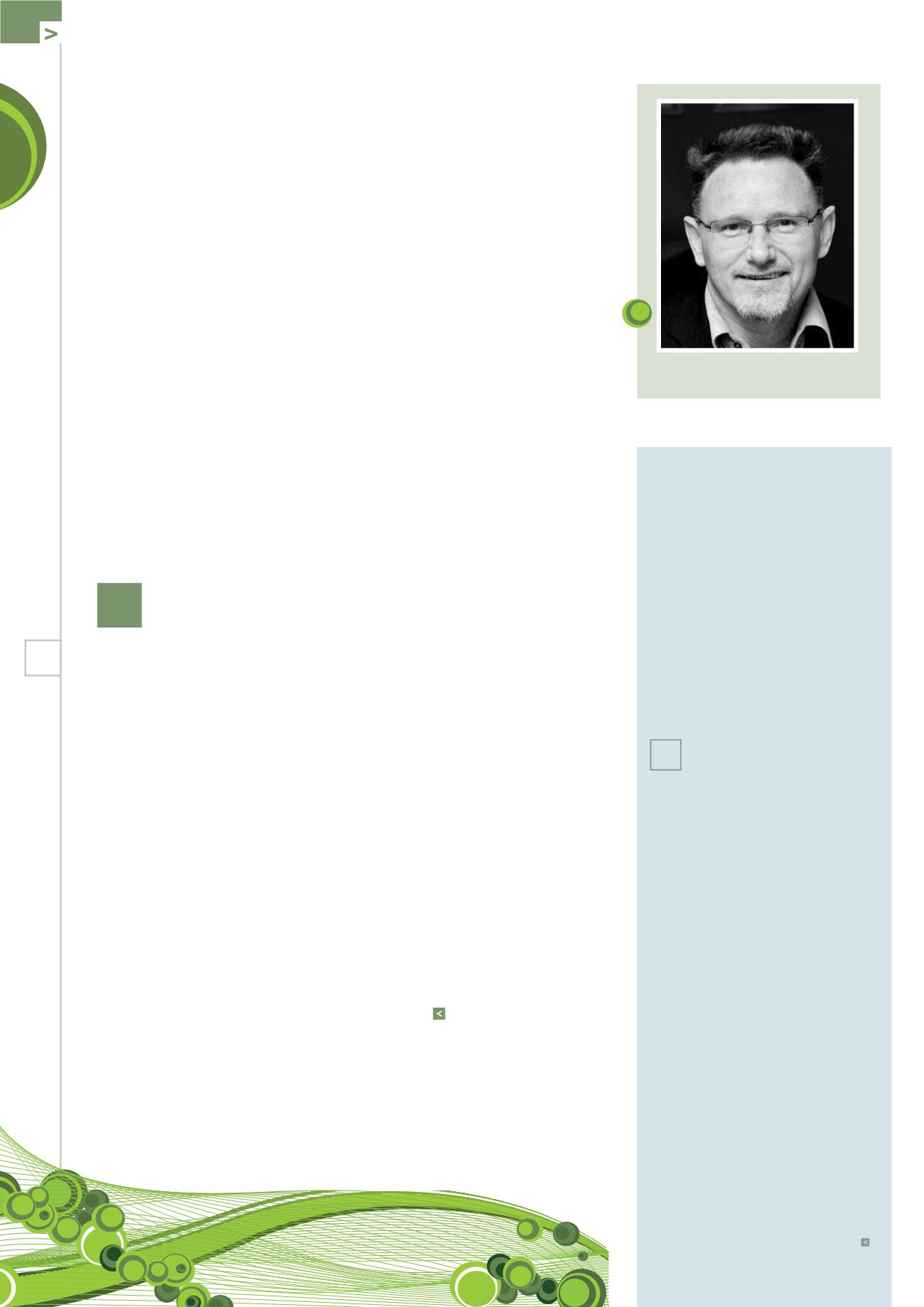
By Neil Cameron, area general manager,
Johnson Controls Building Efficiency Africa.
About Johnson Controls
Johnson Controls is a global diversified technology and industrial leader serving
customers in more than 150 countries. Our 168 000 employees create quality
products, services and solutions to optimise energy and operational efficiencies
of buildings; lead-acid automotive batteries and advanced batteries for
hybrid and electric vehicles; and interior systems for automobiles.
>
or upgraded, while expansion of facilities
and scientific equipment may require HVAC
systems to be updated or HVAC settings to
be adjusted.
Improving system
responsiveness
Significant savings may be achieved by
upgrading air systems to more respon-
sive variable air volume (VAV) instead of
constant volume (CV) equipment. Improved
dynamics in the air system offer energy
saving opportunities by allowing the equip-
ment to adjust to changes in occupancy,
time and equipment usage.
Upgrading fume hoods and
controls
Installing
efficient
laboratory
fume
hoods for effective removal of dan-
gerous fumes can lower demands on
building air systems. New features in fume
hoods include automatic door closure
systems and motion sensors that adjust
airflow if a user is nearby.
The best energy efficiency strategies
will, however, combine technology with
management. Critical environment air
systems which incorporate automatic cali-
bration features can adjust airflow and
operate more efficiently, while improved
fault detection for building equipment
provides the opportunity to avoid unsched-
uled downtime and unexpected costs.
HVAC equipment and building manage-
ment systems will continue to advance,
offering new features, automation and
intelligent
configuration
of
systems.
In critical environments, staying abreast of
these new developments is important as
the benefits in terms of safety and cost effi-
ciencies can be significant in the long and
short term.
HIGH RANKING
SUSTAINABILITY
The list, presented at the World
Economic Forum in Davos,
Switzerland, ranks companies that
prove they are increasing productivity
while using less resources. Atlas Copco is
ranked 46, and it was the eighth time the
company appeared on the list.
Creating business value through
sustainability is at the core of Atlas
Copco’s products and service. The Group’s
sustainability goals include boosting
customer energy-efficiency by at least
20% between 2010 and 2020, decreasing
CO
2
emissions, working actively to elimi-
nate corruption, and promoting access to
clean drinking water in countries in need.
New top-modern factories inaugurated
last year in China and India that were built
according to the Leadership in Energy and
Environmental Design standard are other
examples of Atlas Copco’s commitment to
sustainable, profitable growth.
The Global 100 Most Sustainable
Corporations in theWorld index, known as
the Global 100 list, is presented annually at
the World Economic Forum. The ranking
evaluated 3 641 publicly listed compa-
nies globally that are measured against
sustainability indicators such as safety
performance and revenues in relation
to consumption of energy and water.
At las Copco, a l eading
provider of sustainable
productivity solutions, was
recently recognised by the
annual Global 100 list as
one of the world’s most
sustainable companies
>
ENERGY EFFICIENCIES


