2
CONSTRUCTION WORLD
MARCH
2014
>
COMMENT
EDITOR
Wilhelm du Plessis
ADVERTISING MANAGER
Eugene Botha
LAYOUT & DESIGN
Lesley Testa
CIRCULATION
Karen Smith
PAID CIRCULATION:
(First Quarter ’13)
49
FREE CIRCULATION:
(First Quarter ’13)
4 650
TOTAL CIRCULATION:
(First Quarter ’13)
4 699
PUBLISHER
Jenny Warwick
PUBLISHED MONTHLY BY
Crown Publications cc
P O Box 140
BEDFORDVIEW, 2008
Tel: 27 11-622-4770 • Fax: 27 11-615-6108
PRINTED BY
Tandym Cape
The views expressed in this publication are not necessarily those of the editor or the publisher.
CESA has, over the years, been proactive in
attracting more to the construction industry.
Key is obviouslymaking engineering (or other
built environment related qualifications)
more attractive to prospective students.
There has, however, been a growing
divide between academia (especially at
university level) and industry. This has been a
small, but contributing factor to South Africa
producing less and less engineers, prompting
a very particular skills shortage.
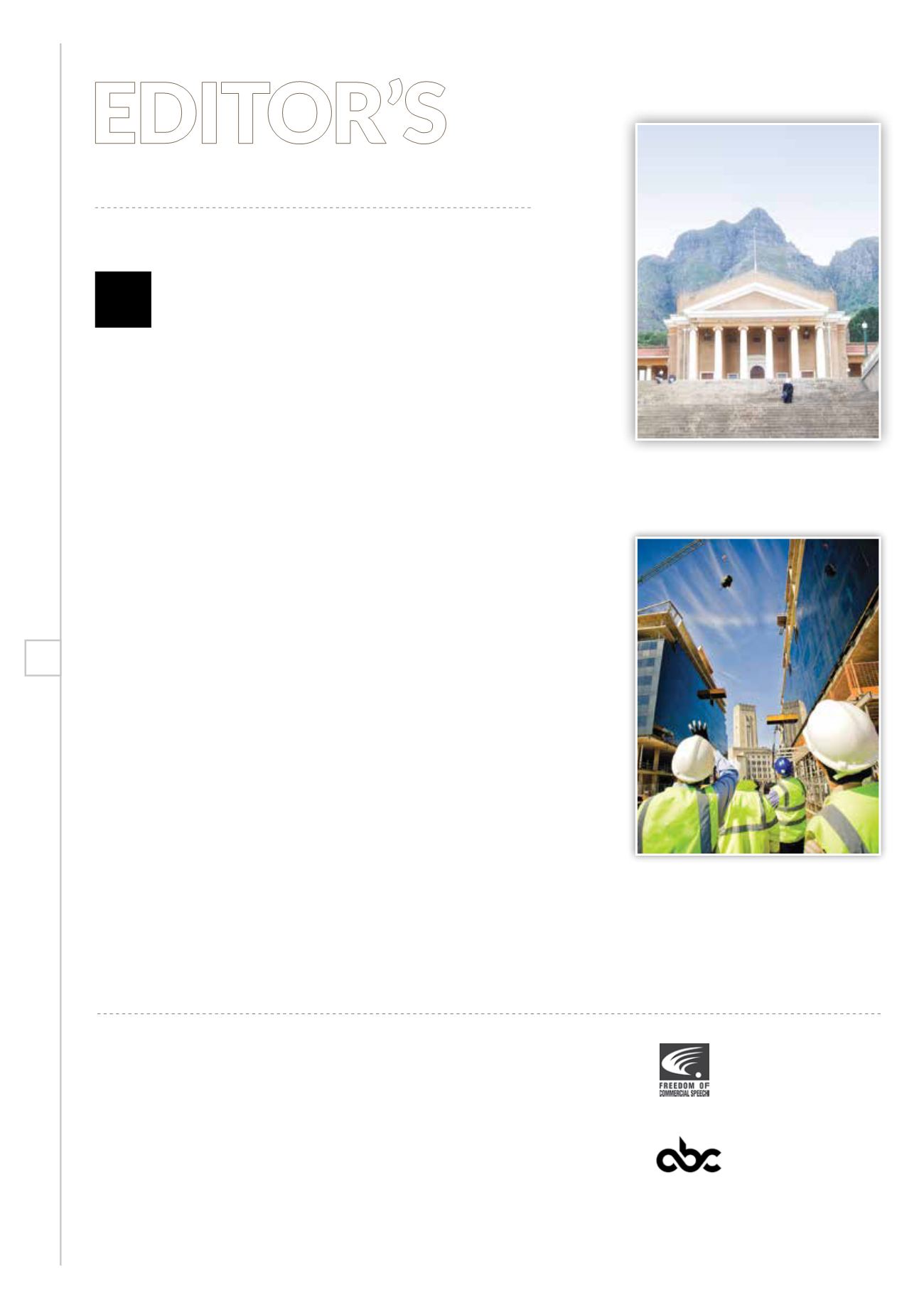
At February’s Construction Industry
Development Board (cidb) Postgraduate
Conference at the University of the Witwa-
tersrand (Wits), Professor Adam Habib, Wits’s
vice-chancellor, said that fundamental to the
evolution and development of South Africa’s
engineering and construction industry and
academia, is the development of meaningful
and sustainable partnerships. These will lead
to the transfer of knowledge and innovation.
He said that it is vital to have national and
international higher education and industry
partnerships as he believes that the industry
will die if the university system dies.
With the divide, both sides lose out:
industry needs to constantly renew itself
by developing new ideas while academics
need to test ideas around the industry. Habib
maintains that the divide is a product of South
Africa’s politics and that this has made our
urban landscape exclusionary.
Besides breaking down the divide, it is
also imperative to establish international
partnerships and to increasingly exchange
ideas related to construction across borders.
This will make South Africa globally more
competitive as Habib says, from a university
perspective, Wits (or any university) will never
be successful if it uses only local ideas and
applies these ideas only to the local context.
Being competitive, by the way, came out
very clearly in Deloitte’s recent ‘Construction
Trend’ report that found that South African
companies, although very active in Southern
Africa, are facing stiff competition elsewhere
in Africa (competitive here includes pricing
and innovation).
Participants to the conference said it was
of critical importance that universities taught
practical problem-solving techniques.
A solution to bridge the gap between
academia and industry would be to co-fund
research projects, collaborate on proposals,
At the recent CESA (Consulting Engineers
South Africa) presidential address, its new
president, Abe Thela, unpacked the body’s
objectives for the year – and longer. One
that I feel is particularly ambitious is
that CESA wants the unemployment rate
to decline from its current 24% to 6%.
The construction industry, that employs
thousands, can be key to achieving this.
Not everything academia does is relevant to
the construction industry and contractors. This
industry wants questions to be answered as
opposed to academics that want questions to
arise from what it focuses on.
student placements, guest lecture, access to
industry’s case studies (by academics and
students) and workshop involvement.
Wilhelm du Plessis
Twitter: @ConstWorldSA


