Basic HTML Version


Lightning
Electrical protection and safety
C
onsider lightning as a gigantic electrical spark travelling be-
tween cloud to cloud or cloud to earth and containing an aver-
age charge of 30 to 50 million volts at a current of 18 000 amps.
• Charges of one polarity are accumulated in the clouds and of the
opposite polarity in the earth.
• When the charge increases to the point that the insulation between
can no longer contain it, a discharge takes place.
• This discharge is evidenced by a flow of current, usually great in
magnitude but extremely short in time.
• Damage to buildings and structures is the result of heat and
mechanical forces produced by the passage of current through
resistance in the path of discharge.
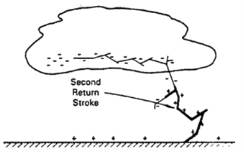
• The second step in the development of a lightning stroke is the
return stroke. The return stroke is the extremely bright streamer
that propagates from the earth to the cloud following the same
path as the main channel of the downward stepped leader. The
return stroke is the actual flow of stroke current fromearth to cloud
to neutralise the charge centre. The velocity of the return stroke
propagation is about 10% of the speed of light or approximately
110 - 106 ft/sec (30 - 106 m/s). The amount of charge (usually
negative) descending to the earth from the cloud is equal to the
charge (usually positive) that flows upwards from the earth. Since
the propagation velocity of the return stroke is so much greater
than the propagation velocity of the stepped leader, the return
stroke exhibits a much large current flow (rate of charge move-
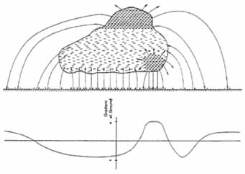
ment). The various stages of a strike development are shown.
Approximately 55% of all lightning flashes consist of multiple
strokes that traverse the same path formed by the initial stroke.
The leaders of subsequent strokes have a propagation velocity
much larger than that of the initial stroke (approximately 3% the
speed of light) and are referenced as a dart leader.
Designing a lightning
protection system for a
generating station
By O Bekker, Fluor
This article establishes guidelines for designing a lightning protection system to minimise the risk of injury to persons or damage to property
at a generating station. Since lightning is a natural phenomenon, total elimination of risk is not possible but the mitigation of risk is achievable.
Permission to use granted by Black & Voarch. Originally presented at EEI
Electrical System and Equipment Committee Meeting. October 25, 1988.
Gradient
at Ground
Second
Return
Stroke
Electricity+Control
September ‘12
22