Basic HTML Version


Return Stroke
Basic principles of lightning protection
• A lightning protection system consists of the following three basic
parts that provide the required low impedance metal path:
–
A systemof strike termination devices on the roof and other
elevated locations
–
A system of ground terminals
–
A conductor system connecting the strike termination
devices to the ground terminals
• Correctly located and installed, these basic components improve
the likelihood that the lightning discharge will be conducted
harmlessly between the strike termination devices and the ground
terminals.
• Lighting protection deals with the protection of buildings and
other structures due to direct damage from lightning by intercep-
tion of the strike.
• Lightning protection systems control electrical discharges by
directing them through a low-resistance path to the ground,
avoiding passage through parts of a structure and reducing risk
of fire or other damage.
• Lightning cannot be prevented; it can only be intercepted or
diverted to a path that will, if well designed and constructed, not
result in damage.
• Requirements will vary with geographic location, building type
and environment amongst other factors.
• Any lightning-protection system must be grounded, and the
lightning-protection ground must be bonded to the electrical
equipment grounding system.
• Installations must be installed in conformance with NFPA 780 [1]
and SANS/IEC 60325 [2].
• The effects of lightning currents must beminimised through bond-
ing and routing of conductors, and surge suppression devices.
NFPA 780: Lightning Protection Systems. A complete system of strike
termination devices, conductors, ground terminals, interconnecting
conductors, surge suppression devices, and other connectors or fit-
tings required to complete the system.
Risk assessment
Lightning risk assessment worksheet
• Lightning loss risk assessment involves the evaluation of various
criteria to determine the risk of loss due to lightning. This guide
is designed to assist in that determination. As a guide, it is not
possible to cover each special design element that may render a
structure more or less susceptible to lightning damage. in these
special cases it is recommended the user of this guide seek profes-
sional advice. Personal and economic factors must be considered
in addition to the assessment obtained by use of this guide.
• For years, engineers, building managers, owners, and insur-
ance carriers have been seeking a more professional method
of evaluating the need for lightning protection. In the past, the
decision to provide well-meaning persons often based lightning
protection on gambles and guesswork, not having specialised
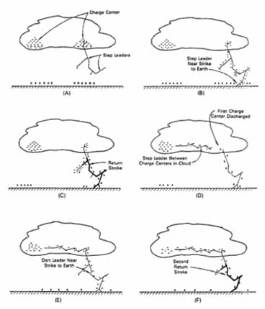
(A)
(C)
(E)
(B)
(D)
(F)
Charge centre
Step leaders
Return
stroke
Dart leader near
strike to earth
Step leaders between
charge centres in
cloud
Second
return
stroke
First charge
centre discharged
Step leader
near strike to
earth
Electrical protection and safety
Adapted from Electrical Transmission and Distribution Reference Book by
Central Station Engineers of the Westinghouse Electric Corporation, East
Pittsburgh, Pennsylvania. Fourth Edition. 1964.
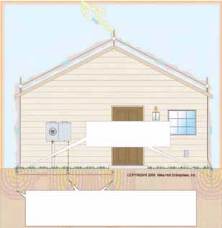
Lightning Protection System
(section 250.106)
Lightning Protection
Grounding Electrode
The lightning protection grounding electrodes must be bonded
to the building or structure grounding electrode system.
23
September ‘12
Electricity+Control