Basic HTML Version


Control systems and automation
T
his is a system that provides a deterministic Remote I/O (RIO)
network for Schneider Electric’s Quantum range of PLCs. The
Q-EIO (Quantum Ethernet I/O) system allows the co-existence
of Distributed I/O (DIO), SCADA/HMI, and RIO traffic on the same
physical Ethernet network. It also provides deterministic operation
of Ethernet RIO without degradation in the presence of SCADA/HMI
and Ethernet DIO traffic. Network determinism is measured by the
maximum amount of time that a mission-critical packet is expected
to take to reach its destination. This value is generally affected by the
size of the system and the interference that any packet might see in
the network from other traffic. In The Q-EIO system offers:
• An extremely fast transmission time for RIO transmissions, re-
gardless of system size; and
• Minimal amount of disturbance associated with other traffic in
the network.
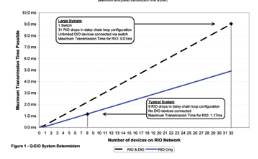
These characteristics are illustrated in the graph in Figure 1, displaying
how system size and traffic mix affects the maximum transmission
time that could be expected in the system.
Figure 1: Q-EIO System Determinism.
This recent automation offer represents a new breed of industrial
networking for automation control. While based on the widely suc-
cessful Quantum platform, it deploys a number of new technologies
to achieve an elusive goal: Network determinism in a mixed-traffic
industrial Ethernet environment.
Network determinism versus overall performance
It is necessary to note that when designing a system, in most cases,
the goal is to optimise the overall system performance. Network de-
terminism is an important component of this effort, but it is not the
only factor. As a guideline, the overall time for an input to be taken
into account by the user logic must include not just the maximum
transmission time on the network, but also the following:
• Input processing time of the I/O module. This will be dependent
on the module chosen.
• Cycle time of the I/O drop, dependent on the number of modules
in the rack.
• User configured polling rate (ie RPI).
• MAST task cycle time or rate at which the immediate I/O block is
called.
Also, the overall time taken for an output to be registered at an output
module in a remote rack once it is set by the user logic must include
not just the Ethernet network but also the following aspects:
• Remaining user logic left to be processed, or time until the next
immediate I/O block is called.
• Cycle time of the IO drop – dependent on the number of modules
in the rack.
• Activation time of the specific output module – dependent on the
module chosen.
As a critical element of the calculation, this article addresses exclusive-
ly the network determinism aspects of the new Q-EIO. This company
differentiates RIO and DIO networks according to the relationship of
the devices to the scanning PLC. In an RIO network, device configura-
tion and diagnostics are integrated in the PLC’s CPU, and are tightly
synchronised to the scan rate of the CPU. This synchronisation of the
I/O allows the PLC to treat the remote devices as extensions of its own
rack, allowing the system to offer certain performance guarantees.
RIO networks are typically proprietary, closed networks that limit the
type and variety of devices that can be connected.
Devices on a DIO network are generally read from or written to
asynchronous to the CPU cycle. In most cases, data is exchanged
cyclically at pre-defined rates (ie rep rates or RPI); in some cases the
exchange with the PLC is done upon request or based on a trigger
Remote I/0
Network Determinism
By D Doggett and MJ Palomino, Schneider Electric
This article shows how the company represented by the authors has generated a highly deterministic Ethernet network that retains the openness
and flexibility of a typical industrial Ethernet environment.
Electricity+Control
September ‘12
4