Flow measurement
variations apply, and will give rise to poor or even unsafe process
control. If we take the illustration of process financials in the previous
paragraph, we have a revenue of R50 700 per hour, so for every week
of production comprising five days of eight hour shifts, we can see that
a 1% measurement error represents a R20 280 per week or R952 900
for a year comprising 47 weeks. For older mechanical technologies,
metering errors of 1% are modest and errors of 10% and greater can
result from uncompensated changes in fluid property.
Let us also consider flow meter installation conditions in respect
of MRO. With the exception perhaps of PD, the older technologies
are significantly impacted by flow profile disturbance. In the past fifty
years, our knowledge has significantly advanced in the area of fluid
dynamics, thanks to extensive research programmes and the develop-
ment of visualisation technology such as CFD (Computational Fluid
Dynamics). This advance in knowledge has allowed us to improve
our understanding of individual flow meter technology behaviour in
relation to flowing fluid conditions.
We now better understand the impact on individual flow tech-
nologies of disturbances to flow such as velocity profile asymmetry
or swirl, caused by common process pipe-work components such as
valves, elbows and pumps. Armed with this knowledge, many plant
operators have become aware of serious shortfalls in the installed
conditions of their older flow meters, and sometimes for this reason
alone, they need to update their process plant control with a more
reliable and accurate technology.
Aiding the transition
The older flow meter technologies mentioned all have one thing in
common, namely that they function as two wire devices utilising
only loop-power. Modern flow meters operating on the Vortex and
Electromagnetic principles have been available in two-wire, loop-
powered form for a considerable time. However, the world's first
two-wire loop-powered inline ultrasonic flow meter was introduced
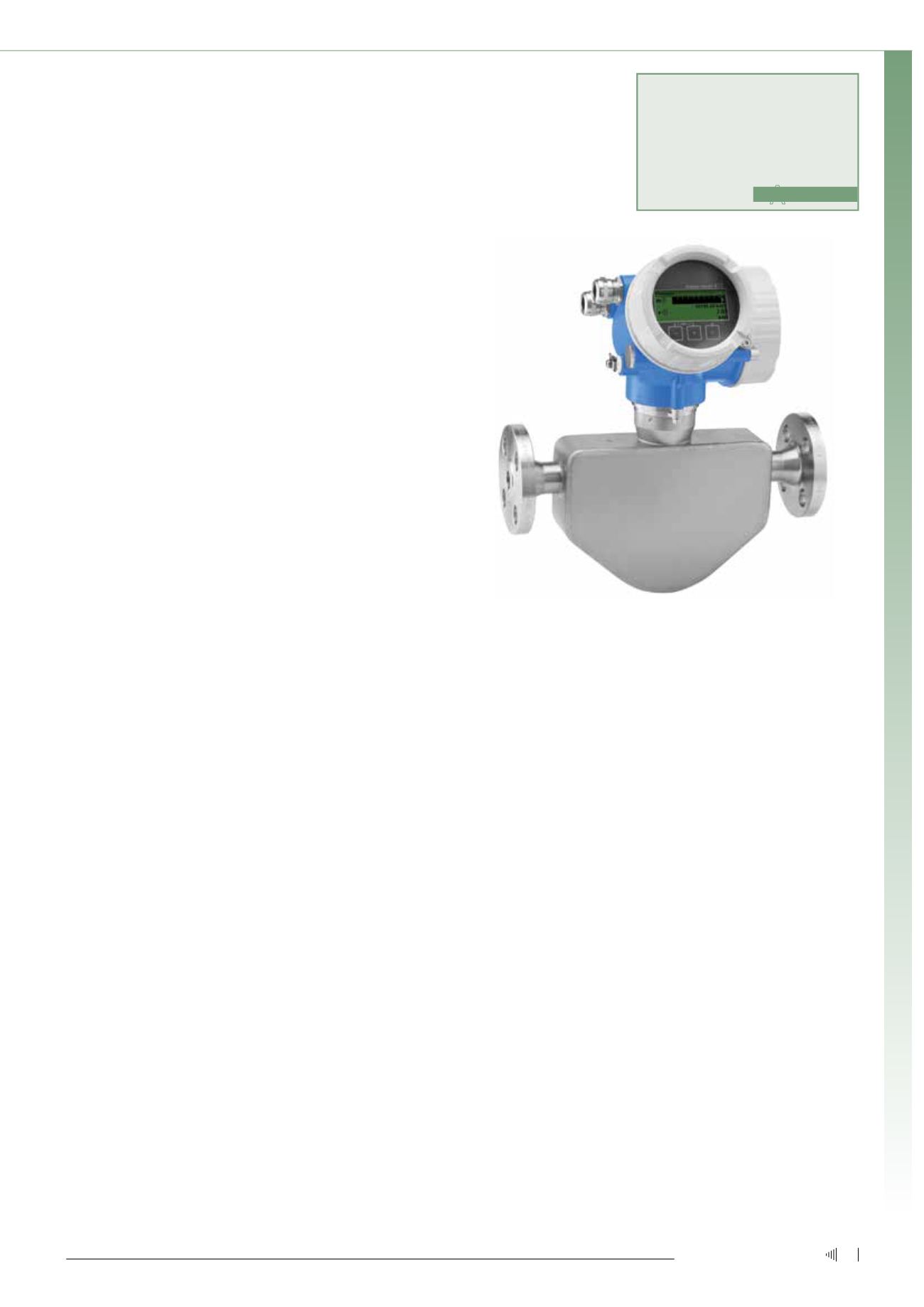
in 2006, and the first true, two-wire and loop-powered Coriolis flow
meter was only introduced in 2010.
These two modern flowmeter technologies respectively lead the
table in flow meter market growth. They offer greater operational
reliability, no moving parts exposed to the process fluid, a wide op-
erational range, fluid property independence, a simplified pipe-work
installation, and virtually maintenance-free operation, thus reducing
cost of ownership. Furthermore, integration of these technologies
in existing two-wire architecture is not only simple, but it offers the
ability to advance the plant controls platform through modern com-
munications protocols such as HART and Profibus.
Where the opportunity is greatest
It is estimated that 25% of all liquids on chemical and petrochemical
plants are non-conductive and many fluids will tend toward signifi-
cant viscosity. In the chemical industries, it is estimated that 60% of
all pipes found on a process plant will be DN5012" or smaller. When
considering the modern technologies for this applications group,
electromagnetic and vortex flow meters would be inappropriate.
Ultrasonic or coriolis technology can provide the solution, and
given the growing preference for two-wire, loop-powered instrumen-
tation in the chemical sector particularly, there is specific benefit not
only from the simplified system integration, but also from the certified
intrinsic safety which is provided by the devices in such installations.
The cost benefit of these technologies in respect of power supply and
cabling requirements can be appreciated by comparison with costs
for the provision of power supply for an alternative 4-wire device.
In 2003, WIB/EXERA (International Instrument Users' Associa-
tions) Report T 2732 X 03 was published, and it provided an average
survey of prices quoted in projects at that time for the provision of
power supply for 4-wire instruments. The price ranged fromR65 000 to
R140 000 per meter, depending upon design and plant characteristics.
We can assume that these costs will not have reduced in the seven
years since, and therefore R103 000 is a conservative figure to use.
Where the flow meter is being installed on an existing, operational
process as a replacement or additional metering asset, thus eliminat-
ing the need for new cable supply and installation work, plant instru-
ment engineers have testified separately to cost savings in respect
of cabling work having a similar range to that of the power supply.
The two-wire loop-powered ultrasonic transit time flow meter
will deliver a volume flow rate measurement with a traceable, cali-
brated accuracy of better than 0,5% of rate. A straight pipe inlet run
of only five diameters is required in most cases, and virtually any
liquid can be measured over a wide range of flow rates, pressures
and temperatures. It is a full-bore meter and thus creates no pressure
drop, and being non-intrusive, it cannot cause line blockages due to
suspended particulate matter.
A
bbreviations
CFD - Computational Fluid Dynamics
DP – Differential Pressure
MRO – maintenance, Repair, Operations
PD – Positive Displacement
VA – Variable Area
17
July ‘13
Electricity+Control


