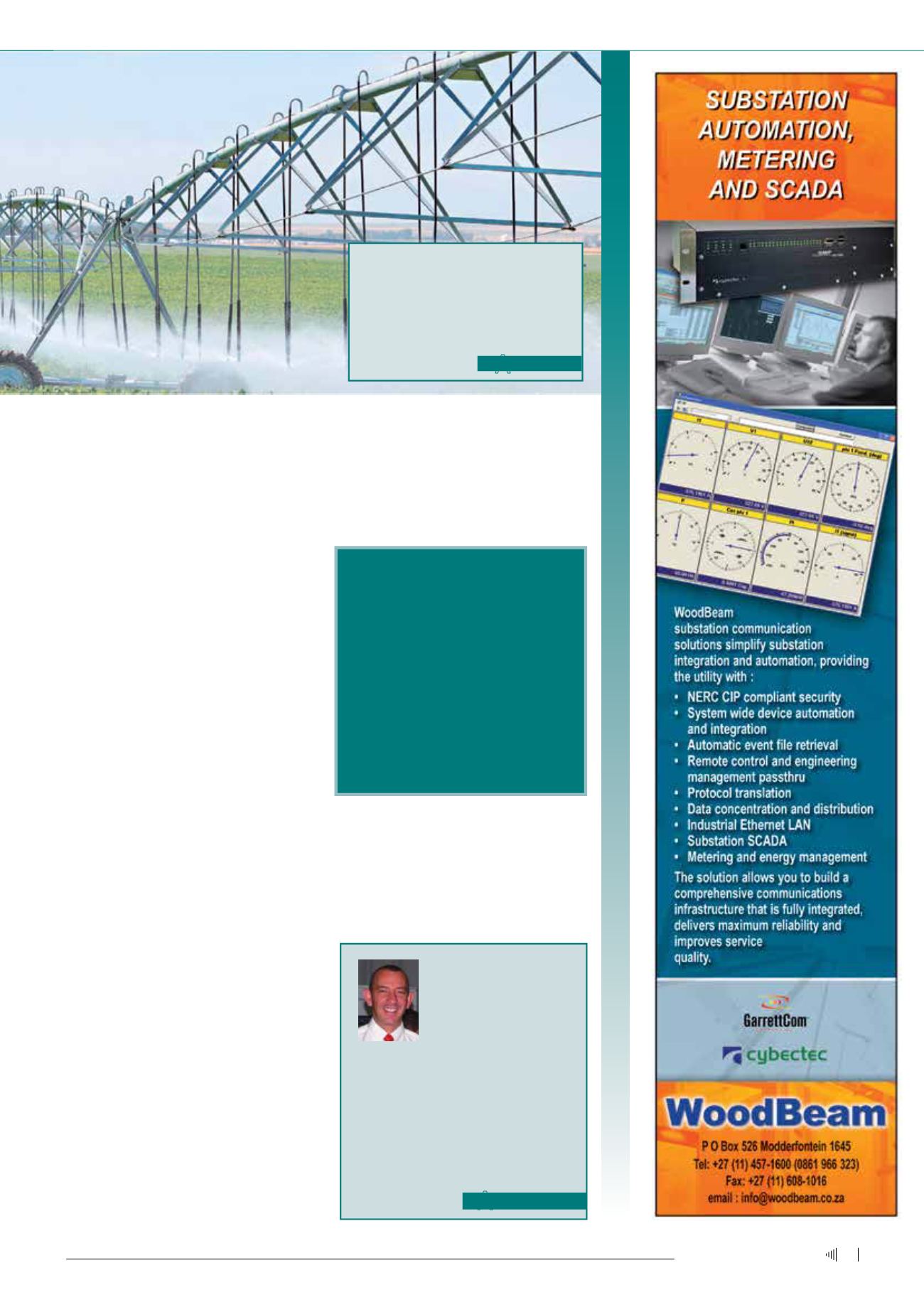
the reduced life cycle costs. For example,
the purchase price of an electric motor and
drive is only 5% of the total life cycle cost of
a typical pumping system.
Solution
Changing of production volumes by mechan-
ical means is inefficient and wastes energy.
A VSD should be used to adapt the speed
according to the respective water flow rate
requirements of the crop. This solution alone
leads to economically significant demand
reduction which reduces electricity bills with
improved and controlled production.
When selecting VSDs for irrigation
pumps in the agricultural sector one must be
careful to choose the correct type of variable
speed drive because of the environmental
requirements. Farms that are classed as Class
C2 (first environment restricted distribution
for public and or residential area) require that
the VSD must have inbuilt electromagnetic
compatibility (EMC) filters.
It is also important to reduce unwanted
harmonics induced onto your network. VSDs
must comply in writing with mandatory
(February 2008) equipment standard IEC/
EN 61000-3-12: ‘Limits for harmonic cur-
rents produced by equipment connected to
public low voltage systems’. It specifies that
the VSD must have inbuilt ac or dc chokes
as standard to minimise the total harmonic
distortion (THD) also in case of partial loads
such as irrigation pumps’.
Actual installations of variable speed
drives with high efficient motors at many
irrigation systems show average energy
savings of 40% and higher. Reduced power
consumption and improved productivity
through better process control results in
higher profitability.
Reference
[1] ABB System Optimisation thru Coop-
eration. White paper - EN 26.04.2013;
No 16755.
A
bout the author
Drives, motors and switchgear
A
bbreviations
BEA – Best Efficiency Area
BEP – Best Efficiency Point
EMC – Electromagnetic Compatibility
THD – Total Harmonic Distortion
VSD – Variable Speed Drive
Fanie Steyn has a National
Diploma in Electrical Engineer-
ing and is a Certified Energy
Manager. He has obtained first
class experience in Gold Fields
and various mining and indus-
trial operations. After working as a projects
engineer at the Zest Group he obtained his
present position as energy efficiency manager
at ABB South Africa. He is responsible for the
motor and drives energy appraisal offerings
within Southern Africa.
Enquiries: Email
Best efficiency point vs Best efficiency area
Researchers of Lappeenranta University of Tech-
nology, Finland, have found that irrigator designers
should focus on various best efficiency points that
occur at different flow rates rather than the fixed
pumping best efficiency point. This means for VSD
pumps, the traditional recommendation of driving the
pump at its best efficiency point (BEP) may not be the
most feasible approach if the pump can alternatively
be driven at a lower rotational speed, for example,
when different flow rate requirements exist.
9
July ‘13
Electricity+Control


