4
Mechanical Technology — February 2014
⎪
On the cover
⎪
M
ining operations and explo-
ration sites typically have
an onsite ore-sampling
laboratory to enable mine
owners and customers to monitor the
day-to-day yield. Ore samples are
brought up from the mine and deliv-
ered to a laboratory, where it is dried,
crushed, split and pulverised. Then,
using ‘fire assay’ processes, samples
pass through a furnace before being
analysed for their metal and other
mineral content.
“Pulverising, putting samples
through a furnace and analysis proce-
dures produce harmful dust and fume,
so an extraction system is an essential
part of any laboratory,” says Knight,
adding that constituents like lead and
NiS particles in the exhaust stream
must be filtered out to comply with
safety and emissions legislation.
Showing the general layout of a
‘superlab’ for a platinum mine Knight
explains that, traditionally, the dust
laden air is extracted from the furnace
rooms and sample preparation work-
stations via ducting connected to each
piece of equipment. “All of the dust is
extracted and passed through a dust
collector, such as the Donaldson
®
Torit
®
Downflo
®
(DFT), a leader in the industry
for over 20 years.
DFT dust collectors use Donaldson’s
proprietary Ultra-Web
®
filter media and
cleaning technology and provide higher
efficiency and smaller footprints than
baghouse dust collectors and most
other cartridge collectors.
Knight explains two new and exciting
innovations that are again reducing the
footprint of dust collectors and improv-
ing efficiency: not only of the extraction
system itself, but also of the amount of
dust handling and peripheral equipment
necessary for an effective system.
The plenum design
A plenum is an enclosed chamber that
allows substances like dust to collect for
later safe processing or
disposal. The plenum
dust extraction design
involves incorporating
“false walls into the
back of a lab to create
a single chamber. By
putting this chamber
under negative pres-
sure, all of the dust
from the workstations
and equipment gets
sucked into the space
inside this chamber.
The advantage?
“The plenum allows
heavy (high density)
dust to settle out in the
plenum chamber. This
means that only the
lighter airborne dust
needs to be extracted
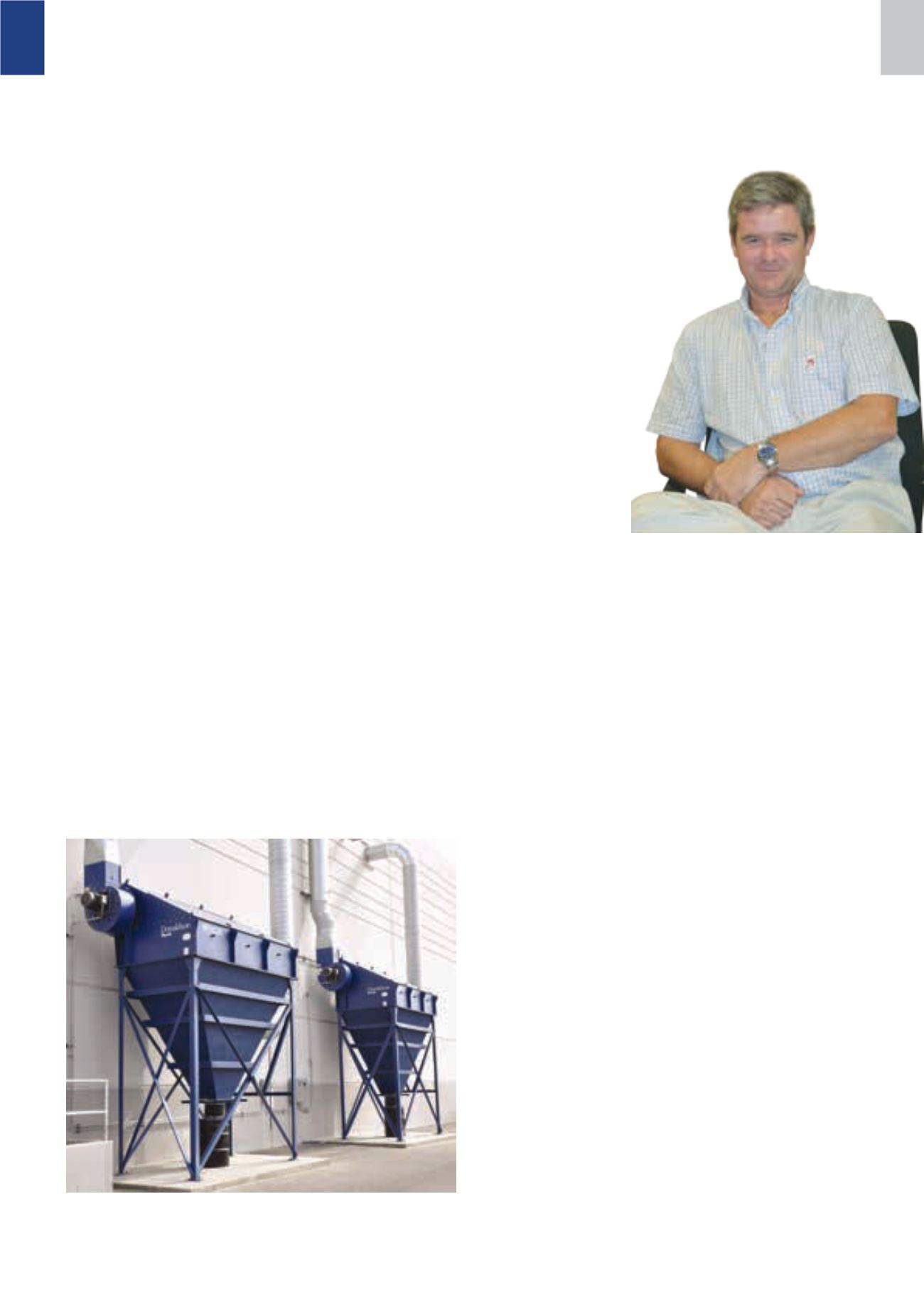
In support of onsite ore sampling at well-established local mines and remote operations across
Africa, Donaldson Filtration Systems SA is developing newer and more efficient filtration
solutions for both mobile and super laboratories.
MechTech
talks to Hilton Knight
(right), the company’s sales engineer responsible for laboratory-based systems.
Donaldson’s Torit PowerCore technology. Donaldson has already installed
one of these systems for an ore-sampling laboratory in Mauritania.
The increasing efficiency of sampling
laboratory filtration systems
through the dust collection system out-
side, therefore reducing the dust loading
on the filter unit, which in turn allows
for a smaller unit to be installed, as well
as a smaller fan using less power,” he
responds. “This design is fast becom-
ing the norm in Canada and the US,
because it is a more efficient way of
extracting and processing particulate
from exhaust streams,” he adds.
Typically, a plenum chamber for a
sampling laboratory is about 1,5 m
deep and sits immediately behind the
laboratory’s equipment and worksta-
tions. A simple vent allows extraction
from the equipment and workstations,
while separate ducting is used to con-
nect the plenum to the extraction unit.
A Donaldson Torit DownFlo filter unit
is used to draw off airborne dust from
the plenum. “The suction created by the
Downflo fan puts the whole chamber
under negative pressure. This draws
dust and fume from inside the lab into
the plenum. The heavier dust particles
drop out in the false chamber, which
allows a lower capacity Downflo unit
system to be used,” Knight says.
Also, by keeping the heavy dust out
of the dust extraction system, the air-
flow speed through the cartridge filters
can be increased to around 1,0 m/min.
“On a traditional system with heavy
particulate passing through the extrac-
tion system, the filter rate has to be kept
down to about 0,5 m/min, to prevent
the dust from blocking and damaging


