14
Mechanical Technology — February 2014
⎪
Proactive maintenance, lubrication and contamination management
⎪
C
urrent industrial filtration
methods often require costly
maintenance and filter mem-
brane replacement on an on-
going basis. However, Tshwane-based
Rand Technical Services (RTS) offer
robust, highly-effective inertial spin
filter technology for industrial dust and
exhaust separation, which is virtually
“maintenance-free”, says Ian Fraser,
chairman of RTS.
“Spin filter units are a high-efficiency
application of cyclone technology. Air to
be separated is blown through a module
that consists of a series of small vor-
texes. The air flow is induced to spin by
fixed vanes at the entry to the vortexes,
and centrifugal force then drives the dirt
particles to the outside of the vortex,”
explains Fraser.
“The dirt-laden air is purged through
an annular port at the end of the vortex
tube. A purge fan is used to keep the
dirt-laden waste air in flight, from where
it is either dispersed or collected as
required. Clean air then exits to pro-
cess,” he explains, adding that 98%
of particles of 15
µ
m and larger are
removed by this simple process.
“In some industries this is particu-
larly useful for materials reclamation,
as the environment is protected and,
at the same time, valuable fines are
recovered that would otherwise be lost
Ian Fraser, chairman
of RTS.
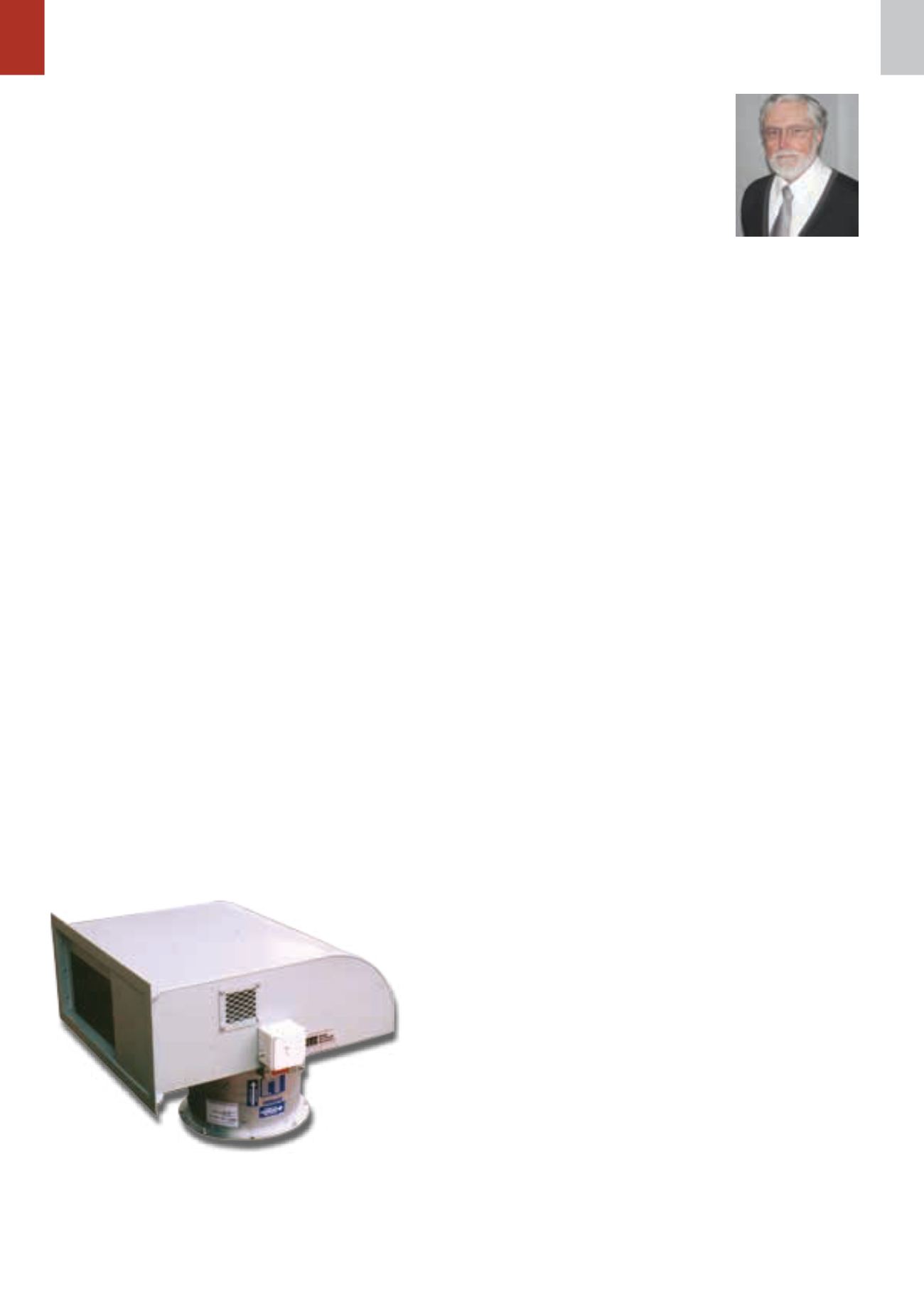
Spin filter units are a high-efficiency application of
cyclone technology. Air flow is induced to spin by fixed
vanes at the entry to the vortexes, and centrifugal
force then drives the dirt particles to the outside of
the vortex.
High-efficiency, maintenance-free cyclone technology is replacing conventional dust and
exhaust filters because of the rapid ROI due to a smaller spend on filtration maintenance
and replacement.
A new spin on industrial filtration
into the atmosphere,” Fraser explains.
Constant resistance,
consistent performance
“Unlike conventional filter membranes,
which clog due to pressure build-up
over time, the pressure drop across
the spin filter module never increases.
The units are self-cleaning and do not
block when correctly installed, thereby
offering consistent performance with
constant resistance. They are highly
energy-efficient too, as the pressure
drop though the spin filter is constant
and does not increase as dust is re-
moved,” he says.
“Not only is pressure constant for the
life of the unit, but the unit itself has
an exceptionally long working life. We
have installations still going strong after
23 years. The sturdy, high density poly-
propylene construction of the blocks is
highly resistant to erosion. Spin filters
are proving to be very effective in mining
applications with heavy dust loads. This
technology is finding wide application
in coal, gold, diamond and other min-
ing environments and is also meeting
arduous dust removal challenges in
underground applications.
“We have built up a population of
spin filters in mining and industry that
includes MCC rooms, control rooms,
transformer rooms, machinery spaces
and workshops, to name but a few.
This technology has also proved effec-
tive for the cooling of variable speed
drive installations,” says Fraser.
Unlimited capacity
He explains that the spin filters are
constructed in modules that can
be built up into large panels, sized
to match required air flow, offering
“an unlimited capacity” on engineered
systems.
“The smallest available unit, con-
taining one Inertial spin filter module,
handles from 1 200 to 2 500 Nm
3
per hour with ease, and upper range
capacity is only determined by the
application, and the available space.”
Fraser says that spin filters pro-
vide sufficient
filtration for
most environmental applications,
such as transformer rooms and control
rooms, without the addition of second-
ary filters.
“In applications requiring secondary
filters to remove finer particles, such
as in air compressor intakes, the spin
filters substantially extend the life of
the secondary filters. Conventional filter
membranes are left with very low dust
loadings and last far longer. There is
also a beneficial ripple effect on cost-
saving throughout the plant.
“Downtime from planned and un-
planned shutdowns is greatly reduced
– and with less damaging friction from
dust particles, this means less equip-
ment wear and tear, or failure.”
Protects switchgear and
electrical systems
Fraser says that a “substantial reduc-
tion in switchgear and other electrical
system breakdown is achieved once
spin filters are installed. Even when
planned maintenance for other equip-
ment is delayed or overlooked, the units
deliver consistent, maintenance-free
performance to keep electrical systems
functioning reliably,” he says.
Environmental benefits
“The benefits of the spin filter system
are almost endless. Return-on-invest-
ment is rapid due to a substantially
smaller spend on filtration maintenance
and replacement – not to mention the
ongoing reduction in equipment break-
down and support costs,” he explains,
adding that “environmental benefits are
also considerable, due to the reduction
in undesirable emissions”.
“Without filtration, many processes
would literally grind to a halt and pollu-
tion and unhealthy working conditions
would be greatly increased. Inertial
spin filters have succeeded, even dur-
ing depressed economic conditions,”
he says, adding, “They keep on saving
time, labour and money long after they
have paid for themselves.”
q


