Benjamin Sibanda, managing director of MATO, a Multotec Group and MATO International Group company with operations in South Africa since 1987, highlights the expanding range of high-performance belt cleaners, ideally suited to coal, diamond, copper and platinum conveying operations.
Click to download and read pdf
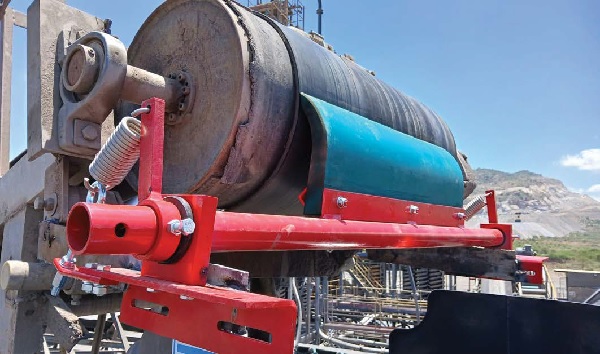
The primary cleaner on a conveyor belt sits on the drive pulley beneath the discharge stream and handles about 90% of carry-back material.
MATO, South Africa’s only manufacturer of lacing clips for mechanical conveyor belt fastening systems, supplies an extensive, high-quality range of belt products and services to large-scale mining and materials-handling operations in Africa.
“We have recently introduced new designs of our belt cleaners, including primary, secondary, and diagonal cleaners that are splice-friendly and offer improved performance,” begins the company’s MD, Benjamin Sibanda.
“When I first joined the company in 2005, we were predominantly known for belt fasteners and lacing equipment, mainly for underground collieries. Mechanical fasteners are generally not preferred in process plants because belt joints are not fully sealed. Fast forwarding to 2015, 2016, with the world starting to worry more about coal's impact on the environment, we were asked to start looking at other applications and products that we could add to our basket,” Sibanda explains.
In addition to its core lacing system offering, MATO manufactures and designs belt cleaners, also known as belt scrapers. “We don't scrape a customer’s conveyor belts, though. We remove carryover material to improve belt performance and extend wear life. And we can now offer a complete range of conveyor belt cleaners that are designed to suit the conveyors for a broad range of minerals processing plants,” he tells MCA, adding that the new range is suitable for all types of belts, rubber belts with vulcanised joints and textile belts, broadening the scope of MATO’s product offering to include diamond, copper, iron ore and platinum mining operations.
“All conveyor belts carrying any mineral product need to be continuously cleaned, for underground and surface operations,” he says.
For all belt types, Sibanda continues, industry has been seeking a conveyor cleaning system that is splice-friendly. “Belt cleaner blades must always be kept just on or above the belt surface to prevent damage. So, in developing MATO blades for primary, secondary or diagonal belt cleaners, we always had to keep our mechanical splice in mind to avoid damaging the blades or ripping the belt joint. With that in mind, our Australian team began investigating designs suitable for any belt joint.
“They came up with solutions for all three commonly used belt cleaners, primary cleaners, secondary cleaners and diagonal cleaners,” says Sibanda.
MATO’s diagonal tail pulley cleaner
To protect the tail pulley lagging, it is crucial to avoid entrapment of spilt material on the underside of the belt. “Here, we can deploy a V-plough or a diagonal belt cleaner, based on considerations, such as how much space is available; how the mine wants to capture the material that comes off, and how to minimise the amount of material that remains under the belt and the tail pulley.
“The traditional plough arrangement tends to be better known and more popular, and these are a part of our offering. But we believe our new diagonal design is often a better solution,” advises Sibanda.
The first and most significant advantage of our diagonal tail pulley cleaner is that it is easy to install. “It is mounted on the channel beams. An installer uses a hydraulic punch to drill two holes on either side of the channel sections of the structure before bolting the cleaner into place. The diagonal blade then rests on the belt under its own weight. The blade floats up and down to accommodate a splice or mechanical belt joint, allowing the cleaner's diagonal blade to continuously remove material from the underside of the belt, channelling it to one side of the conveyor,” explains Benjamin Sibanda.
The system does not require tensioning; it is corrosion-resistant; provides even wear when correctly sized; and includes adjustable limits that engage when the polyurethane blade material reaches 85-90% of its wear life, preventing belt damage from direct contact with the blade's mounting plate.
Primary cleaners
The primary cleaner on a conveyor belt, which sits on the drive pulley beneath the discharge stream, handles about 90% of carry-back material. Correct positioning of this belt cleaner is critical. It must sit against the pulley below the main material flow to redirect any carry-back material into the discharge stream.
“A primary belt cleaner is typically mounted at 15 degrees below the centre on the drive pulley, to protect the blade and to ensure optimal angle of attack is achieved, but we have developed templates to ensure that installers can position them optimally,“ says Sibanda, adding that on an enclosed transfer chute, a cut out hole on both sides may be required to pass the cleaner shaft through for positioning, installation and inspection purposes. An installation manual with templates makes it very clear where the chute needs to be cut, where the blade must be and the required angle of attack. The blade is made from polyurethane material with proprietary additives that are self-lubricating and outperform any other cleaner blades on the market, in both wet and dry conditions,” says Sibanda.
“For underground conveyors, we supply these as overlapping segmented blades 150 wide with a range of different heights, making it easy to install a blade to match any pulley diameter. In addition, for primary cleaners on surface conveyors, we manufacture solid blades in lengths from 450 to 2 100 mm.
“The other nice thing about our MATO blades for primary cleaners is the slide-on, slide-off replacement feature, which significantly reduces downtime. By removing one pin, the blade can be slid off, and a new one slid into its place,” he says, adding that the blade-shape design offers high performance, particularly for belts with mechanical connectors or splices.
Self-adjusting contact with the belt is achieved using either a tension or a compression spring, depending on the client’s needs. Compression springs offer longer life, though, because repeated blade contact with joints can subject tension springs to cyclic fatigue.
MATO Unique (MU) secondary cleaners
Secondary cleaners are located beneath the belt, behind the primary, to remove stubborn material from the underside of the belt. “There is a lot of vibration in these areas; the conveyors can be huge, typically running at very high speeds. Our secondary cleaners are designed to handle these conditions due to their heavy-duty construction, providing an extremely high level of cleaning,” notes Sibanda.
Most notably, the blade shape, even with a hard-metal blade, is belt connector-friendly for all types of splices, thanks to a secondary cleaner design that prevents hard contact with raised connections. “Our MUS series has a slide-on cushioned blade for easy installation and maintenance to minimise downtime, while ensuring that all blade alignments are 100% true across the entire conveyor belt width,” he adds.
While Mato can offer all traditional bolt-on blade types, from MCS 2 to MCS 6, Sibanda is particularly proud of two unique types: the MATO Unique Secondary 2 and 3 (MUS2 and MUS3).
“The MUS2 secondary cleaner, for example, has a unique parallelogram designed into the cushion that gives the cleaner flexibility to float just above the belt while maintaining a constant blade attack angle. This gives automatic adjustability for when the belt thickness varies and for belts with mechanical fasteners, particularly when a tungsten impact blade is used,” he explains, adding that the MU2 with a tungsten blade offers excellent performance on vulcanised belts.
Additionally, MATO’s patented M-Track mounting system offers the same simple slide-on, slide-off method for replacing the one-piece cushioned blade on the crossbeam.
“Belt cleaners enhance safety, reduce belt maintenance requirements, and extend equipment life. Drawing on our experience with mechanical fasteners, we have now designed a high-performance range that outperforms traditional solutions. We also offer comprehensive on-site assessment services for conveyor belts of any kind, which we call MATO CAALC, to make the benefits of our solutions clear to operators,” concludes Benjamin Sibanda.