Janus Bezuidenhout, Application Engineering Manager for SKF South Africa, discusses SKF's lifecycle services strategy for supporting the African continent, which starts with engineered, locally manufactured customisations and extends to include a comprehensive range of lifecycle management and life extension services that ensure long-term value, reliability and sustainability.
Click to download and read pdf
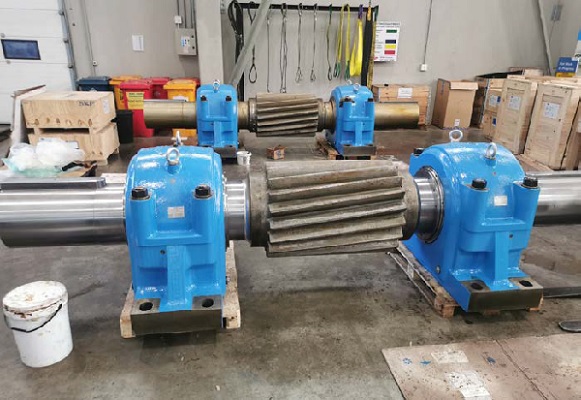
For horizontal grinding mills, SKF South Africa can custom-engineer and locally manufacture mill pinion housing assemblies.
Janus Bezuidenhout joined SKF in 2013 as a project engineer. “Before that, I worked for a company called Henred Fruehauf, part of SA Truck Bodies, as a design engineer for truck axles and suspension systems. I qualified as a Mechanical Engineer from the University of Pretoria with a specialisation in maintenance and reliability, so I have always found SKF a good fit for my skills and interests,” he tells MCA.
He began his SKF journey in the Project Engineering division. “Back then, the Engineering Department at SKF was still split into two: Applications Engineering and Project Engineering. Application engineering typically handled technical issues, assisted customers with designs and technical inquiries, and conducted failure analyses, among other tasks. At that time, Project Engineering was responsible for customised solutions here in South Africa.
“For many years, we have relied on local suppliers to manufacture components for our South African clients to enable us to deliver customised designs to meet niche requirements. In Southern Africa, we often have to supply replacement bearing solutions based on designs from the 1940s, for ageing plant equipment still in use today. So whenever customers can’t find what they need in a catalogue, SKF South Africa can help by manufacturing a housing, seals and any other non-standard elements, and locally assembling a bearing to meet the requirement,” he explains.
As a project engineer, Bezuidenhout worked with high-hitting customers on in-depth projects, not just in South Africa, but also in Australia, Europe, and the Asia region. “In 2017, I took the role of Senior Project Engineer, and I became the Project Engineering Team Leader in 2019.
“Then, in 2020, COVID hit, we moved into a new building, and we had to restructure. Within the global SKF Group, Project Engineering is not well known. It was a service unique to South Africa. So we decided to integrate the project engineering and application engineering teams into a single Applications Engineering Division while maintaining all the core services we have always offered,” Bezuidenhout explains, adding that local customisations and local manufacturing remain key performance indicators within the team.
SKF’s One Africa strategy
“Now, from an engineering perspective, SKF South Africa is not only supporting South and Southern Africa, but we are also responsible for delivering Application Engineering support to the whole of Africa. We currently target and support key countries. Still, if there are needs and opportunities in any other African countries, we are willing and able to respond,” he continues, adding that SKF application engineers have been appointed to support the Northwest Africa and Central East African regions, and there are now seven engineers operating out of the South African office in Gauteng who are available to deliver support and promote SKF’s customised solutions offering.
“OEMs operating in South Africa have installations across Africa. In North-West Africa, for example, we recently had a customised bearing housing manufactured here in South Africa and then shipped it for installation. SKF South Africa-manufactured products are already in many African mines. We also want to develop direct relationships with these customers, through SKF distributors or through our expanding Africa-wide SKF Applications Engineering network,” he says.
Localised manufacturing in SA
“We don't yet have an SKF manufacturing facility in South Africa, so we make use of authorised suppliers that are very close to SKF South Africa and comply with the quality standard of the SKF Group. Some have been working with SKF South Africa for more than 40 years. These foundries and machine shops are all audited and authorised to manufacture products for SKF South Africa in accordance with SKF policies and global SKF quality standards.
“So the products that have been manufactured in South Africa are as good as any SKF Product from Europe. In some cases, the designs are more robust and better suited to the harsh site conditions we have customised them for,” assures Janus Bezuidenhout.
Lifetime service solutions
An integral part of SKF SA’s Application Engineering strategy is to incorporate reliability services into the solutions it engineers. “Application Engineering also incorporates services such as installation, lubrication systems, condition monitoring, and bearing remanufacturing. We want to do more than develop and install housings, bearings and sealing solutions. We want to promote services that help ensure SKF bearings last to their maximum predicted life,” he explains.
Without correct lubrication systems and schedules, for example, even if the correct bearing or housing is installed, premature failure will occur. With manual lubrication, human error can affect the delivery of the correct lubricant, quantity and timing. Lubricating too much, too little or too late can all lead to catastrophe. Automatic lubrication solutions remove uncertainty, improve reliability and extend component life.
“Also, there are certain applications where access to the bearings is unavailable while the system is in operation. You don't want to have to switch off a grinding mill, for example, to lubricate the pinions,” he says.
Poor installation may cause misalignment, contamination or even component damage, which can accelerate failure: even with proper lubrication, accumulated wear or seal damage can initiate a failure. “Unless bearings are being monitored, this can lead to a catastrophic failure. We want to be able to inform our customers of that danger before it happens,” he says.
SKF South Africa can assist with skilled technicians that will install bearings and assemblies according to well-established SKF procedures and methods, says Bezuidenhout, adding that the best way of ensuring that failures do not happen is to use vibration analysis, condition monitoring and lubrication analysis, which can detect the onset of a failure well in advance.
“Using service level agreements, we are trying to incorporate all of our life extension service aspects into our engineered solutions offering, so that customers receive the full benefit from their investments,” he says.
Remanufacturing and circularity
Condition-monitoring information is ideal for scheduling a just-in-time shutdown for maintenance or investigation. Bezuidenhout cites two reasons: first, to prevent a catastrophic failure that would result in an unscheduled plant shutdown; and second, to limit damage so that a bearing nearing primary failure can be remanufactured.
“Remanufacturing is a very big drive for us. In terms of ESG, it’s a sustainability and resource efficiency issue. We can remanufacture bearings and housings from SKF South Africa. The drive is not only to save the customer on cost and delivery time, but also to reduce CO2 emissions,” he points out.
“We have proven bearing remanufacturing capabilities at SKF South Africa, where we reuse as much as we can to give a bearing another life, while significantly reducing the replacement cost. Large-sized bearings are only available from the factories. To bring that new bearing from Europe, it takes about 8 to 10 weeks by sea freight, but if the bearing is reused, remanufacturing it at SKF South Africa takes less than two weeks.
“Also, though, for a new medium-sized bearing housing that might take 6 to 8 weeks to produce from scratch, we can remanufacture a bearing housing in two to three weeks back to the original design requirements.”
Replicating past successes
Most importantly, according to Bezuidenhout, SKF SA wants to replicate its engineering successes. “We have implemented several successful solutions for clients over the past few years. For horizontal grinding mills, for example, we custom-engineer mill pinion housing assemblies. These mills are critical to mine production and always operate in harsh environments, continually exposed to fine dust and water. So our customised bearing and housing solutions are not only more robust but also feature an upgraded seal design to prevent ingress.
“What is also good is that when a condition monitoring system is included, we can monitor these bearings remotely from South Africa, which enables an inspection to be scheduled as soon as we begin to detect problems.
“We see similar opportunities to showcase what we have done in plants in Southern Africa, highlighting how long our custom solutions are lasting, how reliable they are, and just how valuable a similar solution might be in extending the life and improving the reliability of critical assets at other mines in Africa,” Janus Bezuidenhout concludes.