Hilton Woest, Product leader for Torque Transfer and Field Services at Bi, highlights the importance of managing torque in a drive train system and the value of adopting an engineered approach to optimise power transmission systems, ensuring maximum reliability, efficiency, safety, and plant uptime.
Click to download and read pdf
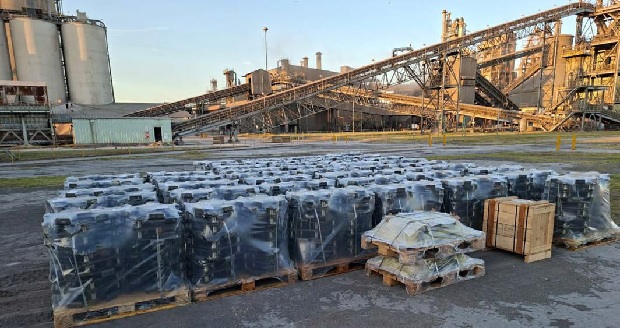
Bi recently installed a high-performance Kobo dual/double-chain pan conveyor in the cement industry, a first-of-its-kind installation in South Africa. Kobo heavy-duty chains can enhance reliability, efficiency and longevity.
“Torque transmission is about how we transfer energy from an electric motor to a machine in a controlled and reliable way. Torque is the turning force (Nm) that makes a shaft rotate at speed (RPM), and torque and speed are directly related through power. If speed is reduced while delivering the same power, torque increases. That’s why most industrial systems use some form of speed reduction, so that the motor shaft speed can be reduced and the torque increased to the output levels needed by the machine,” explains Hilton Woest, Bi’s product leader for torque transfer.
A typical drivetrain, he says, starts with an electric motor, then a coupling, and then some form of speed reduction, which can be a belt-and-pulley drive, a chain drive, or a gearbox. These are then connected to the shaft that powers equipment such as conveyors, pumps, crushers or mills. “Along that whole drivetrain, torque is not just transmitted, it’s managed. Engineers have to consider shock loads, misalignment, start-up torque, overload conditions and more to ensure the torque delivered to the machine is always within the safe working range,” Woest says, adding “managing torque is about protecting assets, reducing downtime and maximising lifecycle value.”
Transmission solutions and couplings
Belt-and-pulley systems, says Woest, are simple, flexible and cost-effective. They absorb torque changes and shock loads well because of the inherent elasticity of the belt material, their ability to slip on the pulley wheel during torque spikes, and the damping effect from tension changes.
“Then there are chain-and-sprocket systems, which are positive drives that cannot slip and are well-suited for higher torque applications. However, they require precise sprocket alignment and proper lubrication, and they do not tolerate misalignment or shock loads as well as belt drives, ” Woest notes.
Directly coupled gearboxes offer compact, high-efficiency torque multiplication, but the choice of gearbox-to-coupling is critical to enable the system to handle misalignment and vibration.
There are many external factors to consider when selecting a torque coupling, Woest says. A coupling for a crane, for example, may be 50 m above the ground. If using a grid coupling, for example, it will require regular greasing, and any maintenance at height is difficult and costly. Here, we would prefer a flexible elastomer coupling that is maintenance-free and provides excellent vibration protection.
“Absorbing vibration from the electric motor is a key factor in pump application, as well. In some cases, a diesel engine might drive a water pump, and if that vibration is transmitted to the pump via a rigid connection, the pump's bearings and seals can fail rapidly. A flexible tyre or elastomeric coupling allows the rubber to absorb vibration from the motor or engine drive, preventing it from being transmitted to the pump itself.
Controlling torque
Torque control involves more active torque management through solutions such as mechanical torque limiters, fluid couplings, or variable-speed drives (VSDs). These help protect against overload, control start-up torque and can react to torque overloads.
Torque limiters are like a mechanical ‘fuse’. They protect the drivetrain by breaking the connection between the drive and driven shafts as soon as the limiter's preset torque is exceeded. There are different types, such as spring-loaded friction plates that act like a clutch, or shearing mechanisms that break to separate the input and output shafts.
A fluid coupling is filled with oil between the drive-side and the driven-side impeller. “On startup, the drive-side impeller accelerates the oil, which transfers momentum to the driven-side impeller, causing the output shaft to rotate. Slip between the impellers allows controlled torque transmission and damping of shock loads,” Woest explains.s
At speed, the whole volume rotates as if the impellers were connected, with much better torque control, first because of the softer start-up, and second because, at speed, the impellers can still slip relative to one another to reduce torque spikes and prevent them from being transferred through the coupling to the gearbox and motor,” Woest explains.
“For finer torque control, however, the modern tendency is to move away from mechanical solutions and to rather look at electronic soft starters or variable speed drives (VSDs),” he notes.
VSDs are used to control the speed and torque of the electric motor driving the system. On startup, a VSD can slowly ramp motor speed and power to keep torque within the system's operating range. Compared to the direct online startup of a motor, soft starters and VSDs significantly reduce the inrush current experienced by electric motors, thereby reducing the electrical infrastructure required and improving equipment energy efficiency.
In addition, a VSD can quickly reduce the motor's speed and power delivery in response to an unexpected torque overload, protecting drive components, improving reliability and extending equipment life.
“Modern managed drive-train systems often integrate VSDs. These allow soft starting, torque limiting, speed control and reduced mechanical stress. With added torque, vibration and temperature monitoring, and the move toward predictive maintenance, drive systems can react to torque spikes, actively preventing damage before it occurs. In addition, regenerative braking through VSDs can also be part of a Bi torque management solution,” he adds.
“There is a place in the market for both mechanical and electronics torque management solutions, however. We offer the full suite of solutions to suit almost any drive application,” he adds.
Engineered drive train solutions
“Torque control becomes especially important in heavy-duty applications, such as apron feeders, bucket wheel excavators, long conveyor systems and mill drives, where start-up torque can be much higher than running torque. It is also vital for protecting critical plant systems, where downtime can have a knock-on effect on the whole plant, causing production to stop with very costly consequences,” he says.
“If torque isn’t controlled properly, broken belts, damaged gearboxes, or stalled motors can result, so in these cases, managing torque during start-up is often more important than steady-state operation,” Hilton Woest tells MCA.
A good example of a torque-related challenge is a mining conveyor experiencing repeated belt failures due to aggressive starts and shock loading. “Instead of repeatedly replacing belts, we would analyse the torque profile with a view to removing torque peaks: by introducing components such as electronic soft-starting methods, torque-limiting couplings, or a size-optimised pulley system. Key to this approach is that the solution addresses the entire drive train, not just the failed component, which is sure to deliver longer component life and far less downtime,” he says.
“This is really where Bi’s strength lies — engineered drive train solutions. The process usually starts with understanding the application: load type, inertia, duty cycle and environmental conditions. Then, torque calculations are done — including start-up and peak loads, not just nominal power.
“From there, risks like over-torque and shock loading are identified, and components are selected accordingly — belts, couplings, gearboxes, brakes, and even control systems. The goal is to optimise reliability and minimise lifecycle costs, which always delivers much better performance and much lower total costs than the minimum-cost repair would,” he points out.
“BI’s offering spans the full spectrum, from basic mechanical torque transmission using belts and chains, to engineered drive trains, torque control solutions, braking systems, advanced VSD integration, and ongoing technical support. It’s a comprehensive approach to managing torque safely, efficiently and reliably throughout the lifecycle of an equipment investment,” says Hilton Woest.
Service and support
After-sales support is also a major part of Bi’s torque management offering. This service includes site inspections, failure analysis, alignment checks, root cause investigations and recommendations for improvement. “It’s about ensuring the installed solution continues to perform as intended, while preventing repeat failures,” he continues.
“We have an extensive branch network, with over 50 branches in South Africa. These are all conveniently located near our key industrial installations, enabling us to respond quickly when our customers need us.
“We are also continually expanding our product and service offering to the market, working with our suppliers to ensure that we can continue to offer globally recognised product brands for any application; brands that we know will meet the needs of our customers' requirements,” he concludes.