marketplace
4
September 2013
CONSTRUCTION WORLD
economy remains subdued, and major
infrastructure projects are slow at coming
to fruition. Nevertheless we have no doubt
that our 3,6million tons cement capacity will
be critically needed when the infrastructure
programme is at full momentum,”he adds.
Lafarge South Africa, local subsidiary of
the international Lafarge Group, the world
leader in building materials, is in a strong
position with its portfolio of modern and
upgraded facilities and is focused on optimis-
ing their use. The Lafarge Group’s successful
long-view strategy of investing in emerging
countries has contributed to its resilient
global footprint andmade themexperienced
in dealing with the tougher market environ-
ments.“In South Africa, our cement volumes
have grown around 3,5% in 2012 and we ex-
pect not more than 2,5% in 2013 if the strike’s
impact is lower than last year,”says Legrand.
The 2014 GDP is expected to increase by
3% and the cement market growth is antici-
pated at 3 to 4%. Inexorable rises in fuel and
energy costs, which are continually impact-
ingmargins, have not been fully recovered
in previous price increases. Fuel costs
increased by 21% in 2011, 16% in 2012 and
Sizing up market prospects for 2014
“There is no doubt that prospects for growth in the South Africanmarket
in the foreseeable future are neither as buoyant as we would like,
nor quite as positive as we were forecasting this time last year,”says
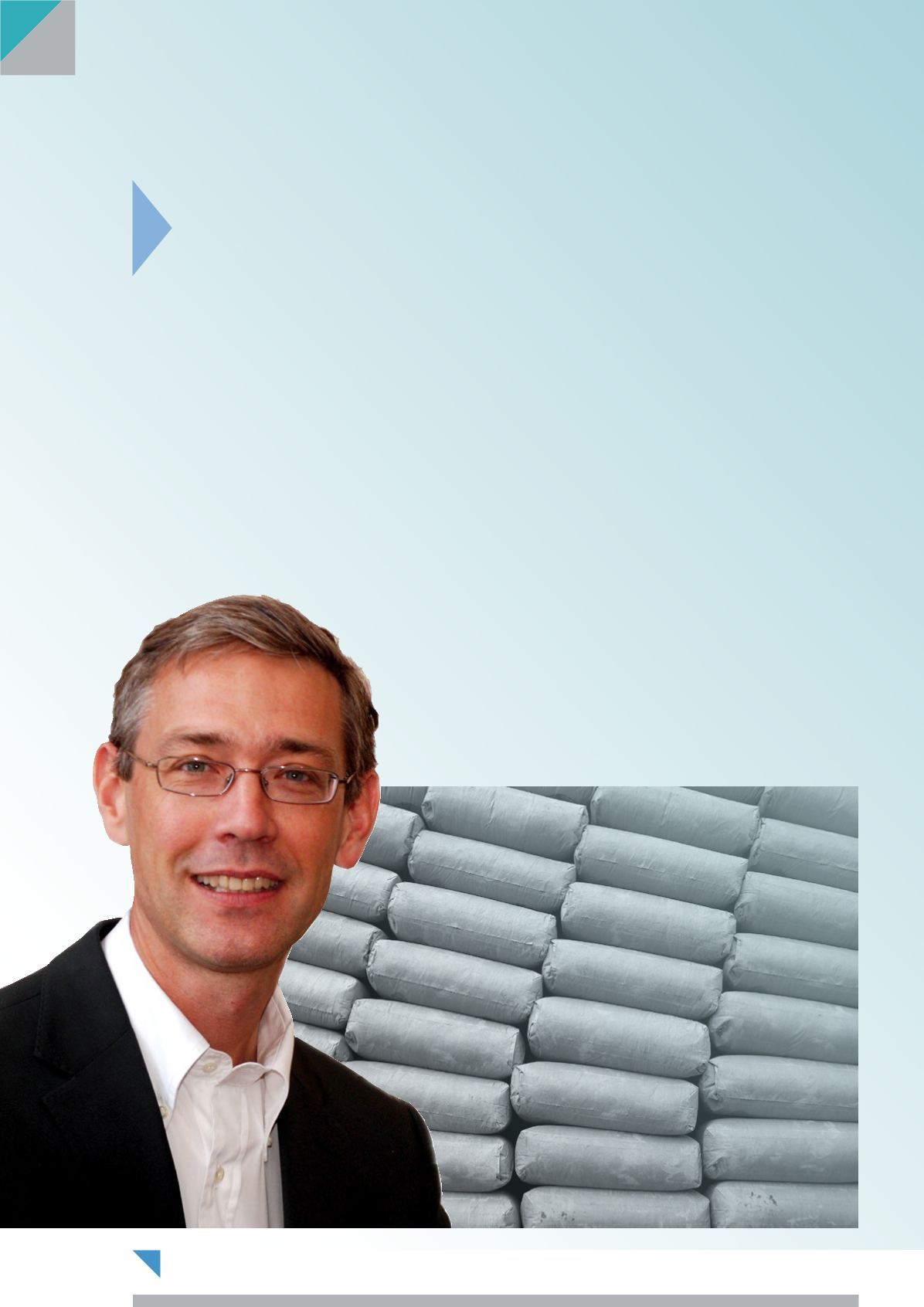
Thierry Legrand, Lafarge South Africa’s Country CEO.
“WE ARE STILL POSITIVE
about the long
term prospects for the cement market in
SouthAfrica.That iswhywe have invested in a
R1,2-billion project completed in 2009, bring-
ing our overall cement capacity to 3,6million
tons a year. Since 2009, the market has not
grown at the expected rate and we have not
been able to fully utilise this capacity. Taking
into account the prospects for growth and
also new capacities coming into the market
we now foresee that we will have enough
capacity in our main plant till 2020,” com-
ments Legrand.
“There are interesting times ahead for
the cement industry in South Africa, as short
term prospects for growth in the country’s
to date in 2013 by 9%, while electricity costs
are increasing bymore than 9%.“Recent price
increases did not fully recover input costs,
while 2012’s average price increase was low.
In order to compensate for the impact of the
high input costs, Lafarge South Africa has
concentrated on cost reduction and optimi-
sation opportunities,” Legrand comments.
“In view of the need to maintain the neces-
sary investment in resources and continue
offering topquality products and services, we
need to increase the current cement prices to
be aligned with input costs”.
Lafarge views the increasingly competi-
tive market as a healthy situation for South
Africa. Committed to driving innovation,
the company is well positioned with its
technical expertise and innovative products
and solutions. The company believes the
country and construction industry would
benefit greatly from the acceleration of the
infrastructure programme.
Government, construction specialists
and building materials companies working
together can facilitate this, creating a great
deal of much-needed employment. As far as
the concrete industry is concerned, limestone
is mined in South Africa, transformed into
cement in South African plants and mixed
into concrete to build infrastructure and
houses in South Africa. The full value chain is
local, boosting the local economy and jobs.
Accelerating the infrastructure and housing
programmes would benefit the industry and
the country as a whole.
●
Thierry Legrand.


