November 2013
CONSTRUCTION WORLD
6
marketplace
MORE THAN HALF OF
South Africa’s six
million residential properties registered
in the Deeds Office are worth less than
R500 000. Currently, 3,5 million or 58%
of these properties fall in the so-called
affordable category – properties under
R500 000 and indications are that 47% of
which are in former townships.
Vuyisile Hlabangane, managing principal
at GIBB Capital discussed these issues at the
SouthernAfricanHousing Foundation (SAHF)
International Housing Conference this week.
The conference highlighted important
issues related topolicy, planning, the environ-
ment, construction and innovative building
methods, financial models and options for
public and private sector housing.
SouthAfricahas aGrossDomestic Product
(GDP) in excess of USD467-billion and a popu-
lation of over 51 million people. The afford-
able segment of the population is 88,14%.
It was estimated that between 800 000 and
1,3 million households fall within the afford-
able housing segment, largely representing
individuals or households earning less than
R16 500 per month.
The demand for affordable housing has
drastically increased, resulting in a grow-
ing housing backlog and situations where
demand for housing outstrips current sup-
ply. The affordable housing market is seen
as the fastest growing market in terms of
volume and value. Indications are that more
affordable homes worth less than R500 000
are being built each year than the more
expensive houses.
Since 2004, an average of 70 000 new
affordable units, including state-subsidised
houses, have been registered at the deeds
office per year, compared with 65 000 in
the category of houses costing more than
R500 000. Although fewer new houses in the
above-R500 000market have been built since
2007, the figures have remained constant in
the affordable housing market.
Hlabangane focusedon the successes and
developments of the Klarinet Housing Project
in Mpumalanga as a case study. “It is a well-
Affordable housing needs
prominence and focus
While good progress has been made in South Africa to enable greater
access to affordable housing opportunities for citizens, much work
remains to be done to ensure that affordable housing gets the
prominence and focus it deserves.
known fact that South Africa has a housing
supply and infrastructure shortage problem.
Where there is property development, there
is an issue with access to finance and infra-
structure.The Klarinet Housing Project, which
is a National Priority Sustainable Integrated
Affordable Housing development of over
12 400 units inMpumalanga, has contributed
towards providing much-needed homes
for communities within the Emalahleni
Municipality,”he says.
However, it should be noted that the
performance of the housing sector as a
whole relies on a stronger working relation-
ship and partnership between the public
and private sectors. “Given the mounting
challenges ahead, limited resources, and the
need to increase the rate of housing delivery,
the industry needs to continue exploring
and implementing mutually beneficial
arrangements between the public and
private sectors as seen in the planning and
implementation of the Klarinet Housing
project,”he concluded.
●
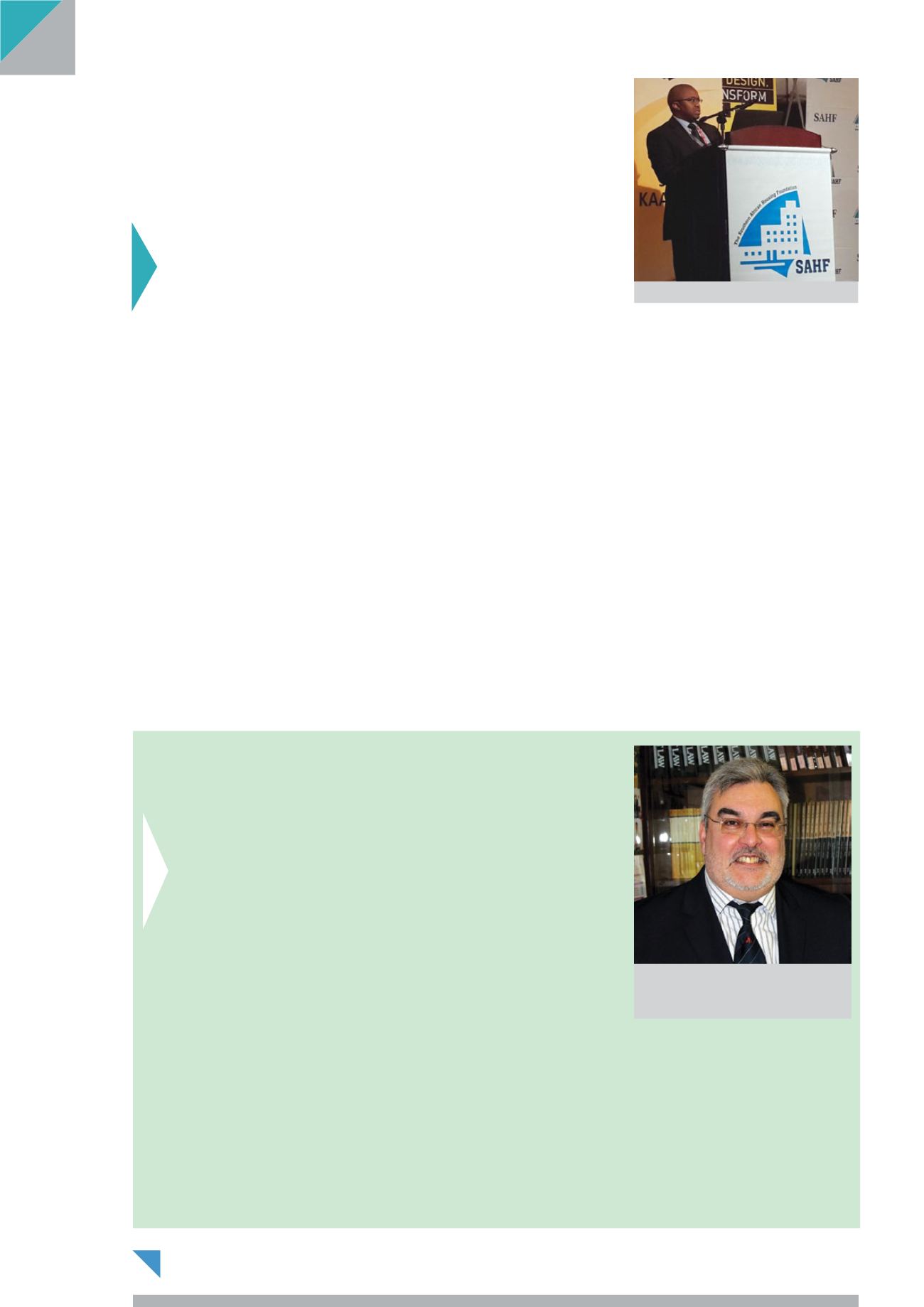
Vuyisile Hlabangane.
THE B I BC -MANAGED SCHEME S
provide security for the families of
everyone involved inthebuilding industry–
ranging from ‘bakkie builders’ to large
listed companies.
They offer vital lifelines in an industry
where many people do not realise that
there are specially designed insurance and
medical aid schemes available to them.
“The importance of pension and provi-
dent fund membership was again high-
lighted recently when the large life assur-
ance benefits were paid out to twowidows
whose husbands had been employed in
the formally organized Building Industry”.
Benefits of R970 000 and R750 000
were paid out to beneficiaries as a result of
the passing away of the two members, who
worked for Dekon Construction and Semper
Prima, respectively.
“Benefits of this nature provide for the
widows and children when the breadwin-
ner passes on either, as in these two cases,
through natural causes or accidental causes.
“The organised building industry recom-
mends membership of these funds to all
employees engaged in the sector.
“We are able to offer very affordable poli-
cies through the BIBC, which is a non-profit
organisation established under Section 27 of
the Labour Relations Act of 1995.
“The Funds have been in operation since
Families compensated
Recent payouts of close to a million rand for the families of two
breadwinners by the Building Industry East Cape Pension/Provident
fund should be seen as a wakeup call for others in the building
industry, says Building Industry Bargaining Council Eastern and
Southern Cape (BIBC) Council Secretary Theo Verschuur.
Building Industry Bargaining Council Eastern
and Southern Cape (BIBC) council secretary,
Theo Verschuur.
the 1960s, and have built up a substantial
asset base over the decades,”he says.
In addition to life assurance, the funds
offer funeral and disability benefits.
“Building is by its nature very physical,
and various illnesses and injuries that will
force the owner, manager or worker in the
business to stop going on site. By joining
one or more of the schemes employers
ensure peace of mind for both themselves
and the rest of their team,”he says.
●


