Drives, motors and switchgear
M
otors often require large amounts of energy when quickly
accelerating to full speed. Soft starters and variable fre-
quency drives can both be used to reduce inrush currents
and limit torque – protecting your valuable equipment and extending
the life of your motor by reducing motor heating caused by frequent
starts and stops.
Soft starters
A soft starter is a solid-state device that protects ac electric motors
from damage caused by sudden influxes of power by limiting the
large initial inrush of current associated with motor start-up. They
provide a gentle ramp up to full speed and are used only at start-up
(and stop, if equipped). Ramping up the initial voltage to the motor
produces this gradual start. Soft starters are also known as reduced
voltage soft starters (RVSS).
Applications
Soft starters are used in applications where:
• Speed and torque control are required only during start-up (and
stop if equipped with soft stop)
• Reducing large start-up inrush currents associated with a large
motor is required
• The mechanical system requires a gentle start to relieve torque
spikes and tension associated with normal start-up (for example,
conveyors, belt-driven systems, gears, etc)
• Pumps are used to eliminate pressure surges caused in piping
systems when fluid changes direction rapidly
How does a soft starter work?
Electrical soft starters temporarily reduce voltage or current input
by reducing torque. Some soft starters may use solid-state devices
to help control the flow of the current. They can control one to three
phases, with three-phase control usually producing better results.
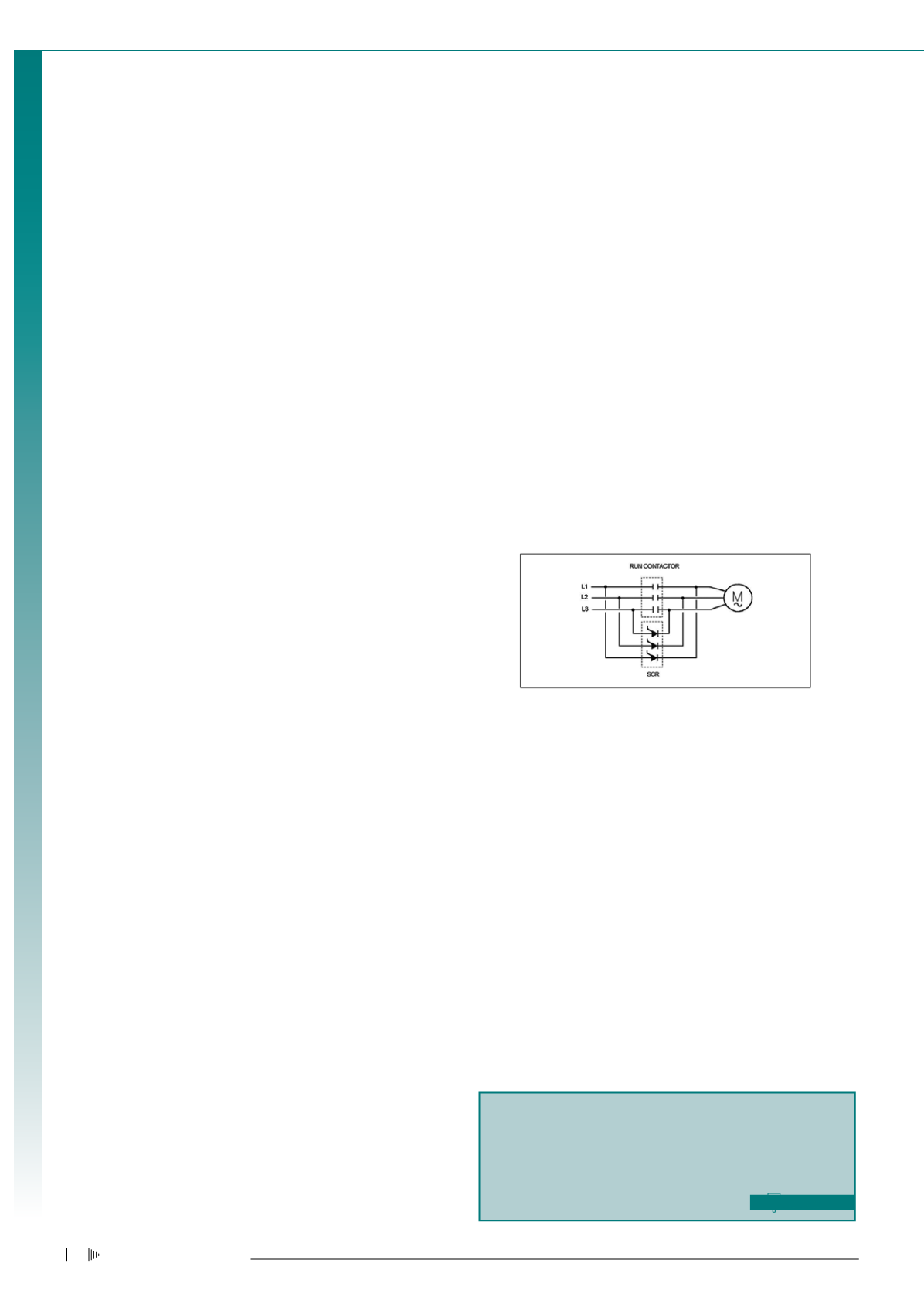
Figure 1: Soft starter schematic.
Most soft starters use a series of thyristors or silicon controlled recti-
fiers (SCRs) to reduce the voltage. In the normal OFF state, the SCRs
restrict current, but in the normal ON state, the SCRs allow current.
The SCRs are engaged during ramp up, and bypass contactors are
pulled in after maximum speed is achieved. This helps to significantly
reduce motor heating.
Benefits of choosing a soft starter
Soft starters are often the more economical choice for applications
that require speed and torque control only during motor start-up.
Additionally, they are often the ideal solution for applications where
space is a concern as they usually take up less space than VFDs.
Variable frequency drives
A VFD is a motor control device that protects and controls the speed
of an ac induction motor. A VFD can control the speed of the motor
Choosing between a
soft starter and a VFD
to fit your application
By K Danielson, Eaton
Choosing between a soft starter and a variable frequency drive (VFD) often depends on the applications, system requirements, and cost – for
the initial start-up and over the lifecycle of the system.
T
ake note
• The choice of either a soft starter or a VSD depends on the application.
• A VSD has the benefit of being able to ensure more efficient motor
operation.
• Lifecycle costing, including energy usage, must be factored into the
decision as to which is the best choice.
Electricity+Control
July ‘13
4


