design competition.Wewere happy to compete and
come up with a few interesting concepts for them.
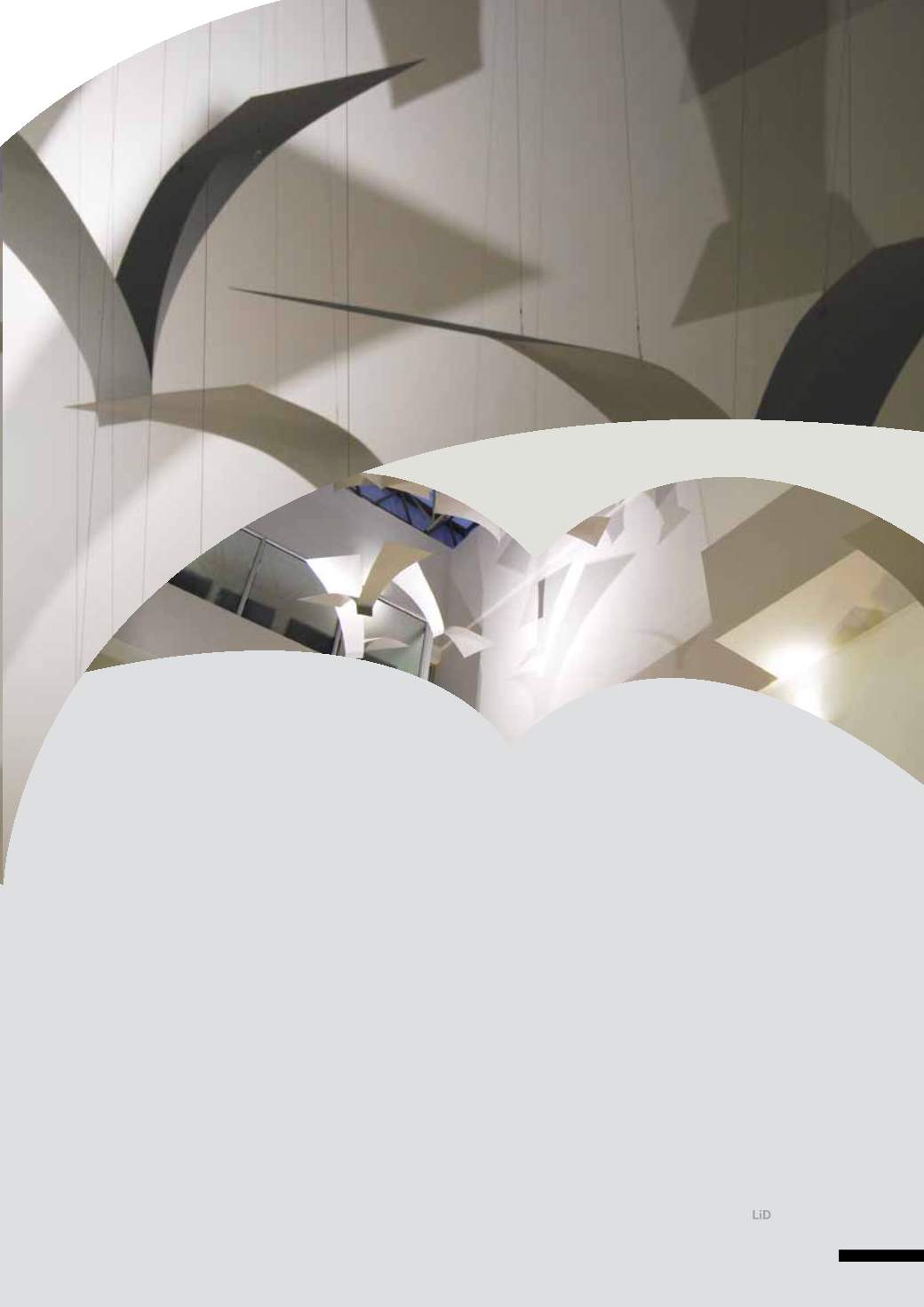
Our final submission turned out to be more of
a ‘Calder’esque’ mobile – with external lighting
throwing dynamic, interesting, shadow patterns
onto the surrounding walls – than a chandelier.
The scale and spatial dimension of the atrium
provided a challenge. A miniature mock-up was
manufactured to scale and directional coloured
light was beamed at the model. The effect was
really interesting and the images of the trial were
submitted along with a cost estimate and a plan for
the method of installation for a full scale version.
Lo and behold, our concept and presentation
‘blew away’ the powers that be and we were
awarded the contract.The Early Birds were hatched.
Thirty stylised spring steel seabirds were going
to fly through the space – emerging from a solid
surface, breaking free and rising as if in a thermal
current.
A full scale model of a pair or two of the wings
was laser cut and fitted together and the neces-
sary engineering undertaken to prove the concept
and ensure the method of installation and safety.
Each ‘bird’ weighs around 5 kg and in the end
two sizes were manufactured.There are now a total
of thirty, excluding the three that ‘morph’ out of one
wall of the atrium. In the final iteration, subtle was
the byword and the birds were painted to suit the
pale earth tones of the space.
The lighting, using high intensity metal halide
spots, was also tested and installed.The luminaires
are fitted at two elevations and on one side only
so the installation, which is observed from three
sides, achieves good shadow patterns.
The installation was laborious and took a week
using a cherry picker and rope access. A kilometre
of fine stainless steel cable supports the birds and
is virtually invisible.
Wow, for a lighting design company we are as
pleased as we could be and look forward to a future
that includes more art illuminated by good lighting.
13
LiD
08-09/14


