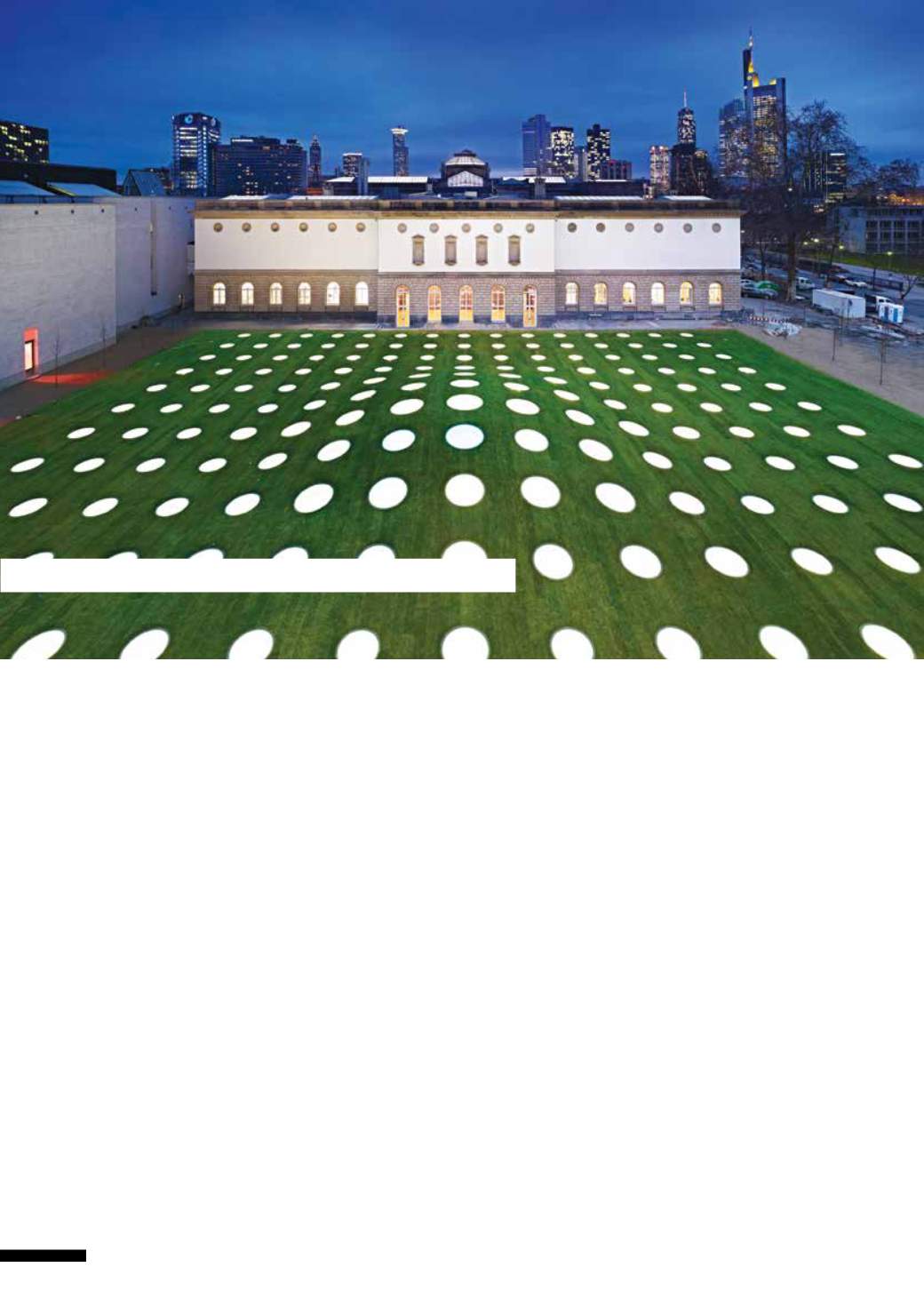
The 2012 Light + Building fair in Frankfurt coincided
with the opening of the Gartensaal, the largest ex-
tension to the revered Städel Museum in its history
of soon-to-be two hundred years. Local architects
schneider+schumacher simply excavated the in-
ner courtyard and covered it again with a slightly
bulged grass roof that can be walked on and now
defines the topography of the garden. The result-
ing space below, however, feels like anything but
a basement. Its pristine white vaulted ceiling is
perforated with a grid of circular skylights that look
plain and simple but hold a multitude of functions.
The inner courtyard, or Städel Garden, is stud-
ded with 195 circular skylights. They range from
1.5 m in diameter along the sides to 2.7 m in
the centre. The exhibition space beneath adds
3 000 m
2
to the museum.
The public quickly took possession of the green,
hilly landscape of the garden and the museum.
Within the first two days of the re-opening 18 000
people had visited the Städel Museum. As part
of the refurbishment of the existing buildings,
the old lobby has been fitted with a sculptural
staircase leading down into the new Gartensaal.
Downlights are recessed into the coffered ceiling;
a peripheral track holds adjustable LED projectors
for accent lighting.
Looking back towards the staircase, all lighting
equipment is confined to two troughs with track-
mounted fully adjustable LED spotlights for general
and display accent lighting. All LED lighting fixtures
have adjustable colour temperatures. The sides of
the skylights carry tightly arranged LED boards that
supplement the natural light. Both intensity and
colour temperature of the lighting are individually
controllable within each skylight. The narrow gap
between the diffuser and the concrete edge accom-
modates a circumferential track for LED spotlights
and framing projectors.
Different conservational or curatorial require-
ments may apply to each of the zones of the
hall, and precise target horizontal or vertical il-
luminance levels are achieved by measuring out
the daylight ingress through a series of reduction
layers, up to full black-out, that automatically uncurl
within the skylight. Artificial lighting is then added
as required. A complex control system coordinates
the daylight reduction as well as the diffuse LED
panels and possible spotlights whilst adapting to
a flexible zoning of the hall. A diaphanous fabric
material stretches over the skylight apertures. It
diffuses the incoming light but still allows one to
get a sense of the blue sky and connect with the
exterior.
Städel Museum was shortlisted for the World
Interiors News Annual Awards 2014.
Städel Museum by Licht Kunst Licht AG
Photo credit: Licht Kunst Licht AG
LiD
08-09/14
16


