32
Mechanical Technology — May 2013
⎪
Manufacturing technology and plant automation
⎪
O
ver the last decade, the
concrete industry has slowly
increased the complexity of
its formulas in an effort to
improve in-situ strength, viscosity and
setting time, while reducing the cost of
production with admixtures that opti-
mise cement to gravel ratios. This has
created a new market for cement mixers
that produce more precise results.
Speaking at the 2013
Advances
in Cement and Concrete Technology
in Africa
conference in Johannesburg,
Dirk Heuer, manager building materials
at the German company, Maschinen-
fabrik Gustav Eirich GmbH & Co KG,
explained why the company’s world-
renowned intensive mixers are gaining
new relevance in the progressively
high-tech concrete industry: “Using a
unique mixing principle, Eirich mixers
have proven to reduce cement require-
ments by up to 10% without affecting
final concrete strength, by means of,
superior homogenisation. Other benefits
are higher early strength of the concrete,
which means precast products can
be removed earlier. This drastically
improves precast manufacturers’ pro-
ductivity,” he explains.
“Eirich mixers offer significantly re-
duced batch times for high performance
concrete. That means daily throughputs
can be maintained for much smaller
mixers and, in turn, this reduces en-
ergy requirements. In fact, this helps
to improve our customers’ profitability
as well as the final quality of concrete.
Proper homogenisation of concrete
mixtures has also proven to reduce the
need for super plasticisers by between
2% and 10%.”
Eirich has previously focused on its
strengths within the specialised mixing
markets, but the increased complexity
of concrete manufacturing has seen
Eirich’s applicability to the industry
grow. “Concrete used to consist of just
sand, gravel, water and cement. But
nowadays, you’ve got sand, gravel,
cement and water as well as expensive
super plasticisers, admixtures, fibres
and colorants that make it imperative
to reduce batch wastage by taking a
more scientific approach,” says Heuer.
“High value cement also has very
small grain sizes, which increases the
mixture’s tendency to agglomerate. To
destroy these agglomerates, you need
more shearing forces to be applied to
the mixture. This is where our intensive
mixing principle offers a major advan-
tage,” he says.
Eirich, represented locally by its joint
venture partner Birkenmayer, started
manufacturing industrial mixers in
1903. The company later invented the
Birkenmayer, in association with Eirich, offers a sophisticated range
of precise concrete mixers with admixtures to optimise cement to
gravel ratios, along with direct sludge drying systems that provides
lower energy costs, better environmental practices and maximum
operational efficiency. Dirk Heuer of Eirich and Birkenmayer’s Louis
Eksteen explain.
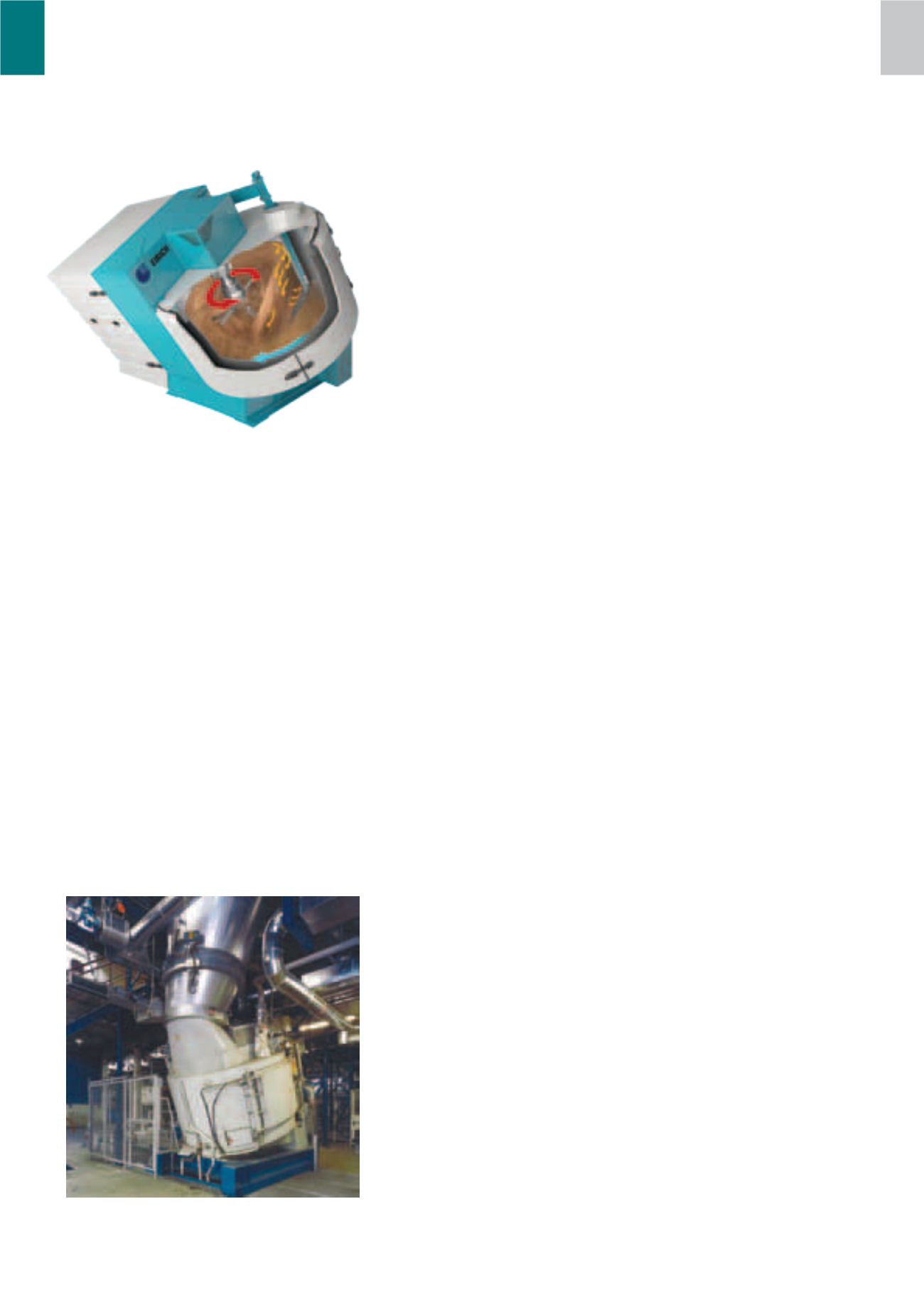
The increased complexity of concrete mixtures
requires more precision to reduce the risk of batch
failures. Intensive mixers from Eirich have proven to
reduce this risk with true homogenisation.
An Eirich mixer connected to heat, steam and pres-
sure controlling systems for drying sludges.
Intensive processing solutions
for concrete and sludge
world’s first planetary mixer in 1906
and in 1924 introduced the first rotat-
ing pan technology to the market and
created the world’s first counterflow
intensive mixer. The first rotor agitators
were introduced in 1960, followed by
inclined mixing pans in 1972.
“Today, we have a range of applica-
tion-specific innovations such as hybrid
mixing sequences, which allow variable
speed mixing, various types of wear
protection covers and fully automatic
cleaning systems. We customise every
mixer to match precisely the needs
of our customers – starting at project
consultation and the supply of mixers
and ancillary equipment to aftersales
services and support. This is why Eirich
is very competitive in price and lead
times compared to mass-produced mix-
ers which need to be re-designed and
customised to suite more specialised
mixing applications,” says Heuer.
Eirich offers three wear protection
systems for the concrete industry,
which provide a maximum lifespan for
mixers, depending on the concrete ap-
plication. They can be equipped with
steel protection for standard concrete
mixtures, while for very fine mixtures
with small gravel sizes, rubber linings
are recommended. Eirich installs tung-
sten carbide plates for very abrasive
mixtures, which can withstand many
years’ of harsh usage.
Eirich is extending its product range
by introducing a new one-litre lab
machine, the EL1, which is ideal for re-
search and development in universities
for fine grain mixtures. Other product
additions include the R16 industrial
mixer which features a capacity of 600
to 900 litres. The R28 industrial mixer
features a maximum capacity of 4 000
to 5 000 litres and the new R33 fea-
tures a colossal capacity of 6 000 to
7 000 litres.


