Mechanical Technology — May 2013
25
⎪
Materials handling and logistics
⎪
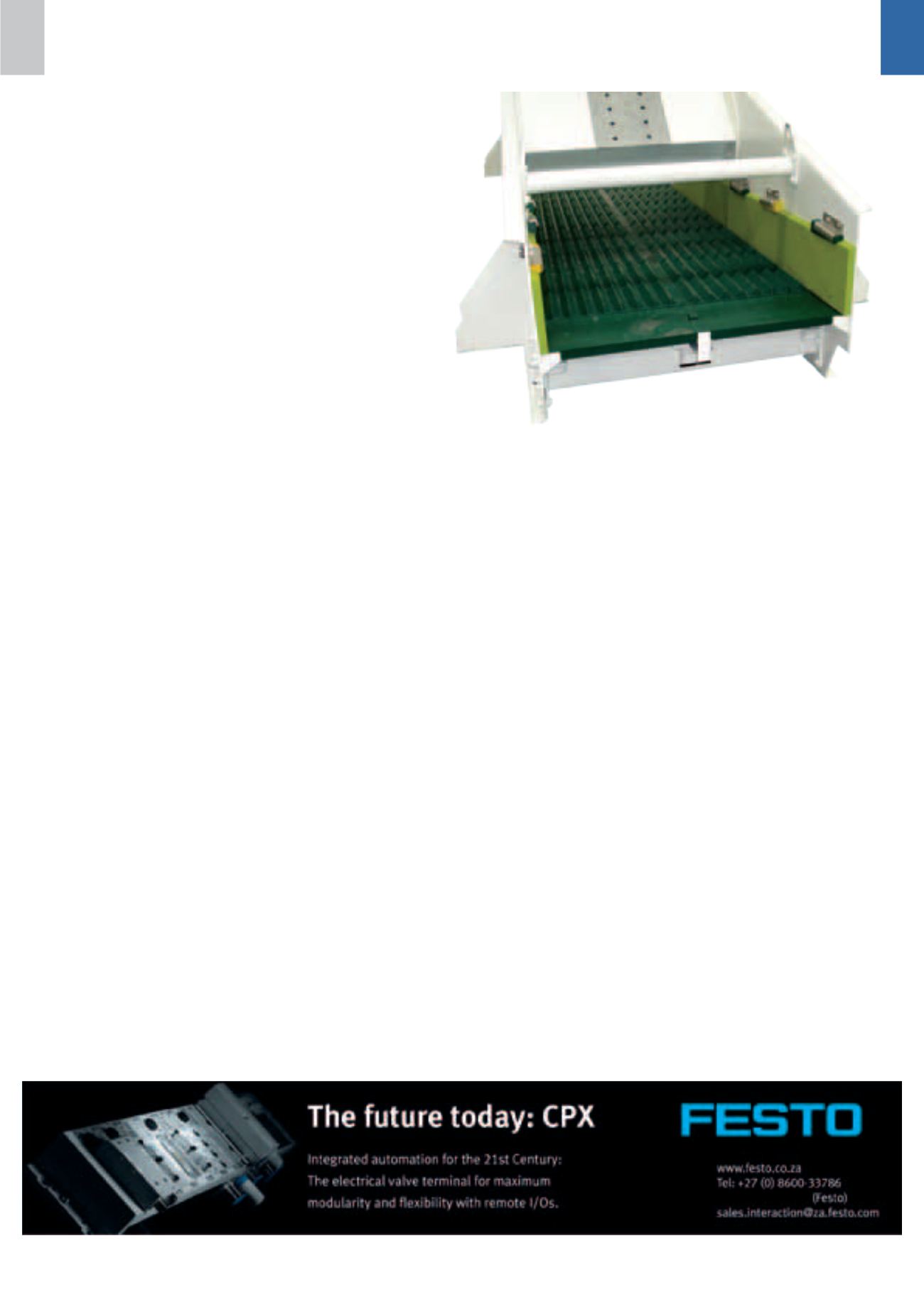
The Multotec TeePee screen panel offers double the
open area of conventional Multotec Hi-Flow screen
panels with the same aperture size.
is expected to produce on average about
85 kt of zircon and 575 kt of ilmenite
per annum, as well as small amounts
of rutile and leucoxene, when in full
production, making it also the largest
new mineral sands project currently
under construction.
Multotec was originally awarded a
contract to implement only up-front
design, finite element analysis and
engineering for these units, but subse-
quently received an order to manufac-
ture and supply the self-driven trommel
screens from the EPCM contractor for
the floating (wet) concentrator, mineral
separation plant and associated site
infrastructure.
“The client required a primary
screening machine to remove vegeta-
tion and tramp material from the beach
sands,” Anthony Yell, Multotec project
manager – screening, explains. “The
high volumes made the self-cleaning
capabilities of a self-driven trommel
screen the most cost-effective option
for the application, as has already
been proved in a number of existing
applications.
“Self-driven trommel screens of this
size are unique in terms of the multi-
disciplinary nature of their manufacture,
involving large steel fabrication, rubber
lining, stress relief, machining, casting
of polyurethane panels and liners, as-
sembly, hydraulic drives and electronics
featuring Human Machine Interface.
Test running is also a requirement, along
with specialised logistics to transport
these units to site – followed by supervi-
sion, erection and commissioning.
Multotec’s self-driven trommel
screen designs use a direct hydraulic
drive on the discharge end, which
simplifies the drive and support mecha-
nism. The hydraulic drive caters for
variable speed as standard, making
it possible to optimise the screening
process to suit the application. Dis-
charge of the oversize is accomplished
through peripheral discharge ports, an
approach that also simplifies the chute
arrangement. The undersize is fed into
a dewatering cyclone and then
onto heavy mineral spirals
and magnetic separation.
I n manu f ac t u r i ng
these two massive trom-
mel screens, the Multotec
team worked from Febru-
ary 2012 to the meet the
non-negotiable deadline
of November 2012,
in order to transport
the units by road to
the Port of Durban
before the annual
holiday season roads
embargo on abnormal loads was
imposed.
Newly engineered TeePee
screen panel
Following a significant investment in
tooling by Multotec, the company has
developed an injection moulded poly-
urethane screen panel that dramatically
increases the open area and drainage.
The new Multotec TeePee™ panel is
already proving very popular in dewater-
ing applications.
“We engineered this new screen
panel with open area in mind and the
resultant design provides a significant
open area that, in some cases, has
been shown to be double what was
previously achieved with conventional
Multotec Hi-Flow panels for the same
aperture, and with double the drainage
capability,” explains Yell.
“In dewatering applications, there is
a significant improvement in drainage
further reducing the moisture content
of the oversized material.”
The Multotec TeePee screen panel
has been designed as a standard
modular panel of 305 by 305 mm with
thicknesses of 30, 36 and 40 mm and
compatible with standard fastening
systems. The panel can be accommo-
dated on any modular screening deck
and Multotec is in the process of manu-
facturing a range of panels with slotted
apertures from 0,3 mm up to 1,2 mm.
Yell says it provides an ideal solution
on plants where existing dewatering
screens are overloaded. “The TeePee is
currently operating successfully in iron
ore, coal, andalusite and diamond de-
watering applications and we expect its
scope to increase as new applications
are tested,” he concludes.
Staying relevant
“Our strength is that we have the abil-
ity to conceive the design, make the
prototype, evaluate it, test it and then
install and operate it,” Holtz continues.
“A tremendous amount of development
goes into each application. Every plant
is different, so a slight customisation on
a certain screen or cyclone has to be
compatible with the next stage. There-
fore, while our products are not unique,
they are customised to each application
by commodity experts.
“For us to stay relevant in a glo-
balised world, we must remain state-
of-the-art in terms of the equipment
we produce. This requires us to balance
the two aspects of developing innova-
tive new equipment, while ensuring
its relevance in the flow sheet. This
commercial and technical relevance
underpins all our development activities
as we work closely with our customers
to extract top dollar from their existing
investments,” Holtz concludes
q


