⎪
Heating, cooling, ventilation and air conditioning
⎪
Mechanical Technology — May 2013
29
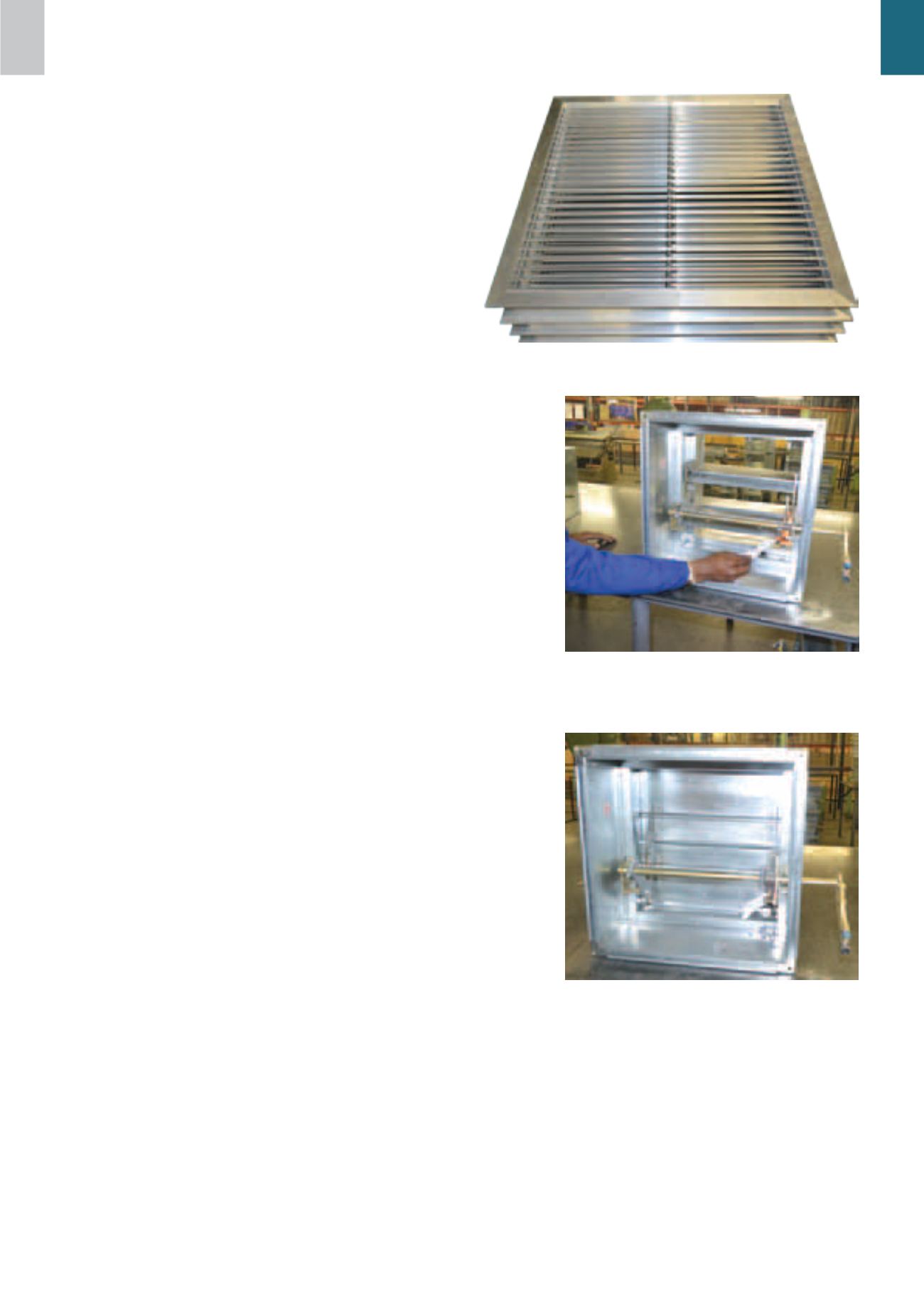
Return air grills have 45° curved blades angled to collect the
rising hot air as efficiently as possible.
Above and below:
Europair’s Prefco McCabe Link fire
dampers use an expanding pin instead of the fusable
link. The pin is designed to expand and pull out of its
link at 72°C, allowing the damper to shut.
compete with. We offer custom-made
sizes, with parts within the same project
differing to exactly meet the building’s
design needs. This is difficult for mass
producers to do, and impossible at
the service levels we achieve,” says
Drennan.
“Furthermore, some people opting
for imports have been ‘burnt’ a little, be-
cause if you under-order or you damage
something and need replacement parts,
then the lead times are extreme and, as
soon as the volumes are not there, the
price is no longer cheap,” she warns.
Niche products
Turning attention to the product offer-
ing, Muller lifts out Europair’s range of
SABS-approved fire protection dampers,
“Fire dampers are designed to isolate a
fire as soon as it is detected. As soon
as heat is detected, the dampers on
the ventilation ducts close, shutting off
the air flow to the burning space and
throttling the spread of the fire,” he ex-
plains. “We manufacture a wide range
of rectangular dampers, all made to suit
the custom sizes of the inlet ducting,”
he adds.
The simplest of these are bladed fire
dampers with a fusable link: The link
holds a row of damper blades open
against a loaded spring. The link is
designed to snap as soon as it senses a
temperature of 72°C, causing the blades
to shut like a louvre blind.
After a fire, however, these damp-
ers cannot be easily re-opened. They
have to be removed from the ducting in
order to replace the link. “But our Mc-
Cabe link solves that problem,” Muller
reveals. Europair’s Prefco McCabe Link
fire dampers use an expanding pin
instead of the fusable link. The pin is
designed to expand and pull out of its
link at 72°C, allowing the damper to
shut. On cooling, the pin shrinks back
again, allowing the damper to be reset
against the springs, either manually
using a quadrant handle or via a mo-
tor under the control of the BMS. “The
damper vanes can then be re-opened
using an electric motor once the pin
has cooled down or it can be reset by
hand. Modern air conditioning and
ventilation systems are usually linked
and controlled by a BMS, which not
only allows the fire safety dampers to
be managed, but our Opposed Blade
Dampers (OBDs) can be opened and
closed to optimise air flow and ensure
less energy is consumed while heat-
ing or cooling,” says Muller.
Supply air grills have a double
deflection system consisting of a
vertical and horizontal blade, to
allow air to be directed in any
direction. “And the return air
ducts, with 45° curved blades
are angled to collect the ris-
ing hot air as efficiently as
possible and to recirculate
it back through the air con-
ditioning system,” he adds.
While Europair does not
manufacture the main ducting, it
manufactures and supplies all of
the flanges, insulation and flexible duct-
ing that connect to diffusers. “And all of
these are manufactured and supplied to
order, based on customer specifications
and preferences,” he reiterates.
As an example of success, he cites a
new green building in Rosebank, which,
through HVAC contractor Improve Air,
used Europair as the preferred supplier
for all of the fire dampers, air diffusion
equipment, supply and return air grills
and insulation. “In green buildings, only
certain types of insulation may be used.
We supply a fibreglass-based eco range
on behalf of Saint Gobain: Duct Wrap
thermal insulation blankets manufac-
tured from flame retardant, organic
glass fibre bonded with a resin; and
Sonic Liner blankets with an acousti-
cally permeable black woven glass cloth
on the air stream surface, specifically
designed as an acoustical and ther-
mal liner for sheet metal ducting,” he
tells
MechTec
h. “And we also supply
spot welding machines with specially
designed pins to help contractors to
attach these blankets to the ventilation
ducts. The pins penetrate through the
insulation and are spot welded to the
metal ducting underneath, a simple
system for keeping the insulation tidily
in place,” he reveals.
Another key requirement for efficient
ventilation and air conditioning is to
keep the ducting, damping and flanges
air tight to reduce losses. “When we
profile our flanges on any of our damp-
ers or grills, we inject a mastic sealant
into the profile to guarantee that the
flanged-joint remains completely air-
tight and that no pressure losses occur
at the joint,” Muller tells
MechTech
.
“With the other First Tech compa-
nies, we essentially offer a complemen-
tary and comprehensive set of building
and infrastructure component solutions
and we strive towards healthy relation-
ships,” says Drennan. “Our slogan says
it all: ‘commitment is the difference’.
We are committed to South African
manufacturing and our employees; to
our contractors and customers; and
to all of the business relationships we
have built up with suppliers and service
providers over the years. All of our em-
ployees have the company’s interests at
heart. And that really is what differenti-
ates us,” she concludes.
q


