Chemical Technology • September 2013
7
mining & minerals processing
• Insufficient detail in the design phase: flotation cell design,
including the level of froth crowding, is determined based
on the process data received during the plant design
phase. If this data is scarce or not of sufficiently high ac-
curacy, this can lead to an incorrect froth crowding design.
It is therefore important to provide your supplier with the
best quality process data possible to allow the flotation
cells to be properly designed for each duty.
As an example, flotation circuit design often calls for
increasing flotation cell crowding down a bank of cells to
optimize the FCR at each flotation cell. However, this also
requires the largest amount of process data (eg, kinetic
flotation data) at the design phase, which is not always
available.
• ‘Safety factors’: during pre-feasibility and bankable feasi-
bility studies, it is commonplace for engineers to add in
safety factors to provide safety against underestimating the
size of the required equipment. In the context of flotation,
overestimating can also be detrimental. If the froth surface
area is overestimated then the FCR can be lower than the
optimum range, which can lead to froth instability and/or
higher operating costs.
• Feed grade: during the initial stages of a project, the ore
produced should ideally be close to the plant design feed
grade. As the project advances, however, the feed grade
delivered to the processing plant will often differ from the
design feed grade. This may be due to numerous factors,
such as a forecast decline in grade, changes in mining
practices and schedule, changes in commodity prices, and
so on. A change in feed grade will affect the amount of
concentrate to be transported by the froth to the concen-
trate launder, (for a given concentrate grade), and subse-
quently alter the FCR.
In extreme examples of feed grade variation, some operat-
ing grades can be half the design grade. This means that
the installed froth crowding is insufficient by approximately a
factor of two. A knowledgeable supplier can implement strate-
gies to rectify this type of problem using equipment modern-
izations and upgrades, bringing the cells back under control.
In summary
Froth transport and properties are a very important compo-
nent of overall flotation cell performance. Hence, accurate
design of froth crowding is also a significant contributor to
overall flotation cell performance. Therefore, to ensure the
optimum froth crowding design for a given application, the
available design data must be carefully reviewed for the cell
design stage of your project.
References
Bourke, P., Output 2005.
Coleman, R., Output 2009
Espinosa-Gomez, R, Finch, J A, Yianatos and Doby G S, 1998.
Technical note: Flotation column carrying capacity: particle
size and density effects. Mineral Engineering Vol 1, No. 1, pp
77-79.
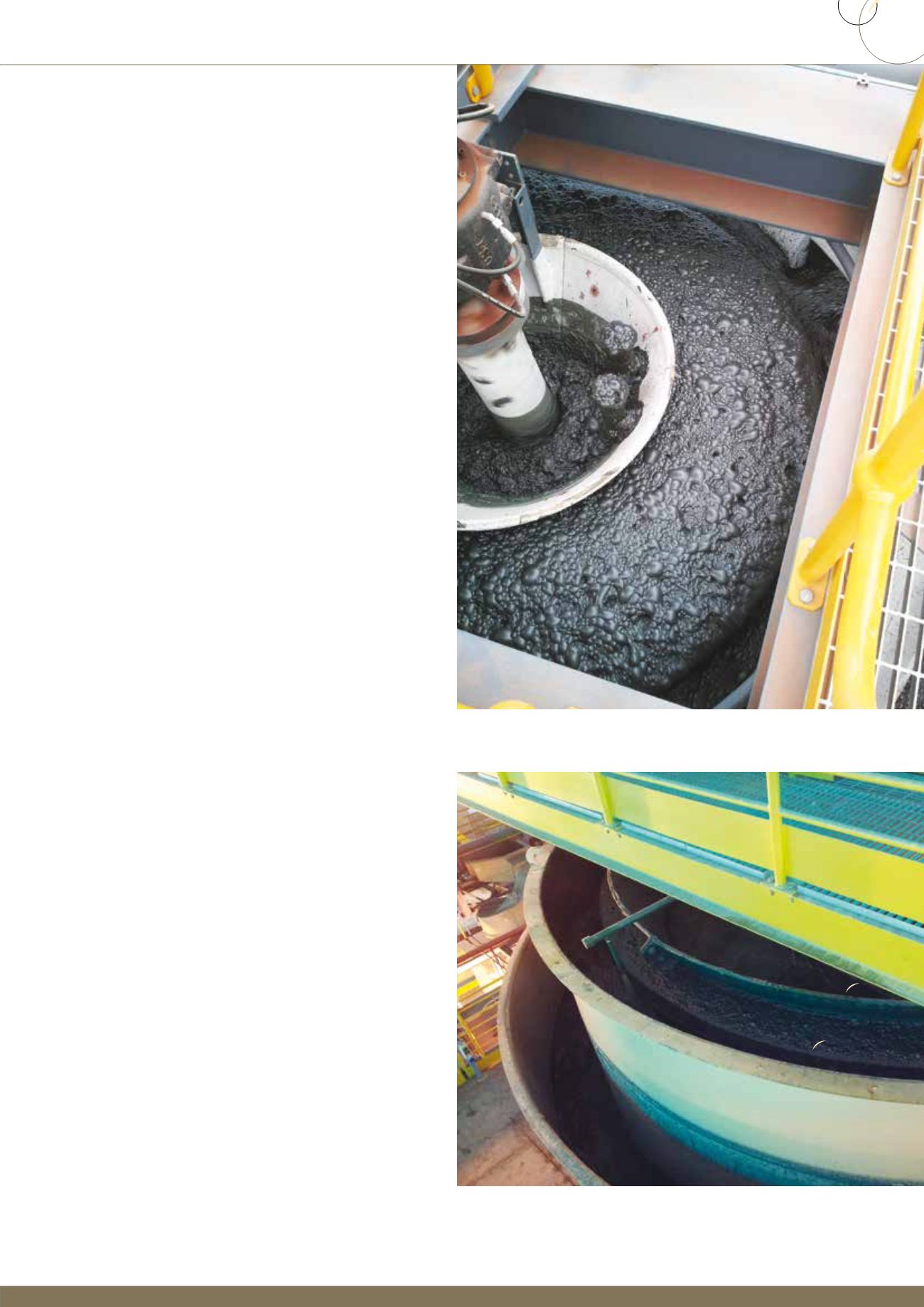
Large froth surface area (low degree of crowding) in an
Outotec TC50 Flotation Cell at a recently commissioned
flotation concentrator in Australia.
Small froth surface area (high degree of crowding) in an
Outotec skim air flotation cell at a flotation concentrator
in Brazil.


