13
Chemical Technology • September 2013
face. The retained particles do not form a filter cake,
because they are maintained in the suspension as a
result of the liquid flow. Cross-flow filtration therefore
provides higher filtration volumes than dead-end filtra-
tion.
Broad spectrum
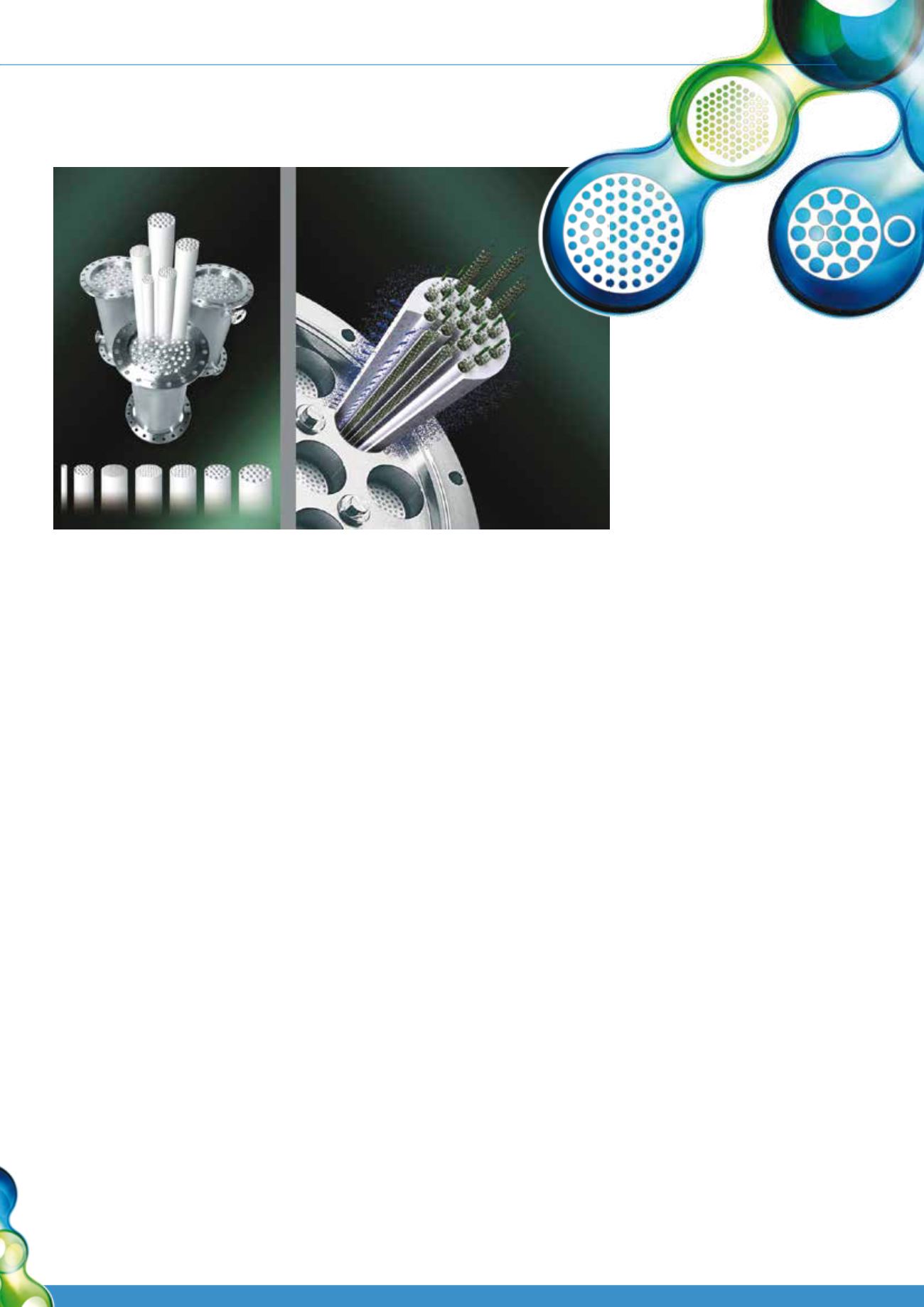
The ceramic membrane elements with different struc-
tures form the heart of a membrane filtration instal-
lation. Several such elements are incorporated into
one module. Membraflow provides a wide range of
available membrane elements which permit optimum
configuration, depending on the area of application
and the product involved.
The channel diameter may range from a unique
1,3 mm to 8 m, and the pore size ranges from 5 nm
(0,005 μm) to 1,4 μm. A channel diameter of 1,3 mm
is currently by far the smallest diameter available
on the market. Extremely large filter areas can be
achieved with this channel size, which is roughly in the
range of polymer membranes. They are suitable for
the superfine filtration of low-viscosity liquids which
have been subject to very good pre-clarification, in
order to maintain the turbulent flow. The number of
channels can range from one channel right through to
more than 277 channels.
It is also possible to produce different lengths of
membrane elements. The sintering furnaces in the
plant in Essingen are able to make elements with
lengths of between 250 mm and 1 800 mm.
The plant makes lengths of 950 mm and 1 020
mm which are common in the industry, and also
makes the membrane elements with a length of
1 200 mm which has recently become used as the
standard. In this way, Membraflow elements, which
have an excellent reputation in the market thanks to
extremely high firing temperatures with their extremely
stable mechanical structure, can also easily be used
as a substitute for all ceramic membranes used in
industry.
With regard to the length, the aim is always to find
the optimum solution for each application. Short ele-
ments are affected by fewer pressure losses in the
filtration process, whereas long elements have the
advantage of a better cost structure. Membraflow ce-
ramic elements have a hygienic structure, and special
seals prevent damage as a result of heat expansion.
The GEA Westfalia Separator Group also supplies
modular housings, backflush equipment and seal ac-
cessories.
Special development: ceramic disc
elements
Ceramic disc elements, which can be installed on a
rotating shaft in a module, are a special development
of Membraflow.
The overflow effect is achieved not by means of
permanent pumping and a cross-flow arrangement,
as is the case with the tubular ceramic membrane
elements; instead, it is achieved by the overlapping
motion of the rotating discs which are stacked in the
medium. The rotary motion ensures that the coating
layer is efficiently removed from the membrane discs,
in conjunction with a dramatic reduction in energy
consumption.
This specialized technology is particularly suitable
for special applications in the pharmaceutical indus-
try.
Modules with variable
membrane surfaces.
separation/filtration technologies


