November 2013
CONSTRUCTION WORLD
48
Gary Theodosiou, engineer and lecturer at
The Concrete Institute, says tilt-up construction
is often overlooked in the design of structures
but can be one of concrete’s most cost-
effective building techniques.
products & services
CONCRETE HAS AN ADVANTAGE
over other building materials in
that concrete elements can be constructed to accommodate specific
applications. Tilt-up construction is a concrete building and construc-
tion technique where the elements are cast on site and lifted into
their final position, maximising many of the unique and sustainable
benefits of concrete for a cost-effective building technique and efficient
construction method.
Elements that are to be tilted up are formed on a concrete slab;
usually the building floor, but sometimes a temporary concrete casting
surface near the building footprint. After the concrete has cured, the
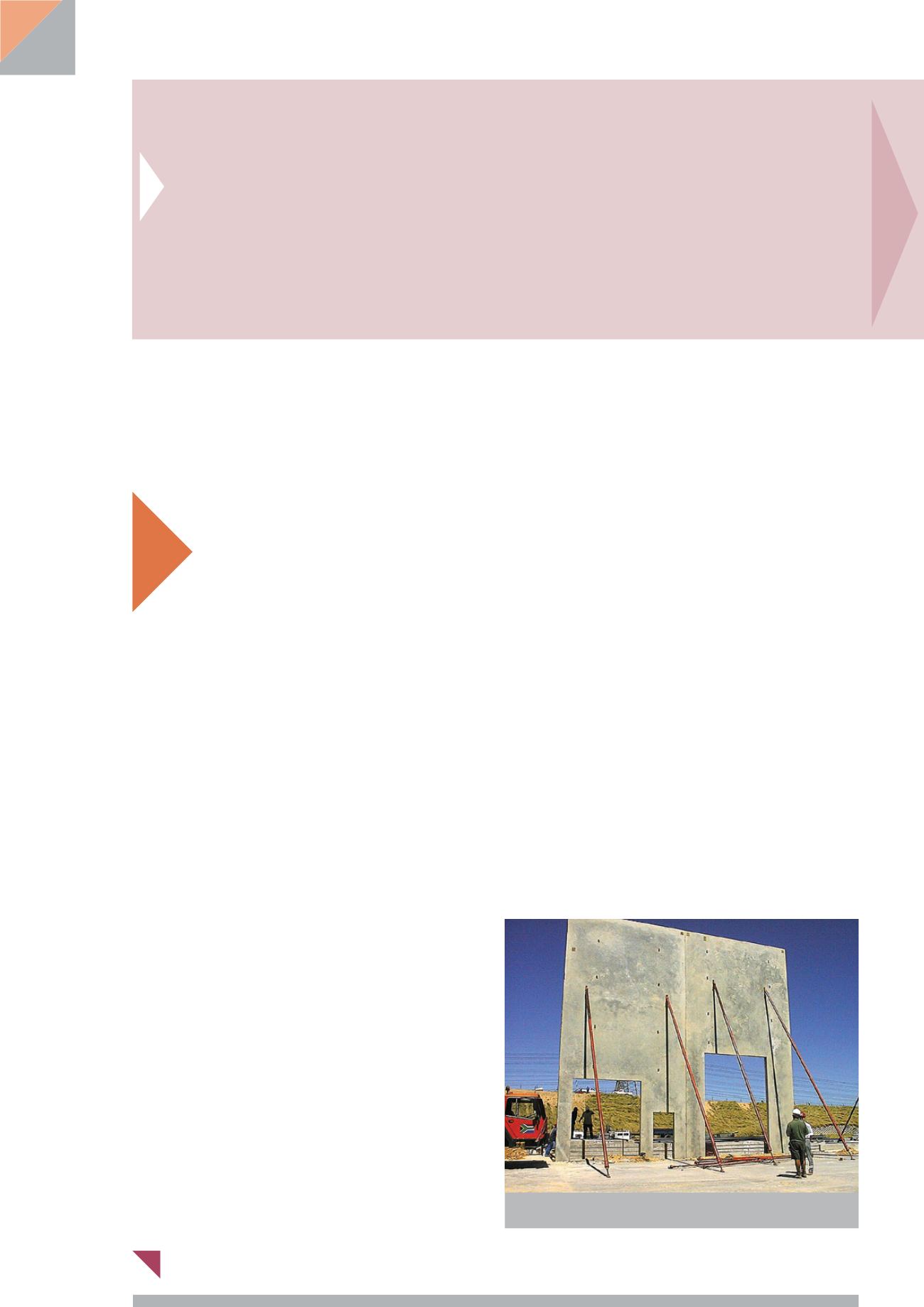
elements are tilted from horizontal to vertical with a crane and braced
into position until the remaining building structural components
(roofs, intermediate floors and walls) are secured. By forming the con-
crete elements on the ground as opposed to the final position, tilt up
provides a convenient construction method saving time, man-hours
and formwork.
Conventional tilt up panels are structural elements within a building
that span from base to roof diaphragm, acting as beams and capable
of carrying roof and slab loads. They combine the building envelope
(façade), structure and final finish in one operation. Panels are set out
in accordance with a predetermined casting layout drawing. Ideally
panels are cast on the surface bed of the project or on final concrete
hardstand areas around the building.
Construction
Once the pad (casting surface or floor slab) has cured, forms are built
on top. A high quality plywood or fiber board with at least one smooth
face is typically used, but aluminum or steel forms can also be used.
Carpenters work off engineered drawings designed for each panel or
element to construct on site, incorporating all door andwindow open-
ings, as well as architectural features and other desired shapes that can
bemoulded into the concrete. Studs, gussets and attachment plates are
located within the form for embedding in the concrete. The forms are
usually anchored to the casting surface with masonry nails to prevent
damage to the floor slab.
Next, a chemically reactive bond-breaker is sprayed on the forms
and casting surfaces to prevent the cast concrete from bonding with
the slab. This allows the cast element to separate from the casting
surface once it has cured. This is a critical step, as improper chemical
selection or application will prevent the lifting of the panels, and may
entail costly demolition and rework.
A reinforcement grid is constructed inside the forms, after the form
release is applied, spaced off the casting surface to the desired distance
with 'plastic chairs’.
Concrete is then placed, filling the desired thickness and surround-
ing all steel inserts, embedded features and reinforcement. The forms
are removedwhen the concrete is cured, rigging is attached and a crane
tilts the panel or lifts the element into place. In circumstances when
space is at a premium, concrete elements can be cast one on top of the
other, or stack cast. Quite often a separate casting pad is poured for this
purpose and removed when the panels are erected.
Cranes are used to tilt the concrete elements from the casting slab
to a vertical position. The slabs are then most often set onto a founda-
tion and secured with braces until the structural steel and the roof
diaphragm are in place.
Tilt up does not sacrifice quality for cost – instead it provides a fin-
ishedproduct superior tomost other alternatives as it offers the strength
and durability of reinforced concrete walls while simultaneously being
able to economically achieve aesthetic effects neither possible nor
cost-effective with other methods of construction. The end-result is
attractive, aesthetically pleasing buildings.
●
Tilt-up construction for cost-effective
aesthetics and durability
Concrete elements are cast on site and lifted into their final position when
the tilt-up construction method is used.
OPENED IN 1972 DURING
the apartheid
years, Avalon Cemetery was reserved
exclusively as a burial ground for blacks.
It had become one of the largest graveyards
in South Africa. Handling over 200 burials
per week, which is 55% of the weekly burials
in Johannesburg, Avalon Cemetery was fast
reaching full capacity; over 300 000 graves
dug less than two feet apart, covered its 430
acres (1 740 km
2
).
Specified for cemetery extension
One of Kaytech’s top quality Geocell products was recently chosen as
part of a new expansion project at Avalon Cemetery situated next to
the N12 in Lenasia, Johannesburg.
In 2011, Johannesburg City Parks approved
an R11-million expansion project that
included land clearing, hard rock excavations,
a road network, ablution facilities, a guard
house, as well as landscaping and fencing at
the cemetery.
Also planned in the project was an
attenuation pond and drainage system, which
included a stormwater channel that required
protective lining. Kaytech’s Byron de Cramer
recommended Kaytech’s Multi-Cell system,


