30
CONSTRUCTION WORLD
JUNE
2014
South African President, Jacob Zuma, attended the opening
ceremony which took place barely a week after the country
celebrated the National Water Week (17 to 23 March 2014).
“The dam will be used for two primary purposes. The first is
to supply water to the towns, industries and poorly serviced rural
communities in Sekhukhune, Waterberg, and Capricorn Districts of the
Limpopo province. Secondly, the dam will supply water to the mines
in order to help unlock vast mineral deposits, mainly in the form of
platinum group metals found in the region. The dam will therefore be
a catalyst for both social and economic development for this region,”
said the President.
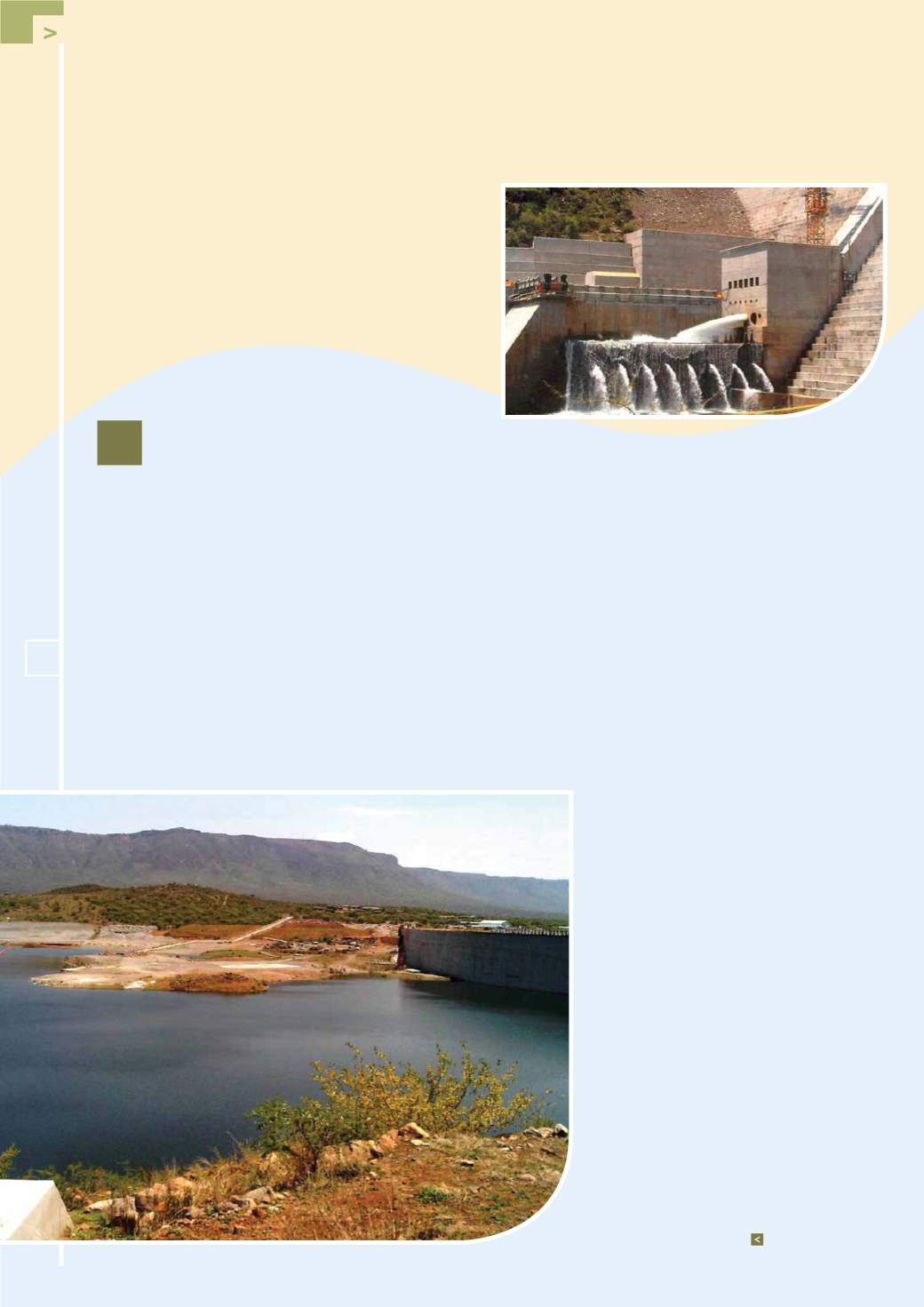
At 347-million cubic metres, the De Hoop Dam that used cement
products supplied by PPC, a pioneer in the Southern African cement
industry; was commissioned in 2007 and is one of the largest concrete
dams in South Africa. It cost in the region of R3,5-billion to complete.
At its completion, it took a staggering 94 963 tons of cement to
construct the De Hoop Dam.
“We are thrilled that the Department of Water Affairs chose our
products to construct this much-needed infrastructure project. We
have been a part of South Africa’s infrastructure development for over
PROJECTS AND CONTRACTS
>
120 years and we plan to continue to be for the foreseeable future,”
said Naseam Ismail, PPC’s Mpumalanga area manager.
The dam will supply water to the surrounding communities and to
the mining industry in the province to help stimulate economic growth
in the Limpopo Province.
The De Hoop Dam is the first project that forms part of the Presi-
dential Infrastructure Coordinating Commission, which seeks to boost
infrastructure development in the country and to stimulate economic
growth and job creation.
The construction of the De Hoop Dam also signalled several firsts
for PPC and the construction of cement dams in the country. At the last
Fulton Awards in 2013, the project was awarded the ‘Civil Engineering
Structure’ and ‘Sustainable Concrete’ awards.
The work done at the De Hoop Dam Project led to significant
simplification of the construction process and allowed one of the
highest construction rates achieved in South Africa, with a peak of
more than 130 000 cubic meters of RCC placed in one month.
The De Hoop Dam Project is also a flagship
project for the Department of Water Affairs and will
address a significant portion of future water needs
in the Limpopo Province.
South Africa is currently seeing a call for
collaboration, which will boost infrastructure
development. During the 2014 State of the Nation
Address (SONA) President Zuma reiterated the
call for government, business and labour to work
together and come up with solutions collaborate
in order for the economy to grow in South Africa at
significant levels.
“We have to work together as government,
business and labour to grow our economy at rates
that are above 5% to be able to create the jobs
we need. Fortunately this collaboration is already
taking place,” said President Jacob Zuma at the
2014 SONA.
The President went on to say that steps had
been made during 2013 to engage with various busi-
nesses on specific steps government could take to
make doing business in South Africa easier.
“The willingness of the private sector to engage
with government around speeding up infrastructure
delivery is very clear; there are many initiatives.
The Business Leadership of South Africa has created
a working group that is interacting with govern-
ment. Everybody is very excited, it is clear every-
body needs a new way infrastructure can be deliv-
ered,” said Ketso Gordhan.
A LEGACY BUILDER
South Africa is currently experiencing a surge
in infrastructure development projects, which
aim to better the lives of all South Africans.
The latest, the De Hoop Dam project, will see a
significant rise in potable and irrigation water to
people living in the Limpopo and Mpumalanga
provinces was opened on 24 March 2014.


