34
CONSTRUCTION WORLD
JUNE
2014
PROJECTS AND CONTRACTS
These are some of the findings of
a new report produced by PwC,
the European Institute for Compar-
ative Urban Research (Euricur)
and the Institute for Housing and Urban
Development Studies.
The report analyses 24 urban projects
in Australia, Belgium, Brazil, Canada, China,
Ethiopia, Finland, Germany, Hungary, India,
Indonesia, Ireland, Italy, Netherlands, Qatar,
Singapore, South Africa, Spain, the UK, United
Arab Emirates and the US. The report analyses
how different type of innovative urban devel-
opment projects and strategies are contrib-
uting to strengthen a city’s capitals and to
strike balances between the economic, social
and environmental spheres.
Fundamental changes such as climate
change, technological advances, increasing
societal demands, shifting power from
national to local levels and the consequences
of the 2008 financial crisis are changing the
playing field of cities worldwide. However,
on closer inspection, the types of imbalances
faced by cities are different. While some cities
struggle to reignite as growth engines, others
fight to curb carbon emissions and criminality;
while some put citizen involvement first.
All in all, the context and dynamics of
each individual city heavily influence the type
of vision and strategies put in place to achieve
sustainable competitiveness
PwC Partner in charge of the Western
Cape, Danie Fölscher, says: “Cities have
always been engines of growth and devel-
opment. Where substantial imbalances in
economic wealth and prosperity exist within
societies, such as is prevalent in South Africa
and many other parts of Africa, the role of
cities in driving growth and development
gains higher importance. The obvious provisor
is that development plans involve and benefit
the entire spectrum of society.
To successfully achieve this ideal, inge-
nuity and creativity is called for. Cape Town’s
selection as World Design Capital 2014 is
very relevant in this context. Cape Town sees
design as an enabler through which the city
can be re-imaged to solve its problems and to
improve the lives of all its citizens.
“Urban competitiveness is driven by a
city’s ability to innovate and diversify towards
new economic activities. But there are other
dimensions that are critical to a city’s future
success and attractiveness, including social
welfare, security and environmental quality.
Balancing all this to achieve sustainable
competitiveness is a key urban challenge for
the next decade.”
The report argues that while there is no
single path to sustainable competitiveness
that every city can follow, there are certain key
ingredients to success. These include:
Collaborative power
This is the glue that brings sustainable
competitiveness projects together. In the
most successful projects, leadership is distrib-
uted across multiple organisations working
closely together to make the project happen.
These include the private sector, universities,
citizens and the non-for-profit sector.
Good partnerships bring in additional
knowledge and expertise, financial resources
and legitimacy. But they do take time and
effort to mature.
Capabilities
Successful urban projects require good design
and vision but also sound implementation
capabilities. Beyond the role of partnerships
and leadership, the report identifies several
other ‘enablers’ including good communica-
tion; smart financial solutions; prioritisation
and piloting; and agile city administrations
capable of adapting to change.
Choice
Depending on the aim of the urban develop-
ment project, the report identifies key choices
and dilemmas that urban managers should
consider when planning for sustainable
competitiveness in cities.
A new type of urban
manager
Successful urban projects require a new kind
of urban manager with multiple skills, who
can connect and distribute power to other
stakeholders within and outside the public
organisation and who involves unusual
parties beyond the business and policy elite,
such as citizens and universities.
“There are growing opportunities for
cooperation between cities and the private
sector. Companies are increasingly ready and
willing to invest in the urban environments
in which they operate. But the successful
involvement of companies in urban devel-
opment strategies requires more, not less
competence, skills and proactivity from city
managers,” says Fölscher.
>
SUCCESSFUL CITIES
of the future
Worldwide cities face
the challenge of growing
economically while balancing
the social and environmental
side of the city to remain
sustainable in the future.
To succeed, they need urban
projects that have a clear
vision and goals, are well
managed and involve a broad
range of parties working
together effectively.
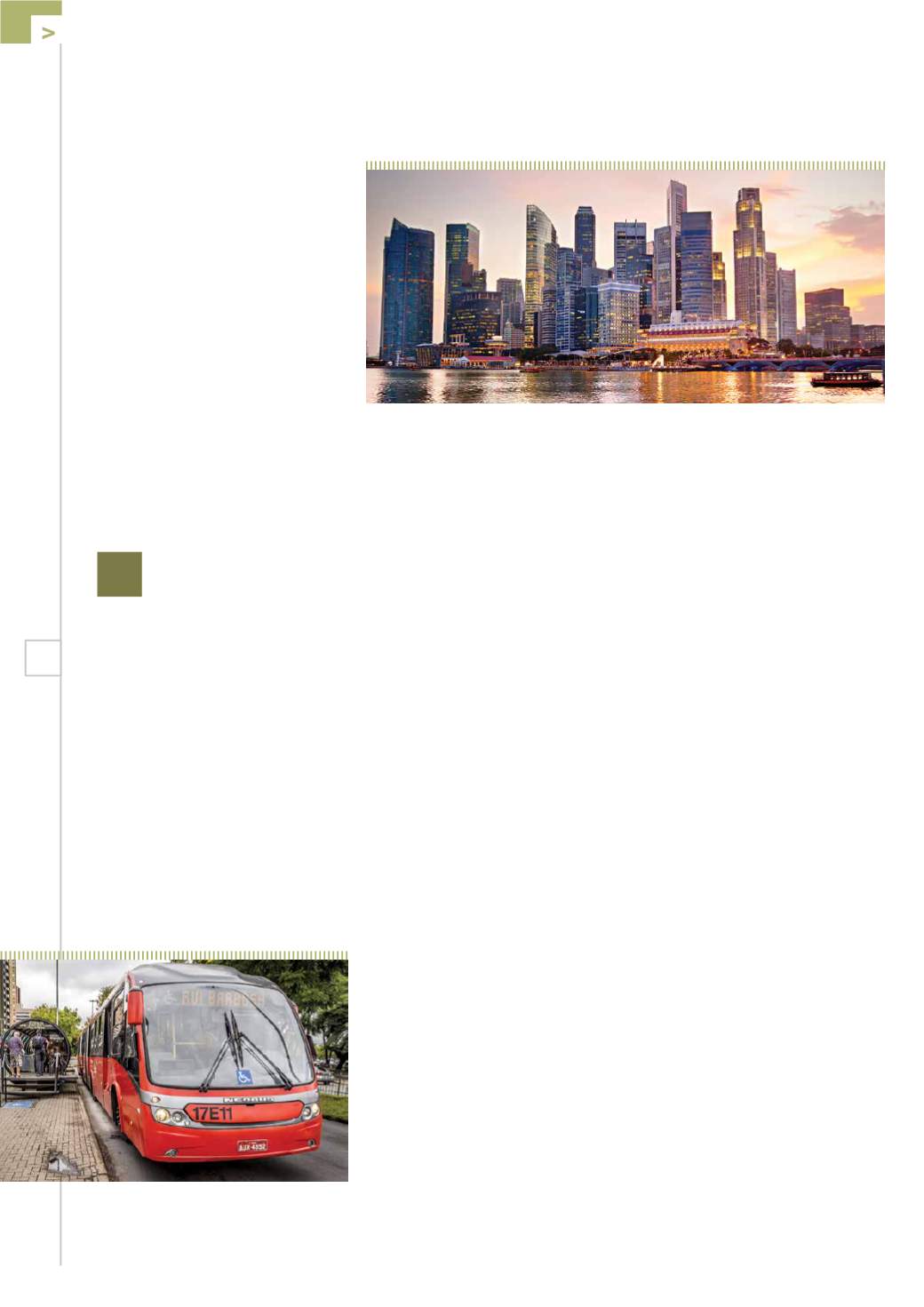
Initiatives aimed at integrating water bodies with the surrounding environment in a holistic way make
Singapore an example of a sustainable city. (© Shutterstock)
The public transportation of Curitiba with
its integrated bus stops is a landmark of
Curitiba in Parana, Brazil and a model for the
country. (© Shutterstock)
Continued on page 36


