36
CONSTRUCTION WORLD
JUNE
2014
PROJECTS AND CONTRACTS
This problemhowever, was solvedwhenMCJ Engineers decided
on Kaytech’s unique RockGrid PC for the project. Kaytech’s
technical sales engineer, Paul Lombard was regularly on site,
assisting Advanced Retaining Systems with their installation.
The first composite reinforcing geotextile to be manufactured in
South Africa, RockGrid PC offers the reinforcement characteristics of
geogrids and wovens in conjunctionwith the favourable hydraulic qual-
ities of nonwovens. Its polyester, nonwoven geotextile fleece compo-
nent protects the high tenacity polyester reinforcement elements
during the critical installation phase, thereby ensuring a safer optimum
performance. RockGrid PC is manufactured according to internationally
renowned technology. As it has 100% recycled polyester content, use of
the geotextile in a multitude of projects results in a significant amount
of post-consumer beverage bottles not reaching landfill. RockGrid PC
is directly manufactured from pellets, produced from recycled PET
bottles, supplied to Kaytech.
The 140 metre long concrete retaining block wall at the site
comprised three sections; a 60 m long x 10 – 12 m high section, a
45 m long x 12 m high section and a third section of 35 m long x 15 m
high. Subcontractor, Advanced Retaining & Paving Systems, installed
RockGrid PC 100/100 at every third layer of retaining blocks. This grade
of RockGrid generates a biaxial ultimate tensile strength of 100 kN/m
at 10% strain.
The difference between RockGrid PC and conventional biaxial grids
is that it has a geotextile fleece component which wicks away moisture
from the fill material, both during and after installation. This assists in
drainage of the fill material during compaction so that higher, more
stable fill-compaction rates can be attained. Only RockGrid PC provides
sufficient drainage capacity enabling it to drastically reduce the flow
paths in the reinforced soil.
Due to this water transmissivity, RockGrid PC facilitates the reduc-
tion of pore water pressure should there be any groundwater ingress.
This improves shear characteristics, which in turn increases stability.
Construction of this mall took place simultaneously with large-scale
earthworks and the demolition of the existing multi-level shopping
centre. Constricted spaces, in which the many contractors were forced
to work, as well as time constrictions, made for an interesting and
challenging project. The quick and simple installation of 15 000 m
2
of RockGrid PC, which does not require highly skilled or experienced
labour, ultimately saved the developer in both time and material costs.
The result was a neat and highly durable retaining wall that happens
to be the highest RockGrid PC-reinforced concrete retaining block wall
in KwaZulu-Natal.
SAVING TIME AND MONEY
Scheduled for completion in October 2014 is the new multi-level
Watercrest Mall in Waterfall, near Hillcrest in KwaZulu-Natal.
The steep slopes of the site necessitated the construction of safe,
durable, flexible retaining structures, the costs of which can be
debilitating in terms of materials and construction time.
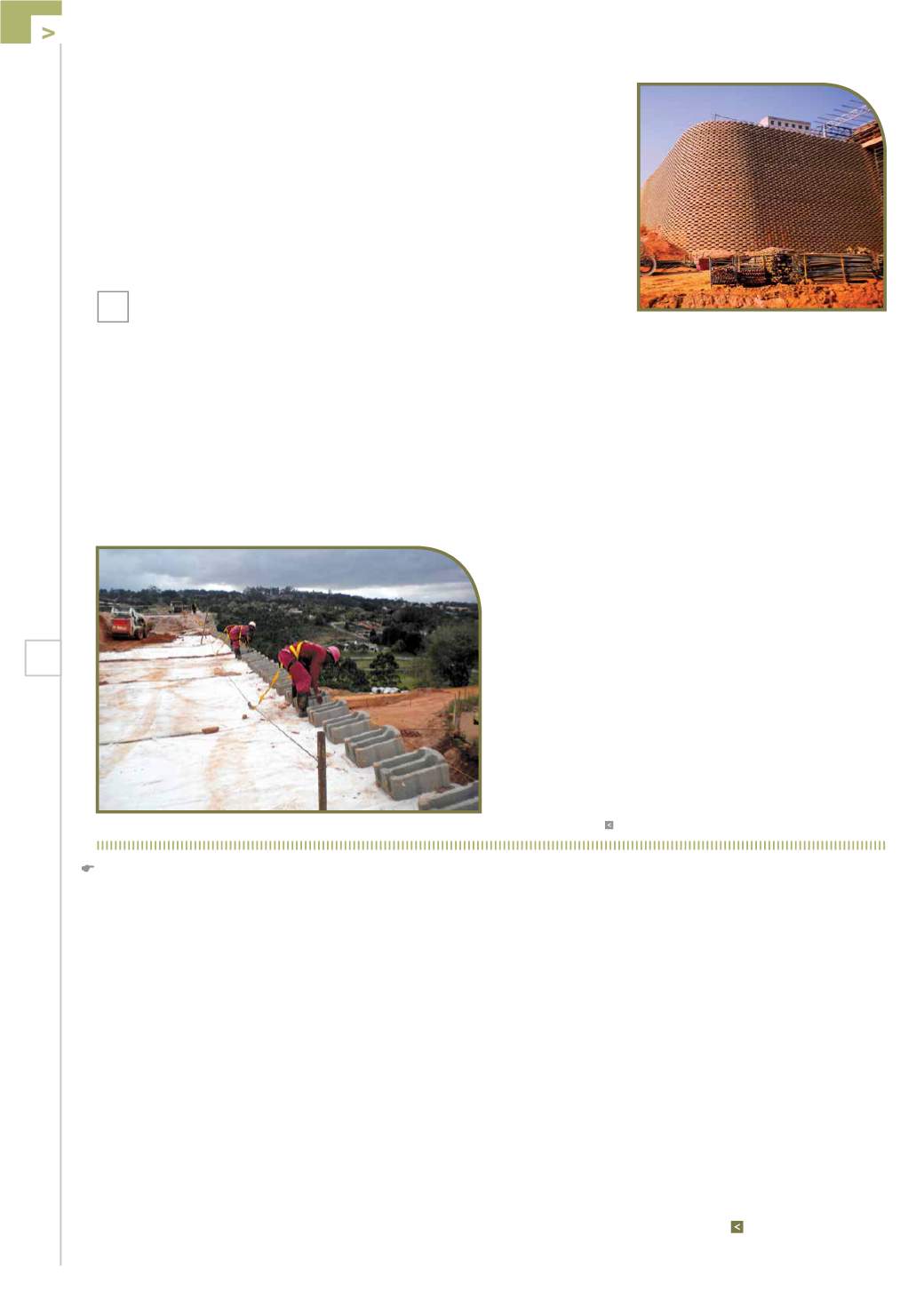
Reinforcing Rockgrid PC was laid at every third row of blocks.
The retaining wall is 140 m long and 15 m high.
>
He adds: “Cape Town is one of the few
urban projects highlighted in the report
that ticks the above boxes.” One advantage
for Cape Town is that the effort and initia-
tive to improve the city’s competitiveness
is supported by a number of public and
private sector initiatives such as the Enter-
prise Development Partnership, Wesgro,
Accelerate Cape Town, CiTi and many others.
The interaction between public and private
sector in the city is producing tangible results.
The Cape Town Central City district plays
an important role within the social, cultural
and political life of the region and hosts
the key sectors of the local economy. Now
regarded as one of South Africa’s safest cities,
only a decade ago the central city district
(CBD) was struggling with high levels of crime
and gang violence with many ‘high risk,
no-go’ areas negatively impacting the city’s
economic growth.
The Central City Improvement District,
launched in 2000, has played a major role in
significantly reducing crime in the Cape Town
central city over the past decade and through
the combined efforts and partnerships with
the Government and private stakeholders,
the city centre is now positively perceived as
a vibrant, tourist attraction.
Other successful urban projects world-
wide include:
Bus rapid transport system – Curitiba, Brazil
This bus system was the first of its kind to
combine service quality of rail services with
the cost savings and flexibility of bus transist.
Success factors include a visionary, creative
leader; Curitiba’s participatory approach to
urban planning; consistent dialogue among
key stakeholders; and the city’s recognition
that urban, environmental and economic
development are intrinsically linked.
Water management – Singapore
Initiatives
aimed at integrating water bodies with the
surrounding environment in a holistic way.
Success factors include a water strategy
focused on creating economic value for
the city-state while being pragmatic; long-
sighted integration planning and strong
coordination between government agencies;
and significant investment in R&D and tech-
nology showing a strong political ‘will to
make it happen’.
Fölscher concludes: “Competitive coun-
tries have competitive cities – cities with
the dynamic capacity to grow and develop
over time, nurturing new jobs, people and
skills, as well as attracting those from the
outside. In the medium and long-term, urban
competitiveness is driven by a city’s capacity
to innovate and diversity towards new
economic activities.
“A key urban challenge for the next
decade is how to improve sustainable
competitiveness, i.e. a city’s ability to
keep growing and developing over time
while fostering social cohesion an environ-
mental quality."


