32
CONSTRUCTION WORLD
JUNE
2014
PROJECTS AND CONTRACTS
“In short,” says Southern Africa
Light Steel Frame Building Associa-
tion (Sasfa) director, John Barnard,
“LSFB allows for almost any design,
is more environmentally friendly and saves
significantly on the bottom line.”
An up-market home in Fresnaye, Cape
Town is yet another example of the efficacy
and flexibility of LSFB. “This 3-storey 360 m²
home was initially designed to be built using
brick and mortar but once the client was
introduced to the LSFB method there was no
turning back,” says Jonathan Pepler, director
of Silverline Group, which is well-known for
its high profile LSFB projects such as McDon-
alds restaurants, Delta Motors show rooms
and, more recently, the Maboneng develop-
ment in Johannesburg.
Pepler added that the architect, Chris
Brown & Associates, supported the change
from bricks and mortar to LSFB because
it is a ‘fresh and modern approach to
construction and, in particular, because of
the positive impact this building method has
on the environment.”
Barnard says that, furthermore, LSFB
offered specific advantages for this project.
“The small size of the plot made it diffi-
cult to work with cranes and storage space
for building materials was limited. By using
LSF these constraints were overcome,”
Barnard says.
He adds that as the owners wanted a low
carbon footprint for the project and were
very focused on ‘going green’, LSFB was the
ideal solution for them because of its signif-
icantly better thermal insulation and quicker
completion time with little or no wastage of
building materials.
The three-level house amply demon-
strates the flexibility of LSFB even in the most
creative, upmarket designs. It has three-bed-
rooms, three bathrooms, an entertainment
area with built-in bar; built-in fireplaces and
stacking doors that open up to reveal a spec-
tacular view of Sea Point and the Atlantic
Ocean beyond. The swimming pool was
integrated into the design, as was a large Koi
pond with a waterfall.
Internal sliding doors were designed to fit
into the wall cavities, saving a lot of usable
space. Ceilings all have bulkheads with shad-
ow-line edges giving the house amodern look.
External wooden decks were introduced with
glass balustrades. The external walls consist
of double light frame walls, which create
the desired ‘bulky’ look while increasing the
insulation of the structure. A steel staircase
winding up the three levels was installed to
provide access to all the floors.
Skylights and glass fa
ç
ades were used
to bring natural light into the house and a
designer kitchen and spacious double garage
complete the picture.
The first and second level floors were
constructed using the Voidcon System, which
is a concrete slab on permanent shuttering.
It is a cost-effective method of flooring, which
reduces the volume of concrete required,
reduces the need for propping, and speeds
up the casting of the floors.
“Due to the small size of the plot it was
very difficult to work with scaffolding and
using permanent shuttering in conjunction
with LSF solved that problem,” Pepler says.
The insulation was supplied by ISOVER,
the steel by Techhomes and the External
Cladding material by UFCC. Silverline Group
was the main contractor.
The complete project took six months
and an overall saving of 30% in construction
time was achieved. Barnard says the owner
could not wait to move into their new ‘green’
house. “It is not that often that a builder and
his clients are on a good footing after the
build. This time, however, the owner even
recommended the use of LSFB to friends.
In fact the project across the road, initi-
ated by a friend of the owner who was so
impressed with the speed and the quality of
the LSF building method, that he will now use
Silverline Group for an LSFB solution.”
Barnard says that as the Southern African
market increasingly realises that LSFB can
be used for a range of different applications
and takes into account the considerable
benefits, both practical and financial, of this
building method, perceptions about tradi-
tional building methods being the only viable
alternatives are being questioned. “There
are more and more local examples of
striking buildings that are being built with
LSFB,” he concludes.
>
LSFB’S FRESNAYE SUCCESS
It is true that the light steel
frame building (LSFB) method
is possibly the fastest growing
alternative construction
method in Southern Africa. The
reasons for this are many, and
include faster construction
and more efficient energy
consumption both in the
construction process and over
the life of the structure.
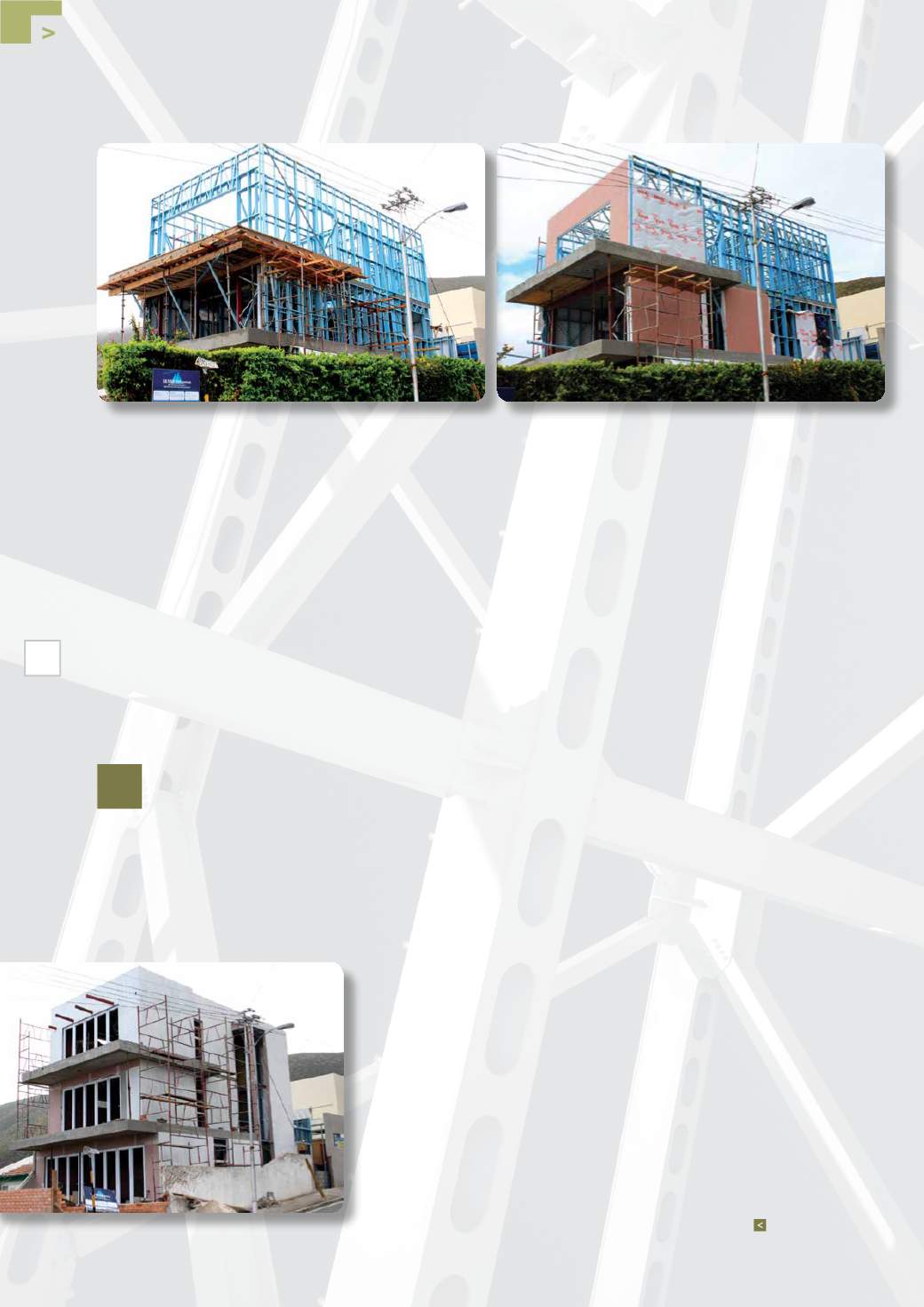
An up-market home in Fresnaye, Cape Town is yet another example of the efficacy and flexibility of the light steel frame building method.
The housing nearing completion.


