Control systems and automation
A
bout the authors
Annunciation rates and alarm counts calculated from process history
data after removal of ‘bad actor’ alarm limits caused by instrumenta-
tion faults are shown in Figure 4. Ignoring standby mode, the annun-
ciation rate is typically in the region of four to five alarms per hour
and the number of alarms visible on the operators alarm list display
is typically four to five at any time. That this performance is accept-
able against the EEMUA 191/SP 18.2 [1,2] human factors guidelines
emphasises that meeting these human factors guidelines is not by
itself sufficient to create a good operator alarm system. An Alarm
Quality target is needed as well.
Using a single set of alarm limits across all threemodes is ‘lumped
mode alarming’ and is the norm in most plants today because of the
difficulty and cost of setting any alarm limits with today’s method.
Much better is to define a set of limits for each mode and use multi-
Mode alarming. Using this newmethod it is very likely that three sets of
limits can be found in less time than it took to find one set previously.
We separated out just the kerosene mode from Figure 3 and
created a new set of limits from the envelope of the 82% of the time
when subsequent laboratory analyses of process samples showed that
in-specification kerosene was being produced. This was considered
the ‘normal’ operating envelope for kerosene operations. The ‘alarm
annunciation’ rates were then calculated for the original set of alarm
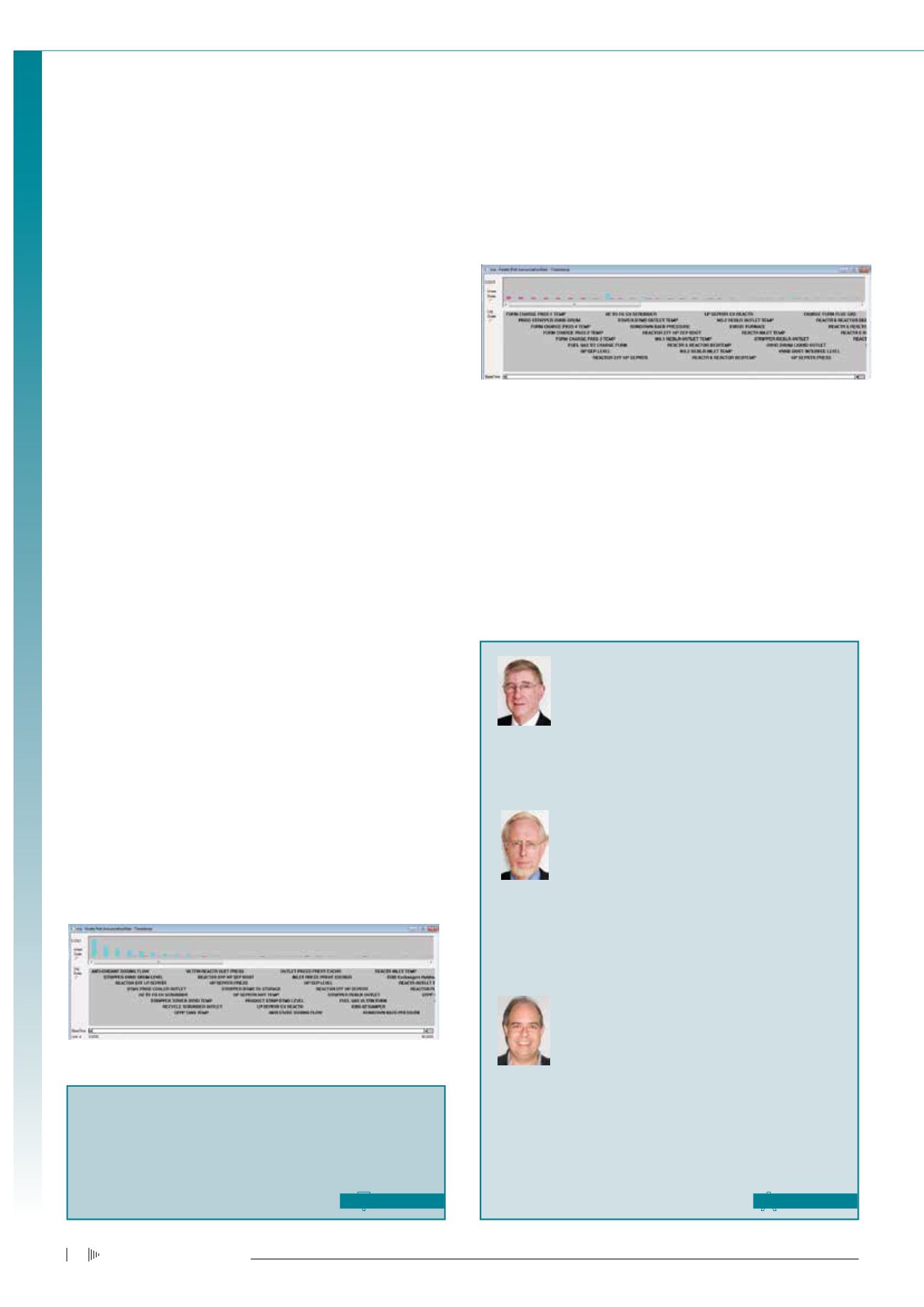
limits and the new set. They are shown in the two Pareto plots of
Figures 5 and 6 which emphasise not only that the total number of
annunciations has beenmuch reduced but also that annunciations are
spread across many more variables and thus giving better protection.
Conclusion
This suggests a simple alarm quality measure could be the fraction
of variables that account for, say, 90% of all annunciations. For the
original alarms this was 15 variables out of 60 alarmed variables giv-
ing an AQI of 25%. For the new alarm set it was 35 variables out of 60
giving an AQI of 58%. Norms for AQI will appear as this dimensionless
measure is collected from larger numbers of plants.
Figure 5: Annunciations of the original alarms in turquoise and the new set
in pink in the order of numbers of annunciations of the original alarm limits.
Figure 6: The same data as in Figure 5 to the same scale but in the order of
numbers of annuniciations of the new alarm’s limits.
References
[1] EEMUA 191. 2013. Alarm systems: a guide to design, manage-
ment and procurement. Third edition. Available from www.
eemua.co.uk.
[2] ANSI/ISA SP18.2. 2009. Management of Alarm Systems for the
Process Industries. Available from
.
[3] IChemE. Proceedings of Hazards XXIII/316 November 2012. Brooks,
Mahoney, Wilson and Zhao. Operator Alarms are the First Line
of Defence. Also available from
.
Dr Robin Brooks is the founder and managing director of
Process Plant Computing Limited (previously Curvaceous
Software Limited). He is a chemical engineer with BSc and
PhD degrees from the University of Swansea. Robin has
worked for Mobil, Laporte, INCO, then had a long career
with IBM as a control systems engineer designing and implementing
some of the most advanced whole - refinery control systems of their time
with companies such as Exxon, Mobil, Shell, Total, CEPSA and PDVSA.
Dr John Wilson is Research and Development manager
at PPCL. After his PhD in Nuclear Physics at Imperial Col-
lege London John worked for British Gas, Scicon, Pavilion
Technologies and other companies producing engineering
software and carrying out consultancy in optimisation,
scheduling and simulation applied to the gas, electricity and process
industries. While working in Dr Brooks’s group at IBM he first encountered
Parallel Co-ordinate technology, and joined PPCL when Dr Brooks founded
it in 1998. John is an Inventor on all of PPCL’s 20 patents. He is a Member
of the Institution of Engineering and Technology.
Dr AlanMahoney is technology manager and senior consult-
ant at PPCL. He is a chemical engineer with a bachelors
degree from the University of Illinois at Urbana-Champaign
and a PhD from Purdue University, Indiana. This was fol-
lowed by post-doctoral research at the Max Planck Institute
for the Dynamics of Complex Systems at Magdeburg, Germany and then
by a number of years as a professor at the University of Sheffield in the
UK. Interspersed with these academic positions were long periods work-
ing for Hicks Oil in Illinois and Air Products & Chemicals in Pennsylvania.
Alan joined PPCL in 2008 and is an inventor on PPCL’s most recent patents.
Enquiries: Email
Visitwww.ppcl.com.
T
ake note
• Operator alarms are inter-related through the process operating envelope.
• AQI can be used to quantify alarm quality and track progress in identifying
and eliminating fractional annunciation alarm systems.
• No matter how good, automated process control can never anticipate
all possible circumstances.
Electricity+Control
December ‘13
8


