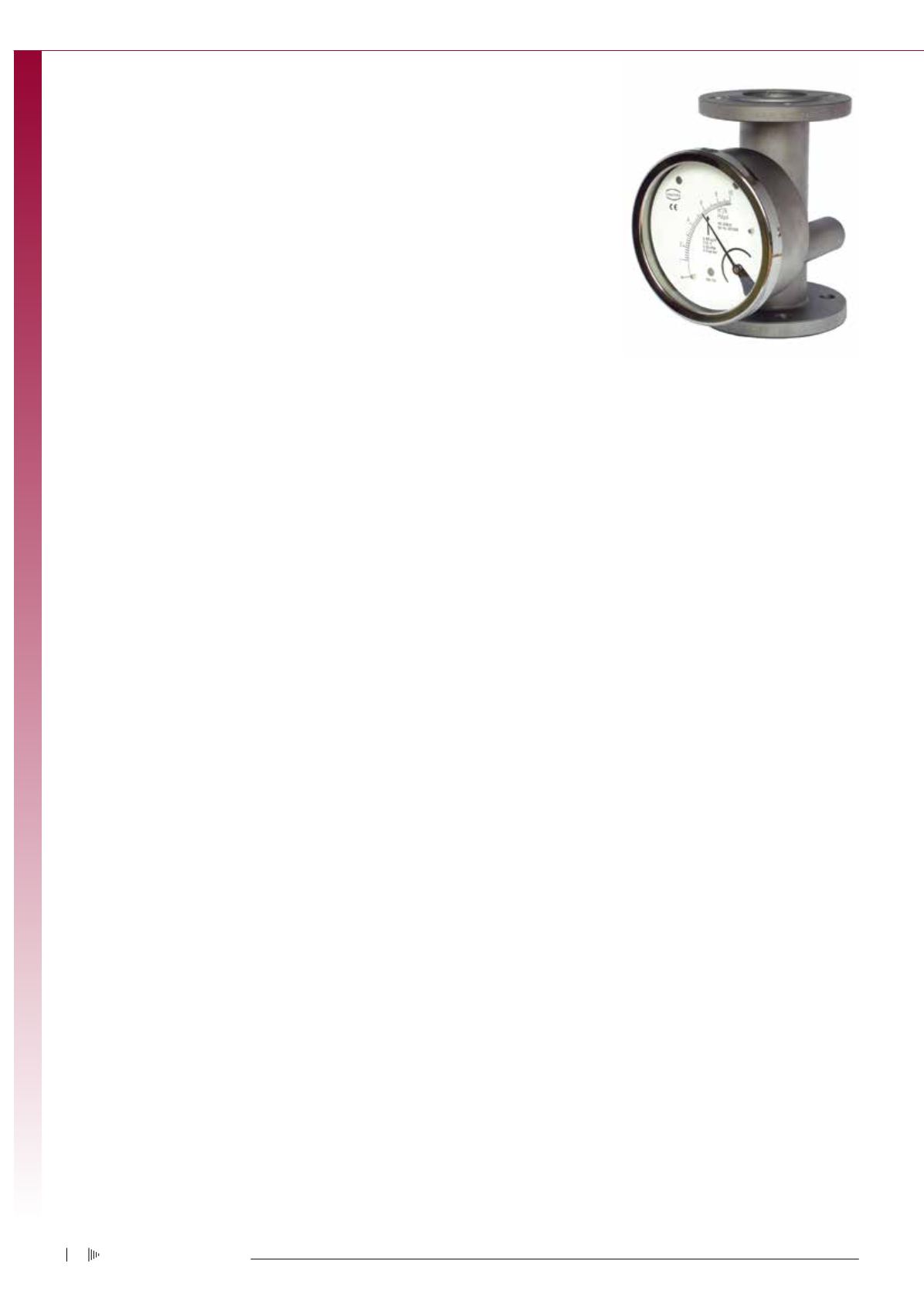
Flow measurement
C
hoosing a flowmeter to measure gas flow can be daunting for
anybody who is not often exposed to this task. Not only are
there many manufacturers advertising their brand and types
of flowmeters, but there are also many varying technologies avail-
able at significantly different cost structures. The outputs vary from
local indication, through the standard 4 – 20 mA signal to advanced
digital bus protocols.
Current gas flowmeter technology is changing and many differ-
ing products, including coriolis and ultrasonic flowmeters, are now
available.
Flow measurement is recognised as one of the ‘need-to-know’
process parameters, alongside temperature, pressure and level
measurement. Accurate measurement of gas flow is critical in the
operation and control of many industrial and laboratory processes. In
the food and beverage sector, the chemical industry and semiconduc-
tor fabrication, flowmeter accuracy is often the determining factor
between optimum quality and reject products. In areas like laboratory
research, pilot plants and custody transfer, precise and repeatable
measurement is equally critical. Elsewhere, high levels of accuracy
are not so crucial and flowmeters are used to give an indication of
the rate at which a gas is flowing through a pipeline.
Regarding the global installed base, differential pressure (DP) is
the dominant means of measuring both gas and liquid flow, although
there are clear signs that other existing or evolving technologies
like coriolis, ultrasonic, vortex and thermal are growing strongly, as
considerations like accuracy, reliability and lifecycle cost ascend the
customer’s agenda. Not surprisingly, DP flowmeters are currently
maintaining the market lead, partly because users keep replacement
instruments in stock and partly because retaining the same flowmeter
is often regarded as the most risk-free solution. But reliability and
performance problems reportedly arising with these instruments
mean coriolis flowmeters, in particular, are being increasingly speci-
fied for new plant and new processes, in addition to being integrated
into existing schemes.
Old versus new
Indeed, flow control experts now tend to distinguish between ‘new
technologies’ and ‘traditional technologies’, grouping coriolis, mag-
netic, ultrasonic and vortex flowmeters under the ‘new’ category,
with methods such as DP, turbine, positive displacement (PD) and
variable area (VA) under the ‘old’. This is a useful classification as it
underlines the advanced computer processing capabilities of newer
instruments, although, thermal flowmeters could be placed in the
‘new’ category, as they are very much at the forefront of digital tech-
nology and upcoming innovations from leading manufacturers, who
put thermal mass monitoring at the cutting edge of flowmeter design.
Flowmeters can also be distinguished by whether they measure
flow rates in terms of volume, expressed in units like ml/min, or mass,
in units such as kg/hr or lbs/min. Strictly speaking, PD flowmeters
are the only ones that directly measure volumetric flow, although
techniques like turbine, ultrasonic and vortex measure the velocity of
the gas stream, to determine volumetric flow. Inferential flowmeters,
such as DP and VA sensors, measure neither volumetric nor mass
flow, but infer its rate from other parameters, like a drop in pressure
or the displacement of a float. Coriolis and thermal instruments are
the only (instruments) where the measured flow rate is given as mass
flow of the gases, albeit using rather different techniques.
All this would be somewhat immaterial if mass and volume were
much the same, but measured volumetric flow rates do vary dra-
matically with temperature and pressure changes. Moreover, whilst
volumetric and mass measurements can be converted between one
another if the fluid density is known, the density of gases is equally
sensitive to pressure and temperature, unlike liquids which are less
susceptible to changing conditions. Thus, while volumetric flow
measurement, undoubtedly, still has its place in many industry pro-
cesses, it is widely accepted that current ‘best practice’ is to measure
mass flow in gases and steam, thereby reducing process variables
- leading to more consistent quality. Accurate, repeatable mass flow
measurement improves chemical reactions, leads to more precise
dosing and custody transfer, facilitates laboratory analysis and helps
to eliminate wastage. This also explains why the coriolis technique,
in particular, which continuously and directly monitors mass flow, is
often described as the near-perfect measuring principle.
Having stated that, various specifying criteria like compatibility,
repeatability, reliability, simplicity and, of course, purchase price,
dictate that the different types of new and old technology flowmeter
each having their own advocates and optimum applications.
Coriolis flowmeters
The coriolis effect causes a vibrating tube to distort and is used for
By H Springer, Mecosa and A Mangell, Bronkhorst UK
Go with the flow
– gas flow measurement
It is important to know the strengths and limitations of the different technologies in measuring gas flow - as accurate measurement is critical
in the operation and control of industrial and laboratory processes.
Electricity+Control
December ‘13
14


