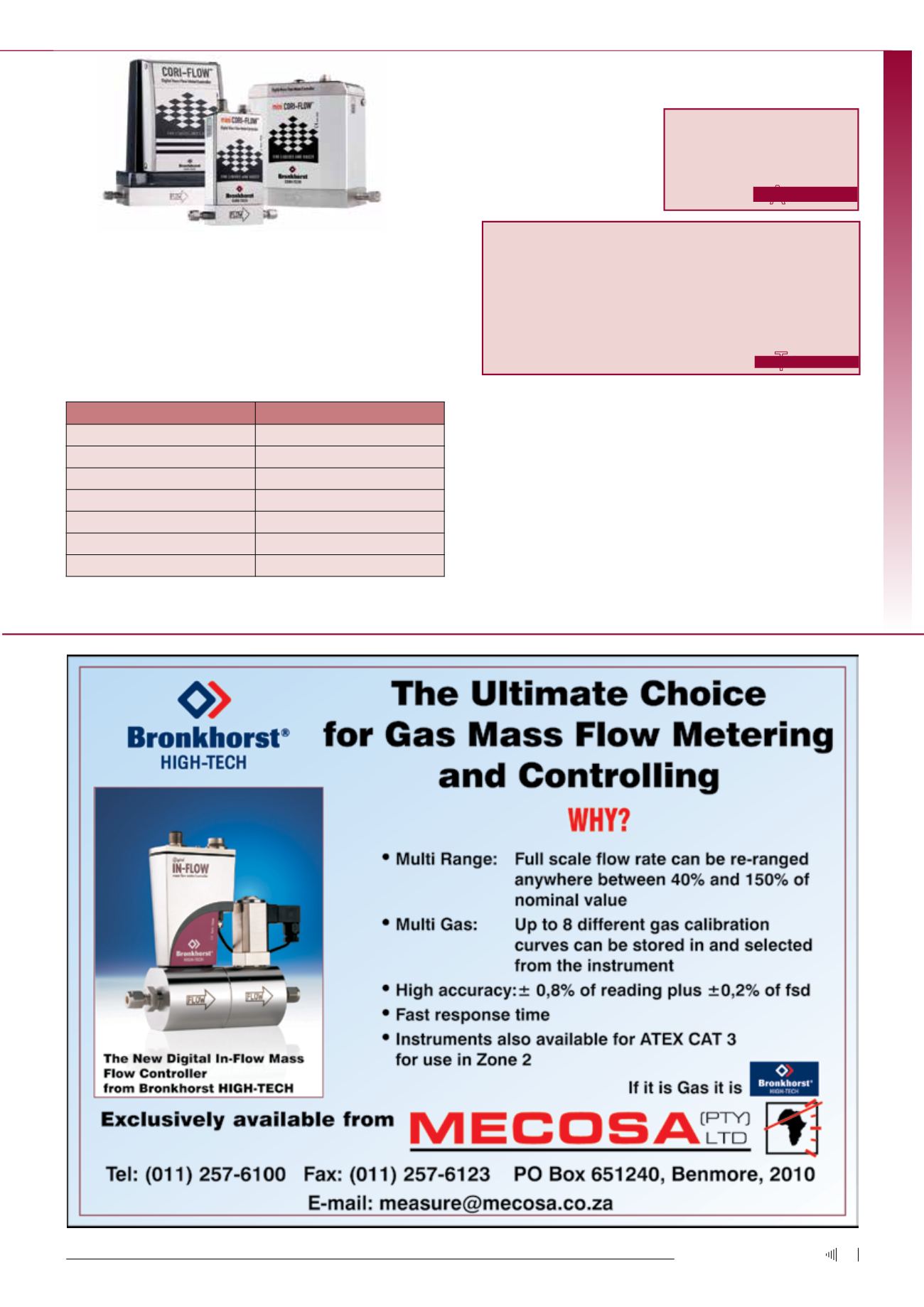
Flow measurement
measuring the flow rate directly, eliminating the need to compensate
for temperature, pressure and density. Coriolis meters can alsomeas-
ure a mixture of gases, unknown gases, and fluids moving between
gaseous and liquid states. They offer high measuring accuracy, unaf-
fected by flow profile, even down to very low flow rates as used in
nanochemistry. Line size was considered a limitation, but the largest
instruments can be fitted to 12” diameter pipes.
Strengths
Limitations
Universal measuring principle
Higher set-up costs
Direct measurement of mass
More limited line size
Very high accuracy
High flow rates
Low flow rates
Low cost of ownership
No major moving parts
Possible density output
Table 1: Strengths and limitations of coriolis flowmeters.
Differential pressure flowmeters
The most common type of flowmeter, the DP, measures the flow of
gases inferentially, employing the Bernoulli equation that interprets
the relationship between pressure and flow rate. These flowmeters
introduce a constriction or obstruction in the pipeline, creating a
pressure drop from which velocity and volumetric flow can be cal-
culated. Various types of DP flowmeters are used, the most popular
being orifice plate, which can be subject to wear. They are typically
less accurate than coriolis flowmeters and are best used with clean,
non-corrosive gases.
A
bbreviations
T
ake note
DP - Differential Pressure
PD - Positive Displacement
VA - Variable Area
• Accurate measurement of gas flow is critical in the operation and control
of industrial and laboratory processes.
• New technology flowmeters offer increased levels of accuracy which
make them worthy of consideration.
• In the food and beverage sector, the chemical industry and semiconductor
fabrication, flowmeter accuracy is often the determining factor between
optimum quality and reject products.
15
December ‘13
Electricity+Control


