⎪
Heating, cooling, ventilation and air conditioning
⎪
Mechanical Technology — August 2013
29
The YMC
2
centrifugal compressors with magnetic bearings at FNB’s
Bank City use VSDs that are cooled during the condensing cycle. The
solution is achieving average COPs of 12.
turnkey designs,” says Cameron. The
14 MW chiller for 17 Shaft has a new
plc-based controller with sensors that
have all been uprated to meet the ac-
curacy and reliability requirements of
the underground environment,” he adds.
Turning attention to commercial
buildings, Cameron reveals a bugbear:
“Most buildings are not owned by the
tenant, creating a conflict of inter-
est. The landlord wants to put in the
cheapest product he can. He doesn’t
benefit from low maintenance or en-
ergy efficiency. The tenant picks up the
energy and the maintenance bill, so
wants something that is reliable, lasts
and is efficient in terms of energy use,”
Cameron argues.
“Generally, people who lease build-
ings in South Africa are naive in terms of
efficient energy use. Legislation is being
discussed, via Green Star ratings, for
example, but in choosing a commercial
building, tenants generally only look at a
price per square metre. Air conditioning
and energy consumption costs are sel-
dom taken into account,” he explains.
York systems, which are both reliable
and energy efficient, tend to be most
successful when companies own their
own buildings. “In the banking frater-
nity, for example, and also for shopping
centres, energy use becomes a factor
because the owner also pays for the
ongoing bills,” Cameron tells
MechTech
.
York Chiller technology embraces
a full suite of air conditioning options.
“We cover the range between two ex-
tremes, from the cost effective domestic
market for split and console units, all
the way up to the centralised systems
that can use a single chiller to supply
several indoor air handling units,” Cam-
eron continues.
The domestic market, which cur-
rently makes up 20% of Johnson’s air
conditioning business in South Africa,
is tending towards the use of environ-
mentally friendly 410-a refrigerant gas,
with the CFC-based R22 now being
illegal in Europe. “South Africa is also
moving in that direction, but R22 is not
yet illegal here, so we are experiencing
competition from cheaper imports using
outdated equipment. The market could
really use some clear communication
from government about the use of R22,”
he suggests.
Cameron cites 15% year-on-year
growth in the domestic air conditioning
market. “More and more people are air
conditioning their living
rooms and bedrooms. A
split unit can be installed
for as little as R2 500 to
R3 500, which is rela-
tively affordable,” he says.
York console units,
which combine the com-
pressor, fan and evapo-
rator into a unit that is
mounted into a hole in
an outside wall, are an-
other cost effective air
conditioning option. “Ho-
tels across Africa often
don’t like complicated
VRF systems because if
the central compressor
goes down, the whole hotel has a crisis.
Console units are much more easily
replaced, and if one is faulty then only
one room is out of service,” advises
Cameron.
At the opposite end of the HVAC
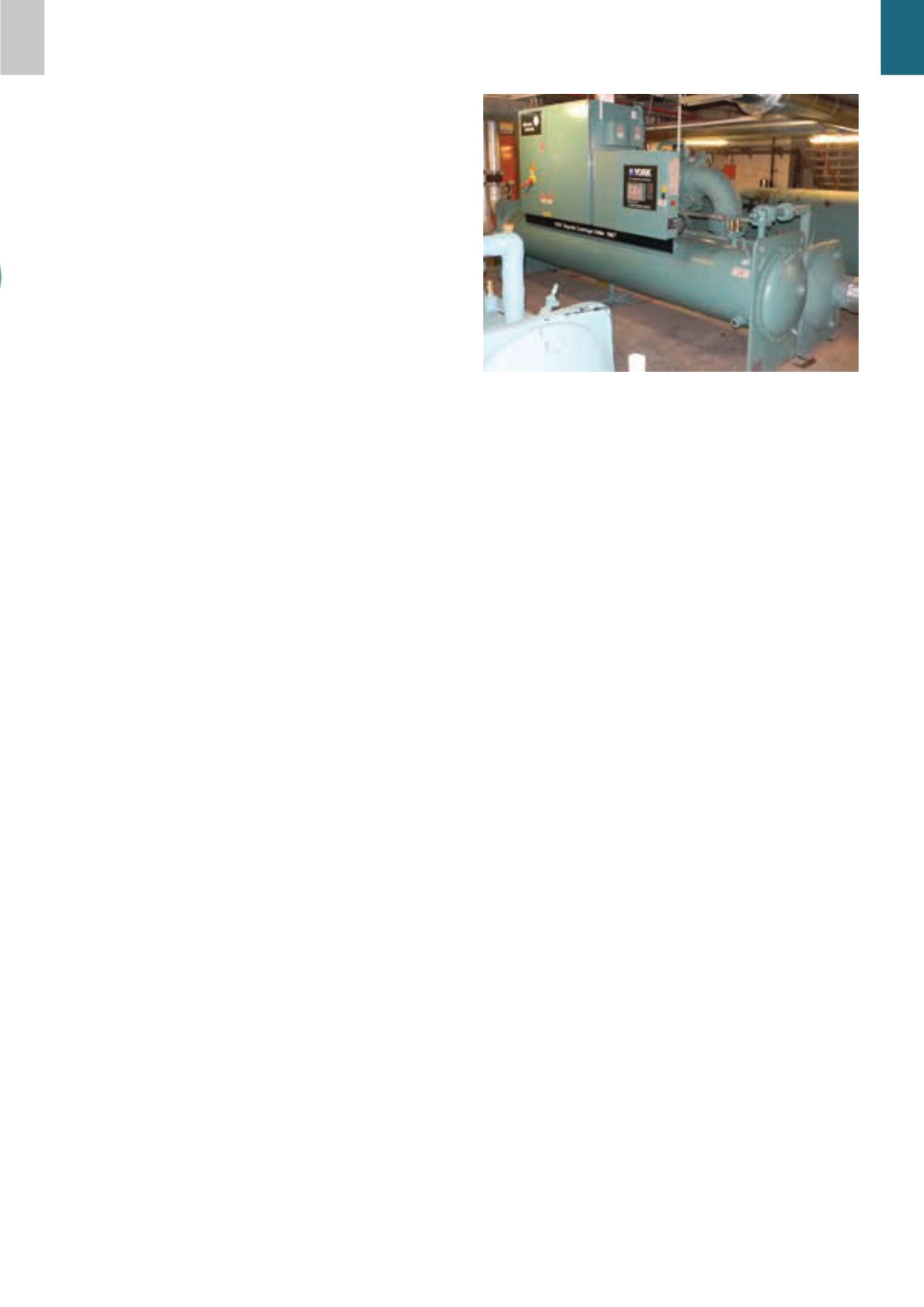
range are Johnson Controls’ YMC
2
chill-
ers: “At the heart of the YMC
2
chiller is
a centrifugal compressor with variable
vane technology. The fan blades that
compress the refrigerant are adjustable
to vary the refrigerant flow. This gives
a direct mechanical flow variation that
allows for a rapid response to cooling
demand,” Cameron explains. When
cooling demand is not continuous,
these are available with variable speed
drive motors.
Much higher efficiencies can be
achieved with VSDs when cooling
demand varies significantly. York has
recently pioneered a VSD solution that
receives water from the condensing cycle
to cool the VSD’s transistors (IGBTs).
These are very expensive devices and
the harder you drive them the hotter they
get. “This solution is an elegant one. If
the VSD is being driven hard, then more
cooling is available from the chiller to
cool the VSD. As well as better efficiency,
this allows the footprint of York VSDs to
be up to 10 times smaller than anyone
else’s,” claims Cameron.
In addition, since the compressor
runs at 32 000 rpm, a magnetic bear-
ing compressor is available. At speed,
permanent magnets are used to keep
the clearance gap between the vari-
able vane compressor shaft and the
housing at 20
µ
m. The key issue here
is oil: “Ball and roller bearings need to
be oiled all the time. If you lose oil, you
lose the bearing and the compressor has
to be shut down and repaired. By using
magnetic bearings, this headache is re-
moved, giving better reliability with lower
maintenance requirements,” he adds.
Johnson Controls has recently sup-
plied nine YMC
2
chillers for FNB’s Bank
City in central Johannesburg. Along with
optimal energy efficiency, these chillers
are also quieter than any comparable
chiller in the market place, because the
magnetic bearings eliminate driveline
vibration. They also make use of the
sustainable refrigerant, HFC or 134a.
“As well as the chillers for Bank
City, we have installed three Variable
Speed Drive units at Eastgate Mall in
Johannesburg, and a further four in
Cape Town. They are about 10% more
expensive than competing alternatives,
but the payback from efficiency savings
alone is in the eight to ten month range
– and, if better reliability and longer life
are taken into account, the lower total
cost argument is compelling.”
By running the YMC
2
chillers at
part load, FNB is achieving peak COPs
equivalent to 18 at Bank City “and the
winter/summer average is at about 12.”
Addressing new developments, Cam-
eron reveals that Johnson Controls has
just launched its connected equipment
offering. “From now on, every chiller
we sell will be enabled for remote con-
nectivity and condition monitoring,”
he says. “We believe that service is
key, and this is how we are going to
be expanding our ability to service and
maintain our products going forward.
In ten years time, we believe that every
piece of machinery will be connected
back to the original manufacturer, who
will optimise its condition and perfor-
mance,” he concludes.
q


