Mechanical Technology — August 2013
37
⎪
Innovative engineering
⎪
Some production facts
It takes about five days to transform a roll of
steel into an ultra-modern Volvo truck.
The cab passes through about 350 pairs of
hands before it is fully assembled.
The Volvo FH topcoat uses 3,8 litres of paint.
The press tools weigh between 25 and 30 t
each.
The new Volvo FH needs 2 790 screws to
be tightened during the build process.
The truck weighs between 7 500 and
12 500 kg, depending on specification.
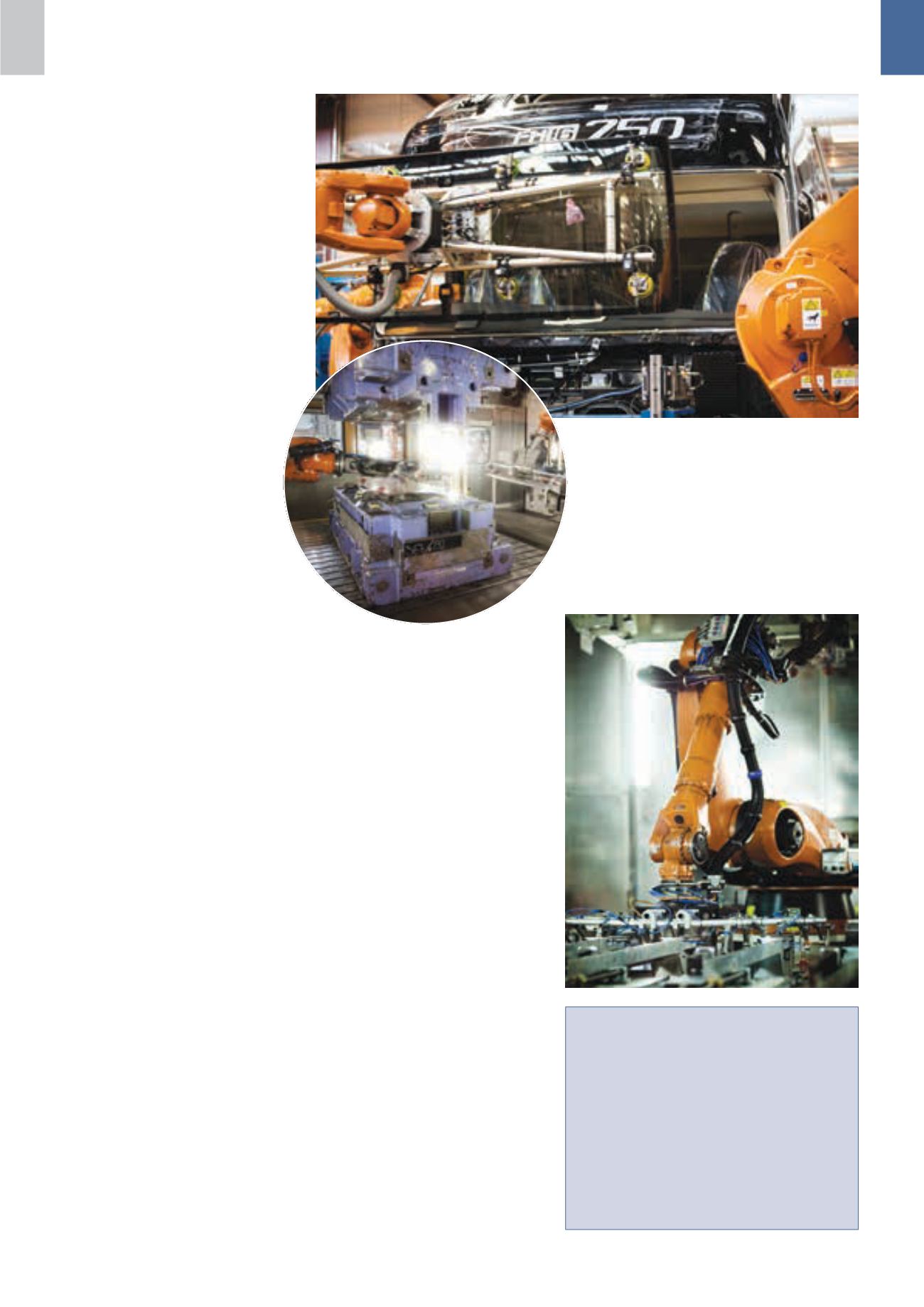
Above:
The glass panels are bonded to the cab,
which improves safety as the glass panels now
contribute to the cab’s overall strength.
Left:
The sheet steel is shaped in 340 presses
and each part is pressed in five steps to ensure
precise geometry.
Below:
The assembly process is carried out with
the help of more than 300 robots, all of which help
improve production efficiency. Automation also guar-
antees that each and every truck offers the same high
level of quality.
help to improve production efficiency.
Automation also guarantees that each
and every truck offers the same high
level of quality. One example of this is
that all the glass in the truck is now
bonded into place. There are several
benefits to this: the cab is safer since
the windows form part of the cab’s
structure, the production process is
more efficient and quality is assured
more easily than ever before.
Pilot plants for product
development
An important role for plants was to
participate in production development.
This had to be achieved without
disrupting ongoing production, so
pilot plants were established in
two of Volvo’s Swedish factories,
Tuve and Umeå. These can be
described as miniature replicas of
the production plants’ full-scale
assembly operations. These pilot
plants allowed new tools to be
tested and the building methods to
be optimised, with key aims being to
transform theory into practice, to deter-
mine the best assembly process and to
find out whether it was possible to build
the truck in the sequence and with the
tools that the engineers had prescribed.
“Just like the human body’s blood
circulation system, we go through the
entire truck to guarantee that everything
works exactly as it should. Advanced
test production in the pilot plant is an
important part of this quality control
process,” Elmqvist continues.
The pilot plants also served as a
basis for enhancing the competence
of the assembly personnel at both lo-
cal and global level. Over the past few
years, key operators from all over the
world have worked side by side with
truck builders in the pilot plants to
learn how the new truck is to be put
together. When the time came to move
the assembly process to the regular
production line in the Swedish plants,
the key operators were able to teach
their colleagues what to do. These
benefits will also be realised during the
global rollout.
“We’re prepared, down to the tini-
est detail, largely because this is such
a complex truck. As a result, it will be
much quicker to roll out a quality-as-
sured production process in other plants
across the globe. The new Volvo FH is
tailored for the whole world,” he says.
More ergonomic assembly
Having said that, it is not only the truck
itself and the newly developed tools that
are ultra-modern.
The pilot plants also served as an
important arena for the development
of simpler and more ergonomic routines
for the employees. Although the product
itself is more complicated, simplifica-
tions and smart assembly solutions
have made it easier to build the new
truck. One example is the chassis,
which is now built upside-down to
make it easier to access all the various
components.
As well as the new chassis assem-
bly process and the new bonded glass
innovation, Volvo has included several
other production line improvements: all
electrical wiring is routed on the right
side of the chassis up to the cab, while
air and water lines are located on the
left side – all so as to make assembly
easier, for example.
“I’d say with absolute conviction
that everything that has improved in
the production process also benefits
the customer. Improved working condi-
tions lead to increased product quality.
If something is easy to assemble, it is
also easy to do correctly,” concludes
Elmqvist.
q


