36
Mechanical Technology — August 2013
⎪
Innovative engineering
⎪
T
his spring saw the first of the
series-produced new Volvo FH
trucks roll out of the factory
gates for delivery to customers
throughout Europe. But just how is an
ultra-modern truck built? How do ad-
vanced electronics and other hardware
turn into a single smoothly function-
ing entity and how can top quality be
guaranteed? This article looks at Volvo’s
manufacturing processes from initial
ideas to finished trucks.
“One might say that an ultra-modern
truck must meet all the conditions of
a complex equation. It must satisfy
customer requirements and society’s
demands and succeed in combining
modern technology with properties
such as quality, driver comfort, environ-
mental efficiency and safety,” explains
Nordqvist.
Work on the development of a
modern truck starts long before produc-
tion is even relevant. The hunt for the
highest possible quality characterises
every aspect of the process from start
to finish. Careful analysis of customers,
society and the competition is used to
determine the demands a
new truck model will have
to meet. The market is also
scanned to identify which techno-
logical innovations can be integrated
into the new product. This data then
forms the basis for a detailed require-
ment specification that governs how a
modern truck should be built.
Production – a crucial factor
Once the requirement specification has
been set, it is time for the next chal-
lenge: to transform ideas into reality. In
order to succeed here, it is necessary to
implement a cross-functional working
method where everyone, from design
through construction to production –
works together from day one.
“One of the most important param-
eters in the development of an entirely
new truck is that it is actually possible
to build it. That may sound rather ob-
vious but it is vital that the production
process is ergonomic, efficient and
repeatable. Ultimately it’s all about
being able to guarantee a high-quality
product,” says Nordqvist.
The fact that series production of the
new Volvo FH is in full swing, and that
the first trucks are now on their way to
their customers, therefore marks not
just the start of something new, but also
the end of a long development journey.
The new Volvo FH has been dubbed the
‘next-generation truck’. Jonas Nordqvist,
product feature and profitability manager
in the strategic planning department
at Volvo Trucks, talks about what this
actually means.
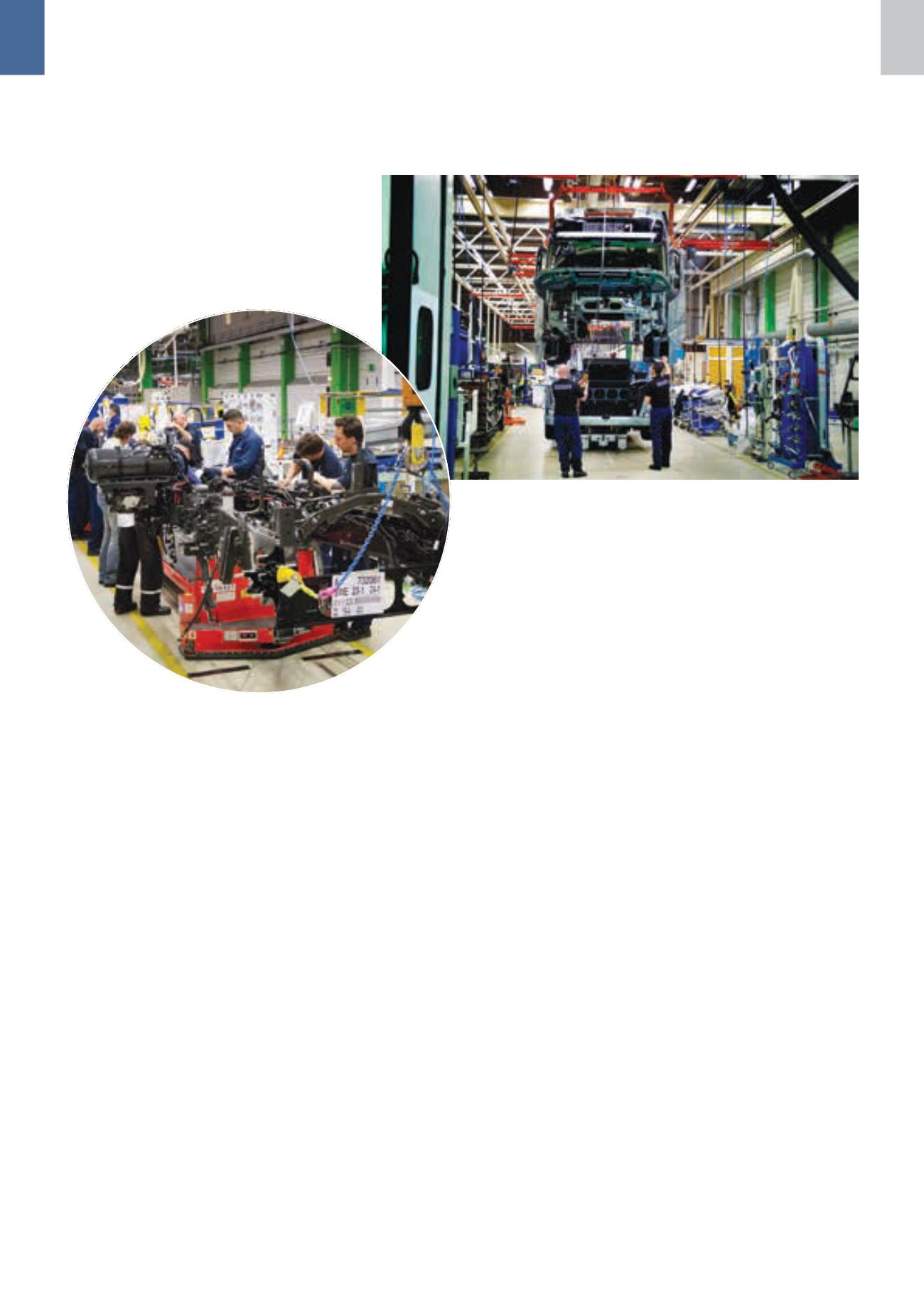
Above:
The Swedish pilot plants in Umeå and Tuve are miniature rep-
licas of the regular assembly line. They are used for product develop-
ment. This was also where the first new Volvo FH was built.
Left:
The chassis is built upside-down to make it easier to access all
the various components. This means a more ergonomic assembly for the
workers.
How the ultra-modern truck is built
For European Volvo plants in Sweden,
Russia and Belgium, the focus has been
on developing the new product in coop-
eration with the engineers. In parallel
they also produce the documentation
for everything that needs to be updated
in the plants and all of the new tooling
and new skills required.
“This is an entirely new cab and
truck. There isn’t a single body com-
ponent that is carried over from the
previous model and this imposes
demands both on our personnel and
on our equipment, since the latter is
often product-specific,” relates Hans
Elmqvist, project manager for overall
production of the new Volvo FH at all
the company’s European plants.
New plant investments
An ultra-modern truck requires ultra-
modern production tools. An important
investment is in the new presses, which
are used in the production of all the
cab parts.
“One thing that is unique in the new
Volvo FH is that we press many parts in
five steps. The focus is on the geometric
accuracy – the more times a component
is pressed, the better the various parts
fit together, thus improving cab assem-
bly,” explains Elmqvist.
Another major investment was the
purchase of 56 new robots, all of which


