platinum
27
06.13
ing-up procedure for the Koepe winders, Engelbrecht
said that what makes the present installation unique
is that for the first time in South Africa (and based
on some innovative design work by RSV) the Koepe
tail ropes have been designed to be entirely installed
from surface using a mobile friction winch located on
the bank adjacent to the headframe rather than from
underground rope handling stations as is convention-
al practice for similar installations.
“This approach was RSV’s brainchild and our
motivation was that it simplified the entire proce-
dure, reduced the significant excavations which are
required, which are an in-line construction activity
with shaft sinking, at the same time allowing much
more precise control of what is a very complicated
operation,” he explained. “To make this solution a
reality, we worked very closely with Siemag Tecberg
of Germany, a specialist in the field of mine hoisting
technology. The mobile friction winch, incidentally,
has been designed for use not only at No 16 Shaft but
also No 17 Shaft and – despite weighing 150 tonnes –
is fully mobile to facilitate this. It can also handle six
ropes, the requirement for No 17 Shaft, whereas No
16 Shaft only has four ropes.”
Apart from the 1 700 kN mobile friction winch,
the equipment supplied by Siemag Tecberg includes
two 1 700 kN, four-rope clamping and lifting devices
(CLDs), rope reelers and a single CLD for single tail
rope change outs from surface. At No 16 Shaft, the
mobile friction winch, located at bank level, and
the CLDs, located 56 m above bank elevation, were
used to hold, lift or lower all of the friction hoist
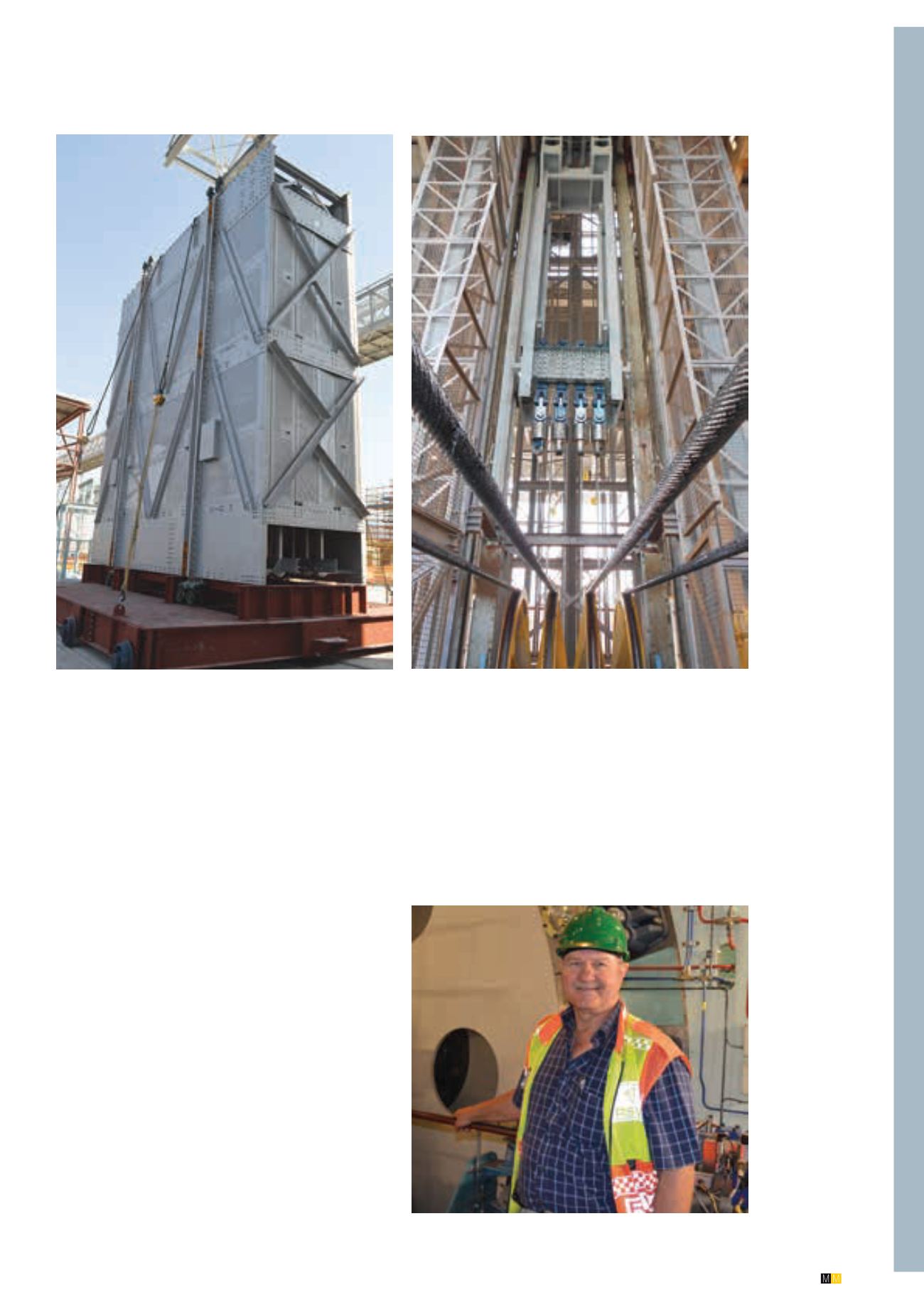
The man cage – which can accommodate 300 people – awaiting
installation (photo: Arthur Tassell).
Tail ropes and deflection sheaves with (above them) the counter-
weight for the man winder.
Torra Engelbrecht, Group Construction Manager of RSV (photo:
Arthur Tassell).
head and tail ropes within the headframe while the
Koepe hoist system was out of balance. This condi-
tion occurred when the tail ropes were not attached
to complete the rope loop. During this period, when
the Koepe hoist was of no use other than to act as
a rope sheave, the mobile friction winch and CLDs
were able to lift or lower up to 150 tonnes of rope,
conveyance and attachments.
The 54 mm diameter head ropes are of a full lock
coil design and have been sourced from a French
manufacturer, Tréfileurope (part of ArcelorMittal),


