companies
37
06.13
RVDS (Rotary Vertical Drilling System), which makes
use of inclination sensors to measure the deviation
from the vertical course. Exceeding permissible vari-
ations activates the hydraulic steering system and
extendible stabiliser ribs generate radial forces that
work against the angle build-up.
The accuracy achieved on the Rowland Shaft pilot
hole is impressive but at a nearby site, also for Lon-
min at its Karee No 4 Shaft, Master Drilling achieved
even greater precision last year when it drilled a pilot
hole as part of a contract to drill two 1 070 m, 5,5 m di-
ameter vent shafts using the same Wirth machine. In
this case it made use of a Scottish system developed
by Aberdeen-based Gyrodata, whose main customer
base is the oil drilling industry. The Gyrodata system
is based on a battery-powered, pre-programmed and
true north-seeking gyro steering tool positioned be-
tween the raiseboring drill rods and the tricone bit.
“The Scottish technology is more expensive but it
allowed Master Drilling to achieve a target depth de-
flection of 50 mm at 1 070 m depth, which the client
called for due to the proximity of an existing venti-
lation shaft,” comments Jordaan. “We believe we set
a world record in terms of accuracy with this pilot
hole.” He adds that the project has been put on hold
and that Master Drilling will return in due course to
complete the shafts (one of which has been partially
reamed to 5,5 m diameter).
While the Wirth HG380 SP is currently the biggest
machine in the Master Drilling fleet, the company is
working on building an even bigger rig which it has
designed and is manufacturing itself at its Fochville
facilities. The company has a long history of manu-
facturing its own equipment, not only raiseborers but
also slimhole rigs.
Given that Master Drilling is almost totally depen-
dent on the mining market (although it occasionally
works in civil engineering), an interesting point is
how it is going to keep its extensive fleet active now
that mining is in a downturn worldwide. Danie Preto-
rius does not see this as a problem – at least not so far.
“In the first place, probably the worst affected min-
ing market is South Africa itself, to which we have a
limited exposure as 70 % of our revenue is derived
from cross-border or overseas operations,” he points
out. “Secondly, most of the drilling we do is produc-
tion phase drilling rather than the drilling related to
new projects. This work is much more resistant to the
mining cycle than new project work and in fact we
have seen very little tail off in the demand for our
services. We remain optimistic. Perhaps we won’t
grow as fast as we might have liked but we have an
excellent order book in place and believe we are well
positioned to ride out the downturn.”
Certainly Master Drilling’s most recent results (for
the year to 31 December 2012) indicate a healthy
group. Revenue was up from R687 million in 2011 to
R818 million in 2012 while profits increased 10 % to
R100 million. Announcing the results earlier this year,
Pretorius said that one of the contributing factors was
Master Drilling’s strategy of continuously growing its
fleet, thus supporting growth into 2014. “On the back
of this, we are pleased to have delivered results that
are in line with our expectations, even prior to the in-
dustry strikes.” He added that Master Drilling would
be pursuing a strategy of geographical diversification
and that it would be venturing into new areas “at a
rate of at least two new countries every year.”
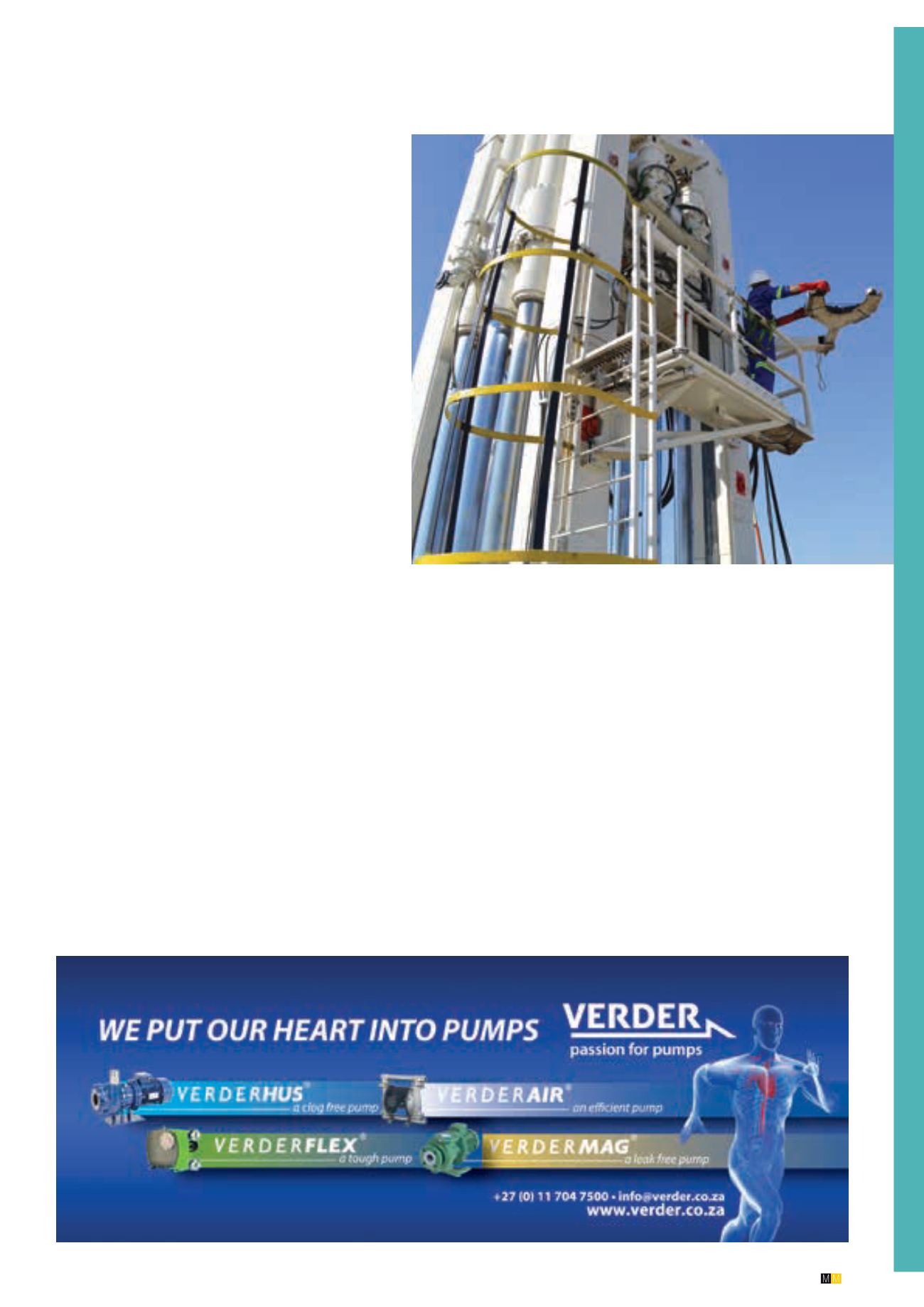
This close up view of the HG380 SP gives some idea of the scale
of the machine.


