companies
35
06.13
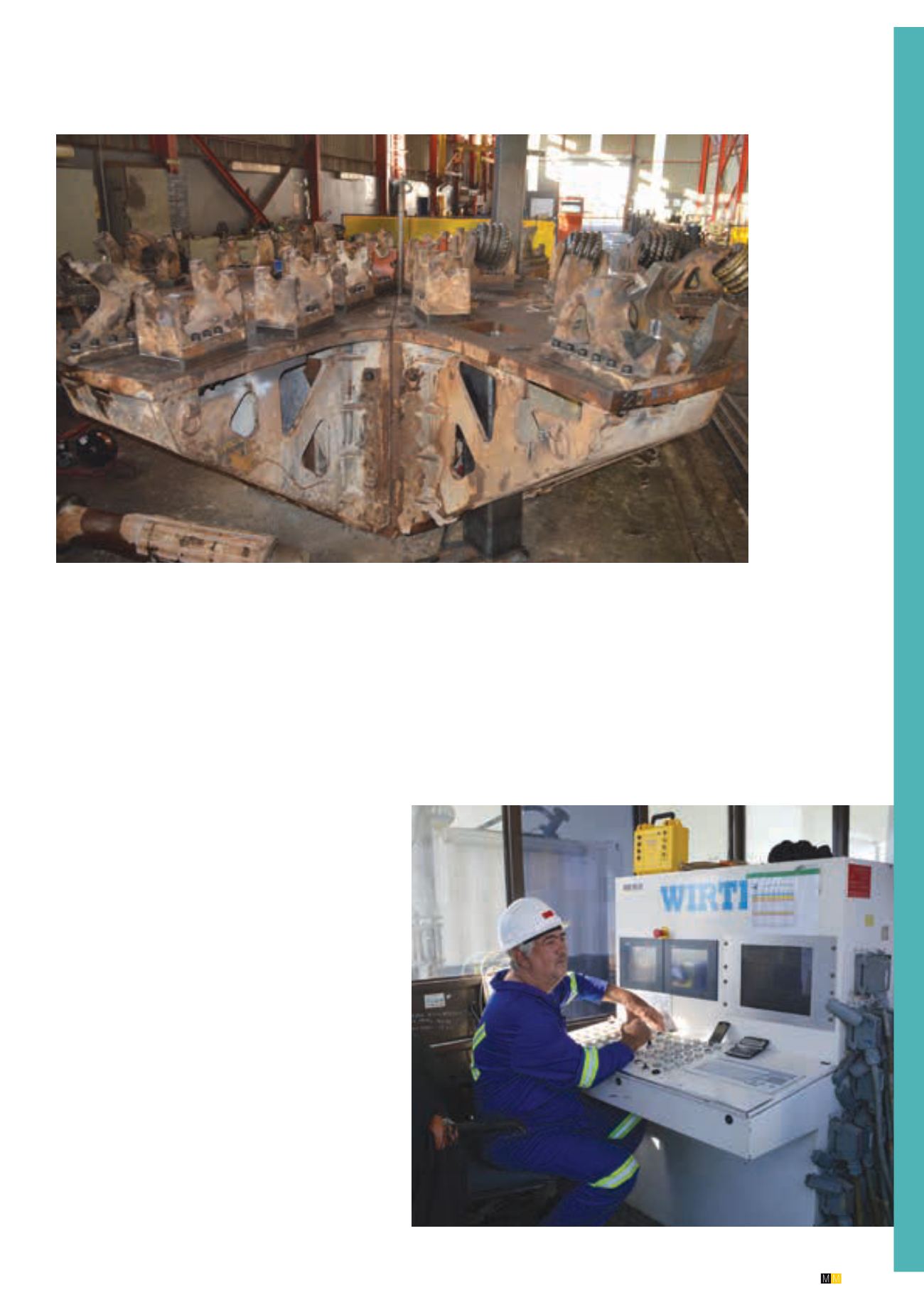
A reaming head being refurbished at the Fochville workshops in preparation for use on a raiseboring contract in Zambia.
The control cabin of the Wirth HG380 SP.
chased in 2003 – has seen service not only in South
Africa but also in Ireland and South America.
The vast majority of
Modern Mining’s
readers will
know what raiseboring (also known as raisedrilling)
entails but, for those few who do not, Master Drill-
ing defines it as “the process of the making of a pilot
hole of approximately 250 mm to 410 mm in diameter
from the surface or an upper horizontal tunnel in a
mine to a lower tunnel. The pilot hole is then reamed
to a larger size of 660 mm to up to 7,3 m diameter by
attaching a reamer head to the end of the drill rods
at the lower tunnel and pulling the head up in a ro-
tatory motion. The head is comprised of a series of
tungsten carbide cutters that cut the rock as the head
is rotated.”
As the capabilities of raiseboring machines have
grown in recent years (particularly in terms of the
hole diameters that can be achieved), raiseboring has
started to compete with conventional blind shaft sink-
ing in many applications. Says Jordaan: “Obviously
for the very biggest shafts in terms of depth and di-
ameter, conventional sinking is still the only way to
go but raiseboring offers many advantages for shafts in
the 7 m diameter and 1 300 m depth range – it’s much
safer, as there are no workers in the shaft barrel at any
point and no use of explosives, it’s generally faster and
it’s also more accurate. Of course, there has to be a low-
er access point which limits the situations in which it
can be used. Traditionally, it has been employed for
boring ore passes or ventilation shafts but increasingly
there is a recognition that it can be used to create full
production shafts with hoisting facilities as well and
we see this as a growth market going forward.”
He adds that a contract for Sasol Mining secured
recently will see two 7,2 m diameter, 120-m deep pro-
duction shafts being bored by Master Drilling, which
will also line parts of the shafts using a remote-con-
trolled shotcrete machine.
At Marikana, Master Drilling is boring a 998 m
deep, 4,5 m diameter ventilation shaft for the Lonmin
Rowlands Shaft operation. When
Modern Mining
was
on site, the 407 mm pilot hole had been completed
and Master Drilling was in the process of fitting the
65-t reaming head. Once this is done, the hole will be
enlarged to its full diameter at a vertical rate of rough-
ly 6 m a day. The contract started in December and is
expected to be completed within about six months.
The accuracy achieved on the pilot hole was a devia-
tion of 360 mm over nearly a kilometre of depth.
The directional drilling technology used on the
contract is a German system (from Micon) known as


