8
MODERN MINING
June 2014
MINING News
In its report on the first quarter ended 31
March 2014, Canada’s B2Gold Corp says
that construction at it open-pit Otjikoto
mine in Namibia remains on time and
within budget. Construction is expected to
be completed and production is scheduled
to commence in the fourth quarter of 2014.
Construction began in January 2013
and will continue into the fourth quar-
ter of 2014 and is being managed by
B2Gold’s experienced team. Excavation at
the mill area is complete and a concrete
batch plant is in continuous use to assist
with the pouring of foundations. A total
of about 15 000 m
3
of concrete will be
poured during construction, and a total
of 13 000 m
3
of concrete had been poured
through March 2014.
Otjikoto still on time and within budget
The mill and mining offices have
already been completed by a local con-
tractor and the construction of all the
other administration buildings is pro-
gressing well. Most of the equipment and
supplies to build the mill have been pur-
chased and are arriving daily at site. Mill
construction activities are progressing
well, 9 000 m
3
of concrete having been
poured in this area, and six leach tanks and
five CIP tanks having been erected to date.
Additionally, steel is arriving daily at site
and the steel workers have begun to erect
steel around the mill and tank areas. The
total volume of material moved from the
pit area to date is approximately 6,5 Mt. In
addition, the tailings impoundment has
been constructed and lined. This facility is
substantially complete and will be used to
capture water to start the mill in 2014.
The current mine plan is based on
probable mineral reserves of 29,4 Mt at
a grade of 1,42 g/t containing 1,34 Moz
of gold at a stripping ratio of 5,59:1 to be
mined over an initial 12-year period. The
current average annual production for the
first five years is estimated to be approxi-
mately 141 000 ounces of gold per year at
an average cash operating cost of US$524
per ounce and for the life of mine approxi-
mately 112 000 ounces of gold per year at
an average cash operating cost of US$689
per ounce.
However, based on the positive drill
results from the Wolfshag zone to date,
on January 21, 2014 B2Gold announced
plans to expand the Otjikoto mine in 2015,
increasing ore throughput from 2,5 Mt/a
to 3 Mt/a. This increase will be achieved
through the installation of a pebble
crusher, additional leach tanks and mining
equipment at a total cost of approximately
US$15 million. Once the expansion is com-
pleted at the end of 2015, B2Gold expects
that the annual gold production from
the main Otjikoto pit would increase to
approximately 170 000 ounces per year.
The 2014 Otjikoto exploration pro-
gramme is budgeted at US$8 million. The
exploration drilling programme will focus
primarily on infill drilling on the northern
portion of the Wolfshag zone and will fur-
ther test the extension of the Wolfshag
zone to the south. The company antici-
pates being in a position to upgrade the
mineral resource classification to the indi-
cated category by the end of 2014. The
2014 programme will also include metal-
lurgical and geotechnical test work for the
Wolfshag zone.
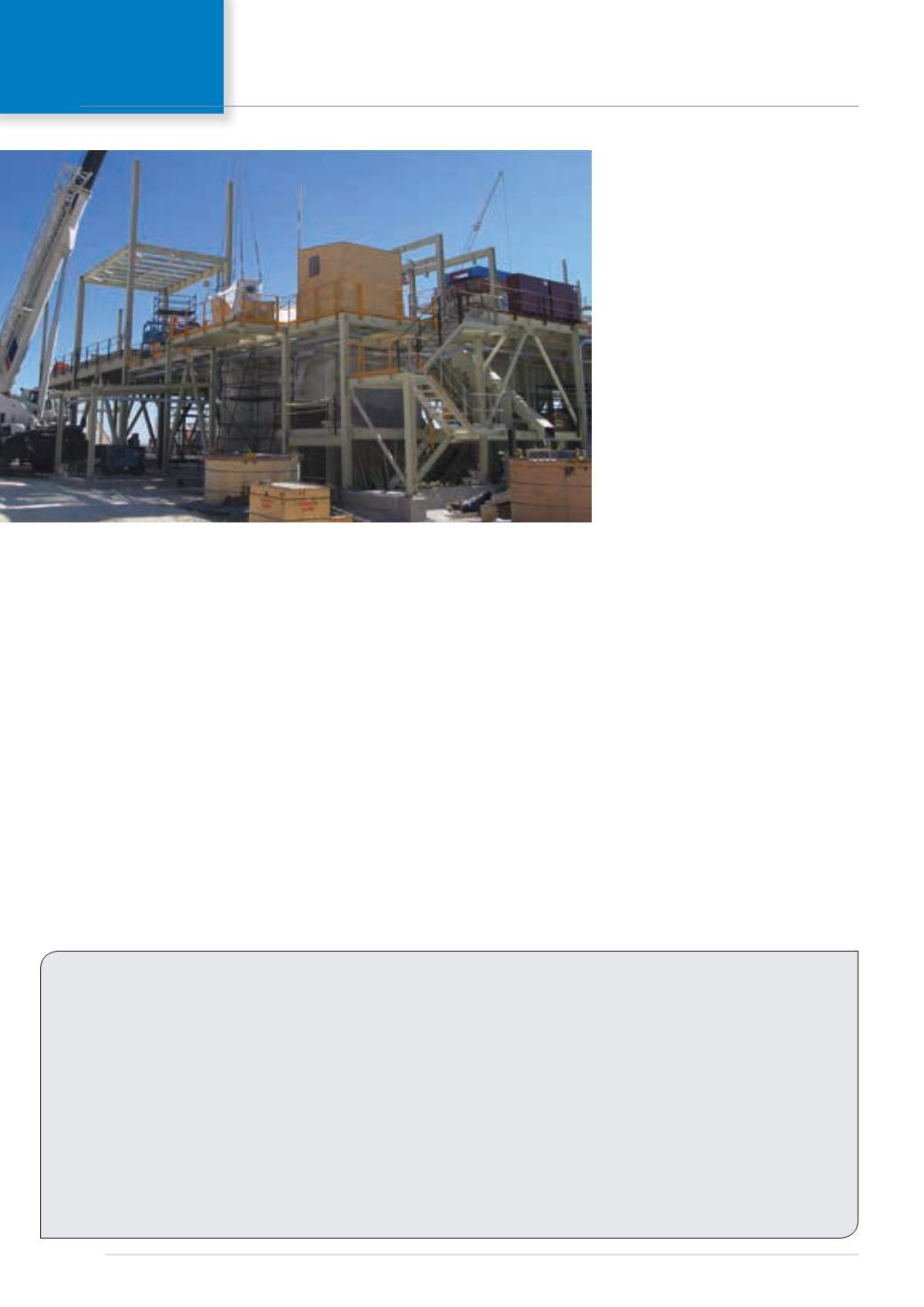
A very recent (early June 2014 ) view of plant erection at Otjikoto (photo: B2Gold).
Burey Gold to acquire interest in DRC gold project
ASX-listed Burey Gold Limited has entered
into an agreement with the founders of pri-
vate registered company Amani Consulting
SPRL and Nevada-based Panex Resources
Incorporated (listed on the US Over the
Counter securities market) to acquire a
55 % interest in two exploitation permits
(constituting the Giro project) which cover
610 km
2
of prospective ground in the DRC’s
Orientale Province.
The tenements are located less than
30 km west of the recently-opened Kibali
gold mine of Randgold Resources and
AngloGold Ashanti. Kibali has 12 Moz of
gold at 4 g/t in proven and probable ore
reserves and 17 Moz in measured and indi-
cated mineral resources. It produced more
than 110 000 oz of gold in the March 2014
quarter.
Both the Kibali and Giro projects occur
within the Kilo-Moto belt, one of the
world’s principal greenstone belts.
The Giro project area is underlain by
highly prospective volcano-sedimentary
lithologies in a similar structural and litho-
logical setting to the Kibali gold deposits.
Both primary and alluvial gold was mined
from two main areas, the Giro and Tora
areas, during Belgian rule and today these
areas are mined extensively by artisanal
miners. At Giro the Belgians mined two
quartz veins with a combined strike length
of 500 m and elluvial gravels over an area
of 700 m x 400 m where reported mined
grades were 0,25 – 2 g/t Au.
The project area had not been explored
for over 50 years (since the Belgian colo-
nial era) with no modern exploration up to
December 2013 when Panex conducted a
57-hole, 2 888 m RC drilling programme at
the Giro prospect.


