COVER STORY
18
MODERN MINING
June 2014
A
fter decades of mining, the
most accessible orebodies have
mostly been exploited and the
rich veins that make the BIC
the world’s most important
platinum resource are becoming deeper. Min-
ers’ tasks are therefore becoming riskier and
rising input costs will in future also threaten
profitability.
This has not gone unnoticed by mining
houses and supporting equipment suppliers,
who are already working closely together to
find methods of extracting the precious metals
in the safest most productive manner possi-
ble. While some mines have an easier route to
mechanisation and have already employed new
techniques, others have different geologies,
existing conventional mining footprints and
altogether different challenges.
High ore dilution rate
Neil McCoy, senior account manager platinum
of Sandvik Mining, says that mechanisation
of mines in the platinum industry is ongoing
and will become a far greater part of mining
operations on the Western Limb in future.
Increasingly these mines will need to follow
the model of counterparts on the Eastern Limb
where orebodies readily lend themselves to
mechanised techniques.
“Generally, the Eastern Limb has flatter,
wide orebodies that allow fast rates of advance.
Mechanisation under these circumstances is a
cinch and has been practised at these mines for
years. On the Western Limb the critical analy-
sis, however, is ongoing and investigations to
determine the feasibility of mechanisation are
ongoing too.
“It is immediately obvious that mechanisa-
tion of the Western Limb is difficult because
Platinumbelt mechanisation
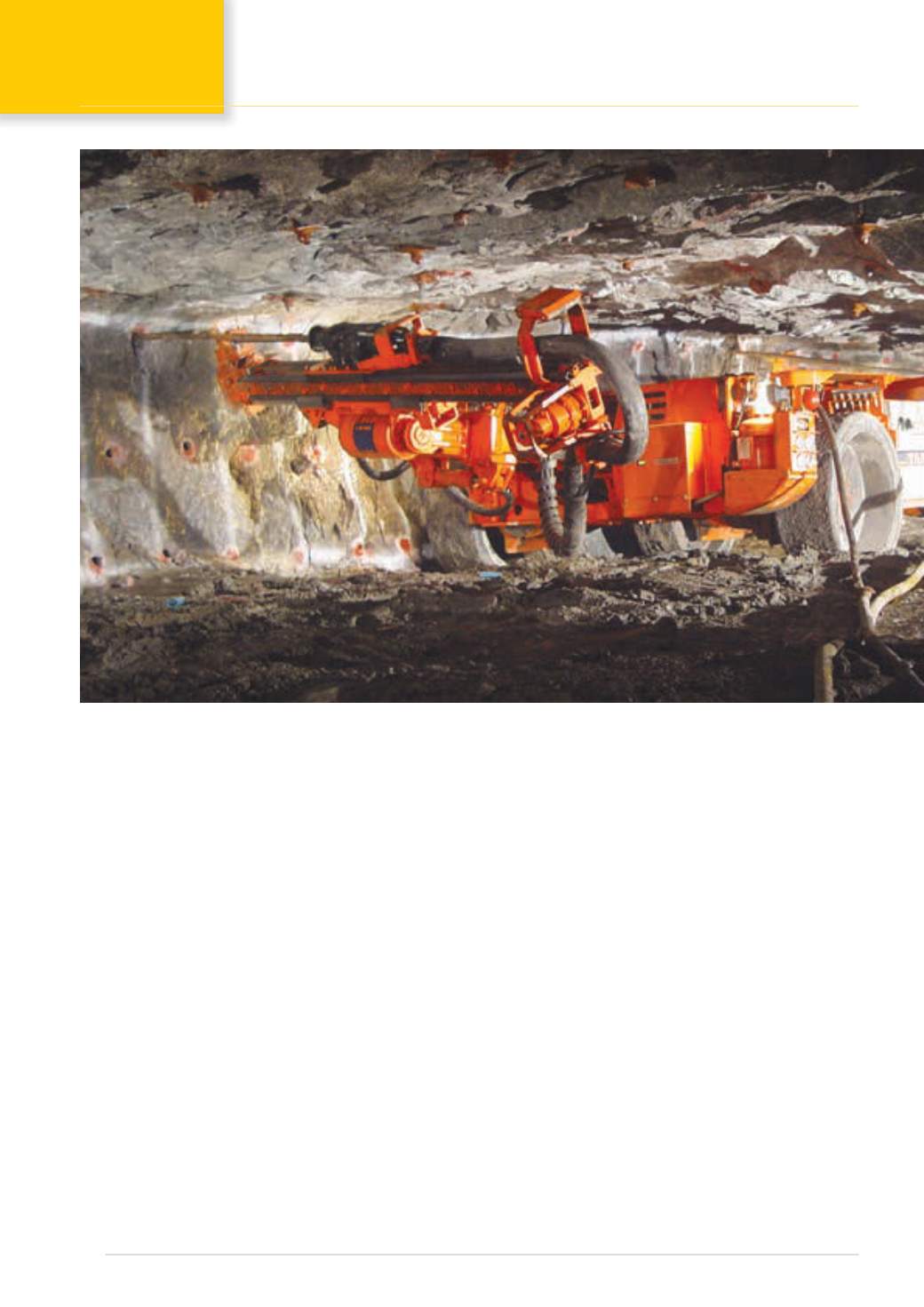
An Extra Low Profile (XLP) face drill – drills of this type can be used in
narrow reef orebodies up to 12 degrees.
There is a growing body of opinion that mechanised mining
techniques will soon be required to reach the increasingly
complex but rich platinum deposits that remain along the
Western Limb of the Bushveld Igneous Complex (BIC).


