16
MODERN MINING
June 2014
MINING News
On 7 February 2014 Australia’s Paladin
Energy advised that its Kayelekera mine
in Malawi was to be placed on Care and
Maintenance (C&M) status due to reasons
beyond the company’s control and related
to the depressed uranium prices. Paladin
stated at the time that processing of ore
would continue during a rundown phase
until reagents and consumables on site
had been depleted, anticipated to be by
April/May of this year.
On 21 May, uraniumproduction (includ-
ing circuit inventory clean up) stopped
at Kayelekera and the operation will now
cease supplying the global uranium mar-
ket, resulting in a reduction in global
supply for the foreseeable future of around
3,3 Mlb U
3
O
8
per annum.
“This outcome is an unfortunate but
direct consequence of the continuing
deterioration in the uranium price. Certain
estimates now place up to 60 % of current
annual global production with costs above
the current spot price, which is unsustain-
able,” says Paladin.
The company emphasises that it is com-
mitted to maintaining the mine and its
infrastructure at Kayelekera in good work-
ing order to facilitate a rapid resumption of
production when market conditions make
it possible to do so profitably. Production
at this project, it says, can now be recom-
DRA delivers study on Namibia’s Tubas Sand project
Advanced stage uranium explorer Deep
Yellow Limited (DYL) has announced
the completion of a preliminary techno-
economic trade-off study by DRA Mineral
Projects for the Tubas Sand project, located
near Swakopmund in Namibia.
The study compared five processing
options representing various levels of ben-
eficiation, yielding products ranging from
an upgraded sand concentrate through
to uranium-bearing precipitates. A physi-
cal beneficiation option consisting of ore
scrubbing, classification and dewatering
to produce an upgraded sand concentrate
for sale to existing Namibian producers has
been selected as the preferred strategy.
Whilst other options remain feasible
under different pricing assumptions, physi-
cal beneficiation was selected due to its
lower technical risk and capital expendi-
ture and shortest estimated development
schedule. In addition, environmental
approval from the Republic of Namibia’s
Ministry of Environment and Tourism is
already in place for this project under these
operating conditions.
“This is a good result. We now have an
independent view of the potential of the
Tubas Sand project,” said DYL’s Managing
Director, Greg Cochran. “The study has
given us greater confidence to move the
project forward and has also provided clar-
ity on the operational choices to be made.
We will now focus on working with DRA
in planning an accelerated pre-feasibility
and feasibility study with a view to com-
pleting it by the middle of June 2015,
depending on funding and market con-
ditions. Obviously current uranium prices
are both unattractive and unsustainable
so we will be looking for stronger market
signals before making any commitment for
development.”
The Tubas Sand deposit consists pri-
marily of low grade secondary uranium
mineralisation (carnotite) in well-sorted
aeolian (windblown) sand which occurs
immediately south of the Tubas palaeo-
channel located on EPL 3496.
The project was originally held by Anglo
American in the 1970s and early 1980s.
Anglo successfully demonstrated that the
deposit was amenable to upgrading via
physical beneficiation and envisaged an
offtake arrangement of upgraded sand
concentrate to Rössing uranium mine.
The deposit can be mined in a shallow,
low cost, free dig, truck-and-shovel opera-
tion and already has full environmental
clearance whilst a mining licence applica-
tion has also been lodged.
Production stops at Kayelekera uraniummine
menced with minimal risk and within a
short lead-time of about nine months.
Paladin has previously stated that the
incentive price for operational restart,
considering the looming supply shortfall,
is US$70 to US$75/lb U
3
O
8
. It adds that it
intends to continue exploration activi-
ties with the objective of identifying and
delineating additional uranium resources
in order to enhance the long term future
of the mine.
Comment i ng on techno l ogi ca l
advances at Kayelekera, Paladin says that
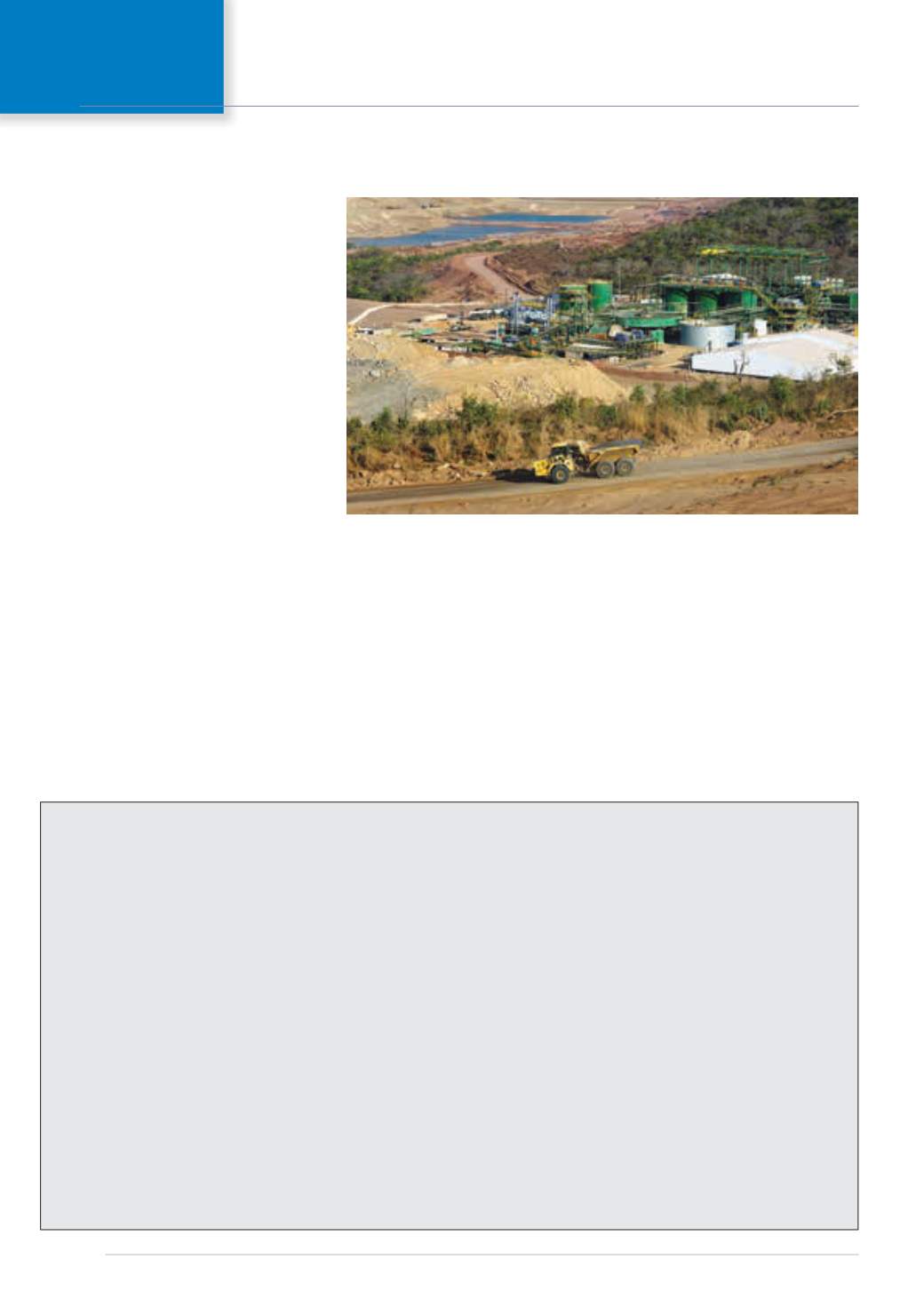
The Kayelekera plant in northern Malawi ceased all production in May (photo: Paladin Energy).
in successfully establishing the first mod-
ern resin-in-pulp plant for a conventional
uraniummining operation, it has created a
valuable technological asset. The company
believes this treatment process will likely
replace older, less efficient technologies
currently in use, for future developments
because of the distinct advantages it deliv-
ers. This position has recently been further
enhanced with the successful addition of
nano-filtration technology (patent pend-
ing) to the process, which has materially
reduced operating costs.


