PRODUCT News
52
MODERN MINING
June 2014
A new range of MGU industrial gear units,
designed specifically for use with grind-
ing mill drive trains in the mining industry,
has been introduced to the local market
by specialist drive engineering company
SEW-EURODRIVE.
SEW-EURODRIVE Head of Engineering
and Sales Conrad Pilger notes that the
MGU series of industrial gear units has
been developed on the back of the success
of the M1 gear series.
“The M1PSF, ME2FS and ML2PSF are a
part of the MGU series of industrial gear
units. They are an application specific
extension of the M1 series of gear units,
which were a proven success,” he states.
The MGU series is said to meet the high-
est quality, reliability and performance
requirements and is made from the best
quality materials. “This has resulted in
increased safety for drive applications that
were previously run using conventional
gear units. The new series also provides
economic advantages for new drive appli-
cations,” Pilger explains.
The MGU gear series features a horizon-
tally split housing which is equipped with
facilities for lifting, oil inlet and outlet, oil
heater, a lubrication unit attachment, an
oil sight glass, along with various other
components. The housing is composed of
various materials ranging from fabricated
steel to cast iron.
This, along with the sturdy and rugged
design, ensures that the gear housing can
withstand a tough working environment.
All of the gears and pinions used in the
MGU range meet ISO 6 standards.
In addition, the gear mesh properties
have been selected in order to minimise
the noise and vibration levels, as well as
reduce the risk of surface wear to the unit.
Pilger says the high speed shafts
are equipped with a three-bearing
arrangement. He adds that the radial
load component from the gear mesh
is supported by two radial bearings,
Industrial gear units designed for mill drive trains
and an additional thrust bearing load is
included to compensate for the axial load
component.
If needed, thrust bearings are spring
loaded to avoid minimum load condition
for non-loaded bearings. Thrust bearings
on HS, IM and LS shafts are located on
the same side of the housing. This causes
a thrust load on HS shaft and a counter
thrust load on IM/LS shaft to be compen-
sated close to each other, minimising the
housing deflections.
Auxiliary drive packages are also avail-
able for use with the MGU gear series.
These include disengaging coupling, brake
disk and caliper or brake motor. The main
drive unit consists of the main gear unit (an
M1PSF, ME2FS or ML2PSF), as well as HSS
coupling, LSS coupling and a lubrication
unit. The auxiliary drive features an auxil-
iary gear unit, disengaging coupling, HSS
coupling, a brake and an electric motor.
During normal operation, only the main
drive will be in use. The auxiliary drive will
be disconnected from the rotating main
drive by disengaging the coupling. This
drive is only connected and used when
the mill is being serviced, but there is still
a need to rotate the grinding mill slowly.
SEW-EURODRIVE, tel (+27 11) 248-7000
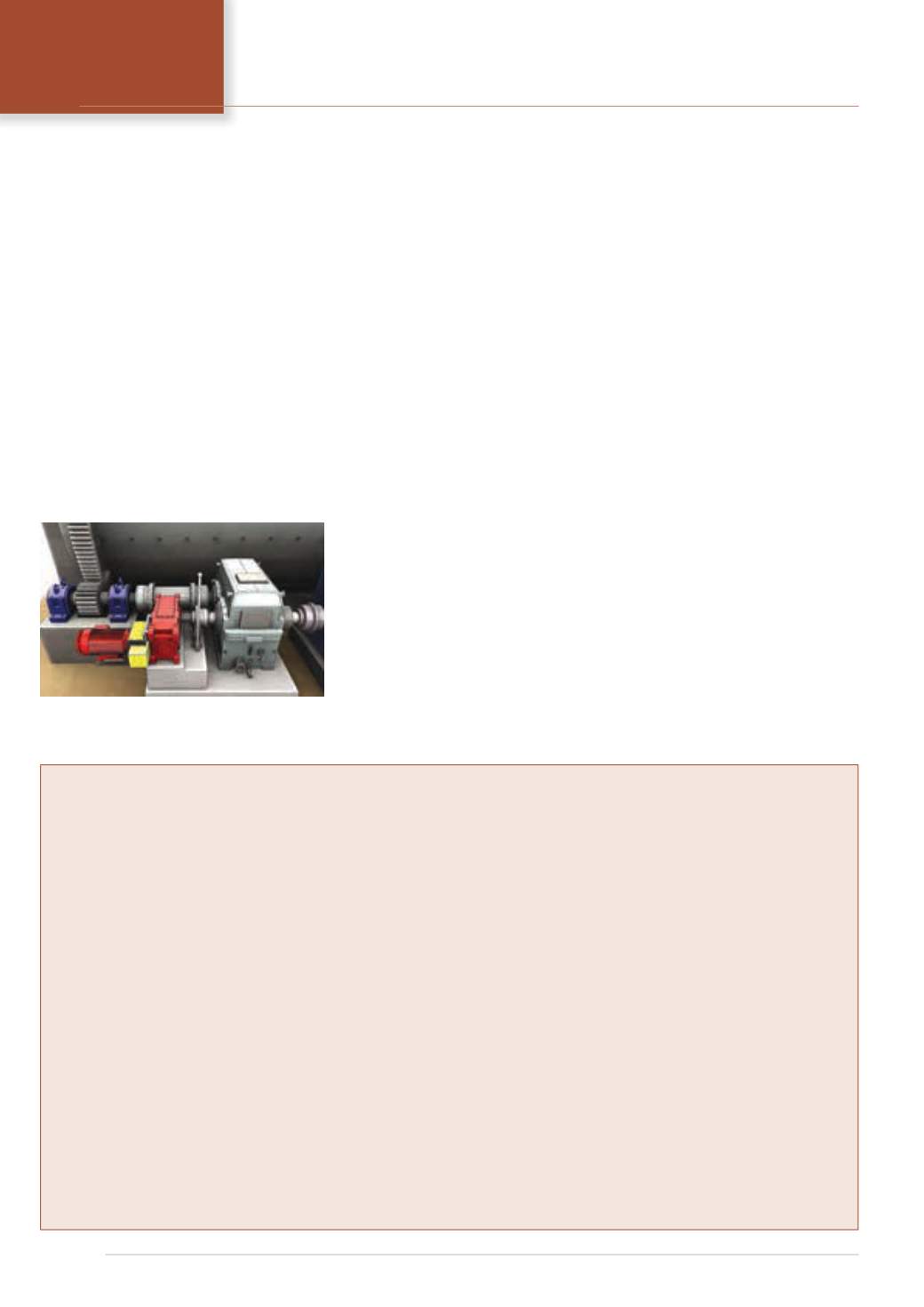
SEW-EURODRIVE has introduced a new range of MGU
industrial gear units, designed specifically for use with
grinding mill drive trains in the mining industry.
SAISC develops steel construction digitisation tool
The Southern African Institute of Steel
Construction (SAISC) has developed a
digital tool that enables the structural
engineer to design the appropriate struc-
tural steel connection at the ‘press of a
button’.
SAISC Education Director Spencer Erling
says that this eToolKit will revolutionise
the steel construction industry. “Imagine a
digital tool on your laptop, tablet or smart
phone that is so intuitive you will be up and
running in a minute and within a few ‘clicks’
the capacity of the connection is displayed,”
Erling says.
According to the Erling, the entire pro-
cess is as simple as it gets. The steps are as
follows:
Click on the SAISC standard connection
you want to use (there are five major
groups, fromwhich you can choose your
particular requirement).
Select the member sizes you wish to join
(a full database of sections is available to
choose from).
Select the bolt diameters, number of
rows of bolts and the plate thickness.
Push the calculate button and instanta-
neously the capacity of the connection
is displayed.
But there’s a lot more to this program,
says Erling. “By placing your cursor on the
box you are told what ‘the weak link in the
connection is’, allowing you to refine the
connection design. This is really the ‘jack-
pot’ feature of the program,” he says.
SANS10162:2005 sets down the rules
for designing steel structures. To simplify
the designer’s life, the SAISC publishes
The
South African Steel Construction Handbook
,
popularly known as the Red Book, which
turns the code formulae into tables. This
‘bible’ of the industry also provides guid-
ance and general information to help the
steel designer.
In 2013, to complement updated ver-
sions of the Red Book, the SAISC published
a new hard copy version of the Green Book,
which brought connection design up to
date. The book is notable for its guidance
and includes a plethora of simplifications,
where appropriate.
“Once again, there is a great deal of text
to explain‘what and how’but also examples
to guide the designer through the maze of
formulae and methods,” says Erling. The
book has become a desktop companion to
those involved in connection design and
more than 300 designers have attended the
SAISC courses on connection design based
on the Green Book.
Notwithstanding the simplifications,
connection design done by hand can be
a laborious task, especially if the designer
desires to optimise the efficiency (i.e. cost
in rands and cents) of connections. “The
net result is that too many steel structure
designs are issued for construction with
inadequate attention paid to the connec-
tions and their details. This is a serious
concern for the SAISC and the industry and,
so, after a tremendous effort by the SAISC
team, the new connection design eToolKit
was developed,” Erling says.
Paolo Trinchero, SAISC, tel (+27 11) 726-6111


