June 2014
MODERN MINING
45
EXPLORATION AND
GEOLOGY
most recently, Lonmin, where he headed
Mineral Resources and Geology for the mines
and projects. He is now Principal Resource
Consultant at MSA.
Witley believes that the earlier MSA is
involved in a project, the better the result for
the client. “We prefer that clients come to us
early on in their exploration programme, as that
way the client can reach his desired outcome
at the required standard in the most effective
way,” he observes. “We pay a great deal of
attention to what clients are trying to achieve.
Are they trying to add value to a project for an
exit or a listing? Are they planning to mine it
themselves or joint venture it? All these factors
will influence the approach to exploration and
to all the follow-up work, including the miner-
als resource estimate.”
Witley is emphatic that MSA will – when the
realities on the ground dictate it – give advice
to clients which they don’t necessarily want to
hear. As he says, “We’re not afraid to tell clients
that they should walk away from a project. We
often see exploration companies wasting mil-
lions pursuing projects which are clearly not
economic. We’d rather be honest and tell them
that they are throwing their money away.”
He also makes the point that what tends to
differentiate MSA from its competitors in terms
of its mineral resources work is that it is typi-
cally working with data generated by its own
teams – as opposed to data generated by third
parties. He adds that a thriving part of MSA’s
business is managing databases for clients.
“We’ve seen a big uptake on database man-
agement and we’re now managing the data on
around 20 projects,” he says. “We can do this
for a fraction of what it would cost companies
to do it internally, particularly those who may
not wish to purchase costly software.”
On the subject of technology, Witley says
that – on the whole – progress currently in the
field of geology and resource modelling tends
to be evolutionary rather than revolutionary. “If
I look at software, for example, the big leap for-
ward occurred perhaps two decades – or more
– ago when the first 3D geological modelling
software was introduced and computers started
to have the processing power to handle it,” he
explains. “What we’re seeing now is incremen-
tal improvements to this software year by year
but with no real game-changing breakthroughs.
In terms of modelling, we are seeing a lot more
focus on geometallurgical modelling, which
adds tremendous value in understanding the
behaviour of the ore during processing, both in
current operations and at the project phase.
“At MSA we’re familiar with all the major
commercially available packages for geology,
resource modelling and mine planning – par-
ticularly what we used to call Datamine, now
branded as CAE Mining – and we supplement
these with some in-house tools we’ve devel-
oped where off-the-shelf products are either
inadequate or non-existent.”
Clarke adds that a major advance out in the
field has been the introduction of hand-held
XRF (X-ray fluorescence) analysers. “They’ll
never replace traditional assay procedures but
they’re helping to speed up and optimise the
planning and implementation of exploration
programmes and they’re also allowing in-field
teams to be selective in what they send to labs
for analysis,” he says. “They truly are time-
and money-savers and are rapidly becoming an
indispensable part of the geologist’s toolkit.”
Haddon sums-up by saying that MSA takes
innovation very seriously. “All our geologists
are given iPad or Android tablets as a matter of
course, we have an innovation competition and
we spend a lot of time going to conferences and
similar events, partly as a marketing exercise
but also to ensure that we stay absolutely up to
date with developments in our field,” he says.
“Needless to say, we also adopt international
best-practice in everything we do and we have
just added OHSAS 18001 to the other accredi-
tations we already have. The business we’re
in is highly competitive and it is only by stay-
ing abreast of developments and being open to
innovation that we can stay ahead of the pack.
MSA throughout its existence has offered its
clients a technological edge and we have every
intention of maintaining this strategy as we
move forward and grow both our African and
global footprints.”
Photos courtesy of The MSA Group (unless otherwise
acknowledged)
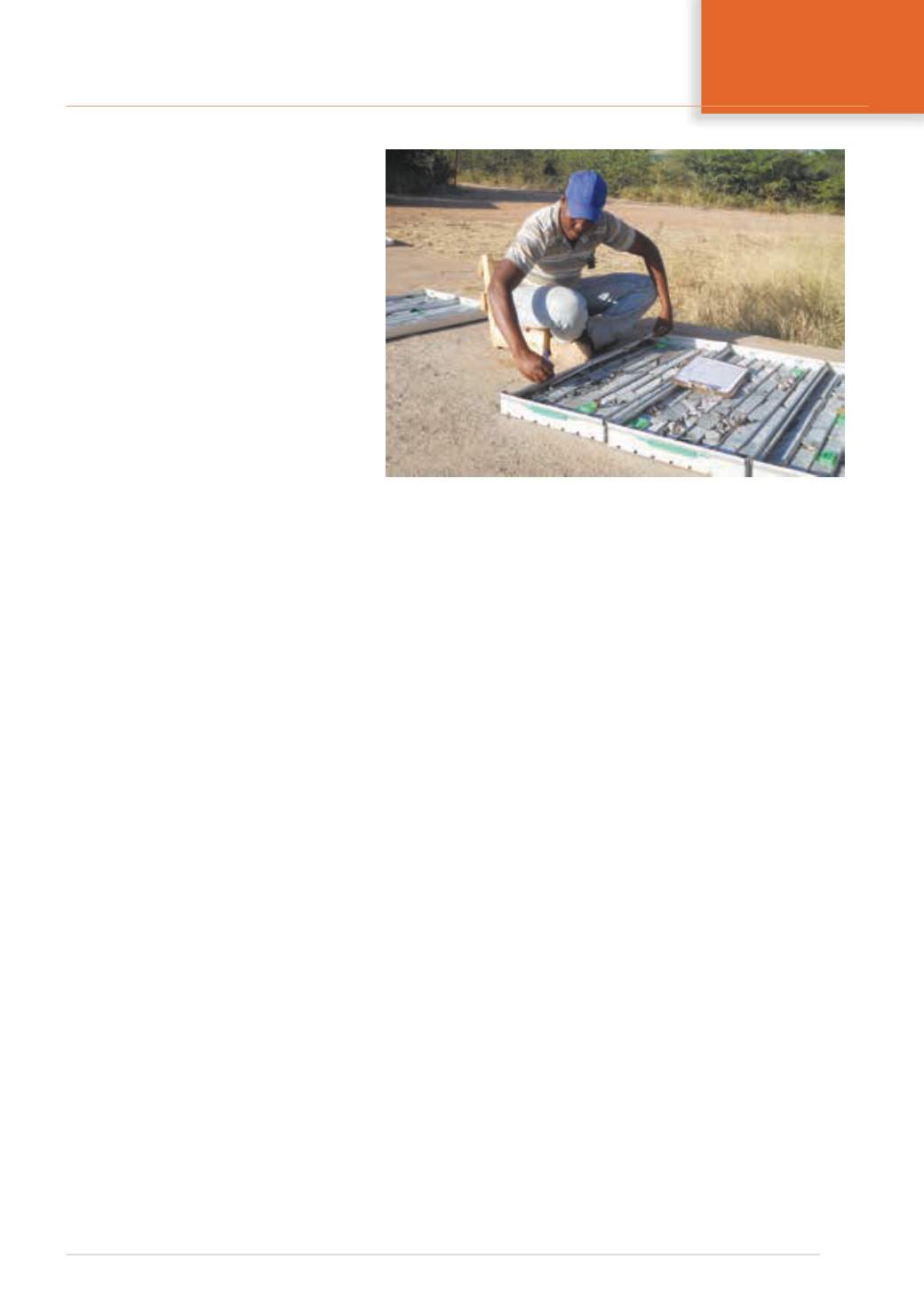
An MSA geologist marks
core in Musina.
feature
“We’re not afraid
to tell clients
that they should
walk away from a
project. We often
see exploration
companies
wasting millions
pursuing projects
which are clearly
not economic.”
MSA’s Jeremy Witley


