PRODUCT News
48
MODERN MINING
June 2014
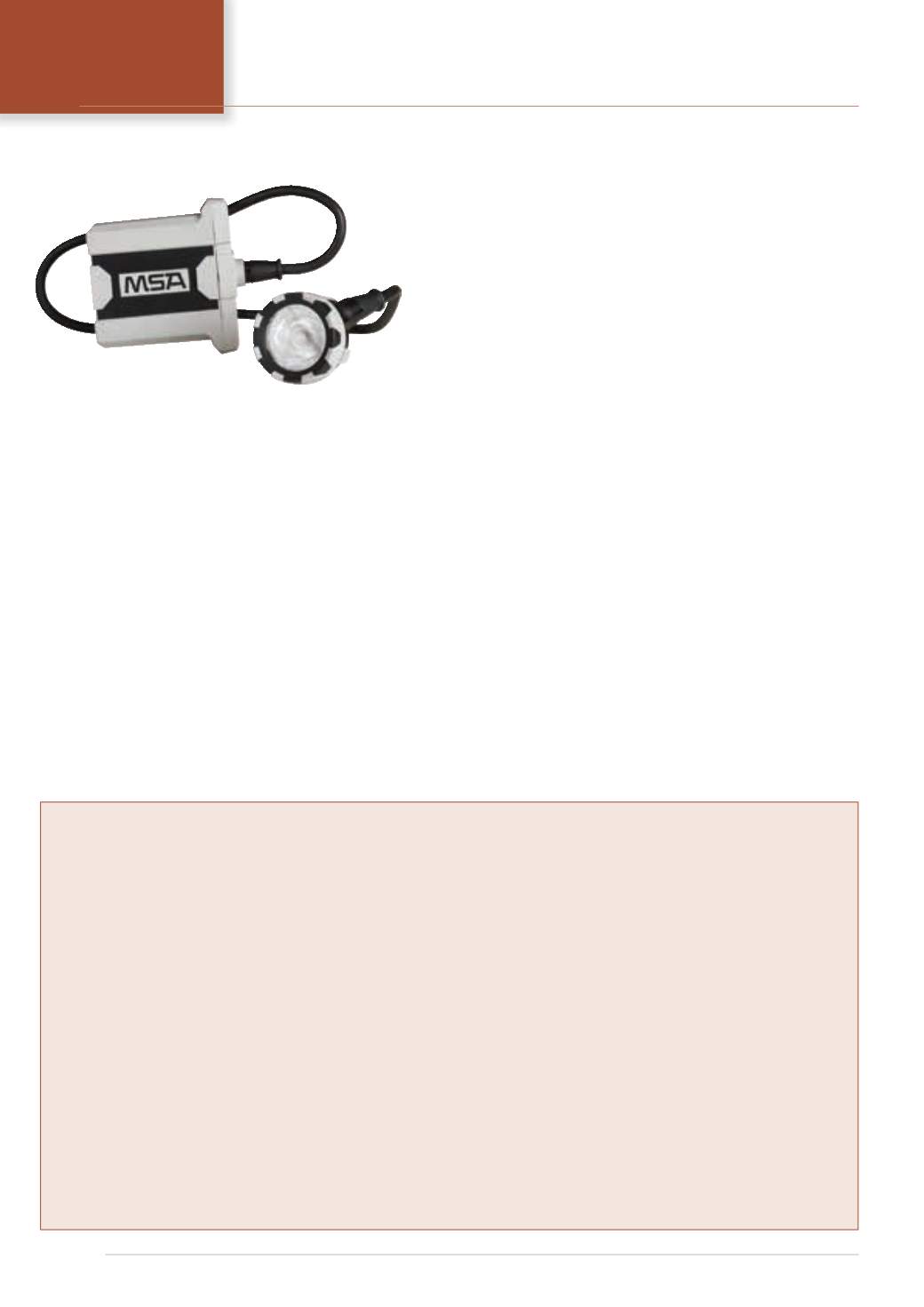
A first-of-its-kind cap lamp
– the Luminator – set to eliminate the haz-
ards of reduced visibility in South African
underground mining operations has been
officially launched by MSA Africa.
MSA invented the first electric cap lamp
in 1918 in a bid to counter the high number
of underground mining fatalities caused
by open flame lamps that were exposed to
high levels of combustible methane. Ever
since, the company has remained a front
runner in cap lamp innovation, with the
locally developed Luminator being the lat-
est international breakthrough in response
to local market needs.
MSA Africa Sub-Saharan Sales Leader
José Peral notes that the Luminator sets
itself apart from all other cap lamps in
the world, as it features a number of
ground-breaking innovations which,
he says, are set to dramatically improve
visibility and personal safety for South
Increased uptime with ceramic pulley lagging
Not only does conveyor belt slippage have
negative financial implications for process
plants and mines, but it is also potentially
dangerous. In instances where the slippage
continues, there is an increased danger of
fire as well as damage to the carcass and
splice, caused when the belt does not grip.
To alleviate these issues, Multotec Wear
Linings developedMultoLag™, a direct bond
ceramic pulley lagging system for drive and
non-drive pulleys. The standard 100 by 25
by 6 mm smooth high alumina ceramic tiles
are applied to non-drive pulleys while stud-
ded tile lagging is applied to drive pulleys.
MultoLag™ lagging serves as a mainte-
nance free, wear resistant cover which is
applied to pulley shells to improve traction
in the case of drive pulleys and provide a
polished low friction surface on non-drive
pulleys. The high co-efficient of friction,
approximately 0,78, of the ‘studded’ tiles
on the drive pulleys ensures no movement
between the ceramic lined drive pulley
surface and the conveyor belt surface. It is
not possible for wear to occur if there is no
movement between surfaces. Conversely,
the smooth/polished surface provided by
the very hard ceramic on the non-drive
pulleys provides minimal friction, less resis-
tance and therefore no wear.
“Ceramic pulley lagging would be used
in instances where the pulley operates in
extremely aggressive conditions. Typically
this would be in wet conditions and other
applications where a low co-efficient of fric-
tion or a high level of traction is required on
drive pulleys or where general wear protec-
tion of the non-drive pulley is needed. This
would include bucket elevators or where
material cannot be prevented from becom-
ing trapped between the pulley shell and
belt,” Noel Mills of Multotec Wear Linings
points out.
Ceramic lined drive pulleys are covered
with high-density 20 by 20 by 6 mm ceramic
tiles, with 1 mm-high round-edged studs on
the tile face that create maximum traction,
without the associated damage to belts.
The 6 mm thick high-density smooth
ceramic tiles are bonded directly to the
pulley’s surface with specially formulated
Multotec Hi-Bond epoxy. This allows the
company to achieve a bond strength at
least 70 % higher than that of rubber to
steel or rubber to ceramic. The epoxy allows
for surface flexing, corrosion protection and
water dissipation. In the unlikely event that
patching is required, local damage can be
repaired quickly without removing the sur-
rounding pulley lining.
“An attractive feature of the ceramic
material is that, although more costly than
conventional lagging, it is field proven and
in one application has already been in oper-
ation for a lifespan of more than 200 months
compared to a mere eight months for the
original liner,”Mills says.
Bernadette Wilson, Multotec Group, tel (+27 11) 923-6193
Innovative cap lamp introduced by MSA
African underground miners.
“A major feature is that it enhances
the miner’s ability to more effectively
detect cracks on hanging walls, which
usually represent signs of
ground falls and roof collapse.
By swiftly identifying these
cracks, miners save valuable
seconds and are able to evacuate
in the event of a rock fall,” he states.
This improved visibility is made pos-
sible by two state-of-the-art LEDs. The
working beam is emitted by an OSLON
SSL 150 high class LED and works through
an internal reflection and refraction lens,
which creates homogenous and halo free
light. In combination with its colour tem-
perature, identifying cracks on hanging
walls or seam layers is simplified with the
MSA Luminator.
An easy-to-find functionality button
allows the user to switch between three
modes, namely: working light narrow
beam, peripheral light and walking light.
MSA Africa Product Manager Tshepo
Lebona points out that the walking light
feature adds to overall worker safety.
“The extendedwalking light illuminates
the two-step walking distance in front
of the user, which increases the worker’s
comfort and underground safety by reduc-
ing injuries caused by tripping or slipping
due to insufficient light,” he explains.
The Luminator cap lamp also boasts
MSA’s LiFePO4 lithium-ion battery pack
technology, which ensures that the work-
ing light is able to run for more than 36
hours – well above the industry average of
24 hours. It also provides an additional 100
hours of emergency light.
Lebona continues: “The LiFePO4 bat-
tery pack is protected against deep
discharge and has a cycle life of 1 000 dis-
charge and charge cycles, with the battery
capacity maintaining up to 80 per cent
nominal capacity. A Luminator cap lamp
that has been used for a 12-hour shift can
be recharged within four hours, while a
fully flat battery can be recharged within
ten hours.”
The MSA Luminator cap lamp also fea-
tures what is said to be a world-first cable
management solution that can be easily
adjusted between 1 m and 1,6 m to mini-
mise the risk of hooking on to obstacles
that may cause serious injury to the miner.
Lebona adds that the lightweight and
comfortable design is another feature of
the cap lamp.
According to Peral, the cap lamp can
be easily clipped onto any type of hardhat,
and each unit comes standard with a radio-
frequency identification (RFID) tag that can
be used for asset control.
Jose Peral, MSA, tel (+27 11) 610-2600,
website:
MSA Africa’s Luminator cap lamp.


