project profile
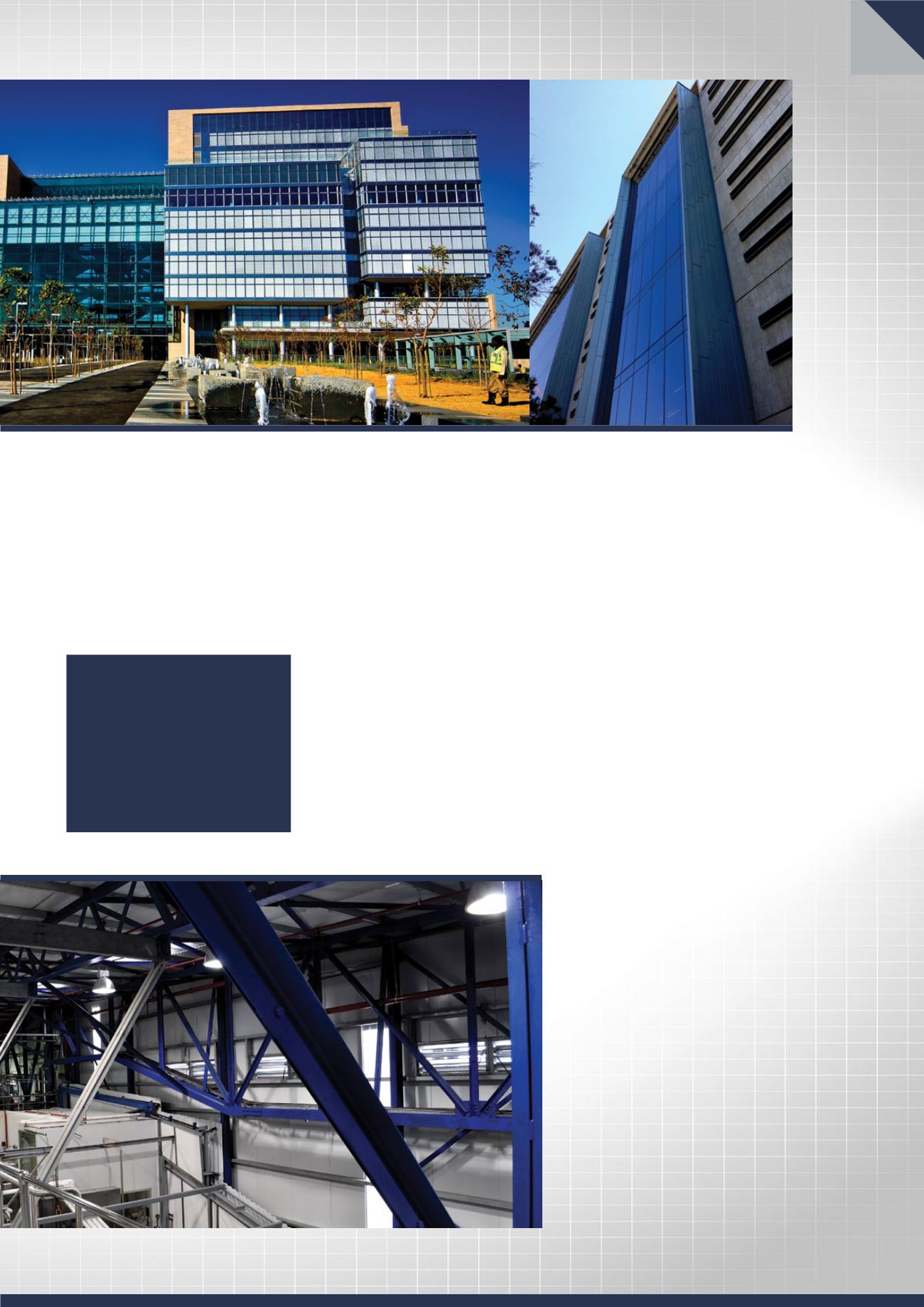
Architecturally the building features a con-
tinuous design of fluid curves. Sections of the
façade incorporate s-shaped scallop walls,
while wavy, flowing lines and patterns are
further integrated throughout the interior
of the building. Everything radiates out from
the centre of the building – clearly shown
by the shape of the bridge links. Bathroom
facilities are concentrated around the central
core of the building and occupants are never
more than a 20 m walk from these facilities.
Steel was used in every form throughout the
project especially in the following aesthetic
elements: the bridges and roof lights; the
spiral staircase and the cladding.
Joint winners in
Refurbishment and
Extensions Category:
King Edward VII School New
Library and Museum
The new library andmuseumproject at King
Edward School (KES) in Houghton, Johan-
nesburg, has been made the joint winner of
the Refurbishment and Extensions Category
at Steel Awards 2013.
Heather Dodd, representing the South
African Institute of Architects, and one of the
judges, said that this project is a “beautiful
example of a careful rework of an historic
building giving it a new programme and
lease on life”.
The original gymnasium as it stood offered
no real connection to the school. The high
windows provided no view of the gardens,
and there was no link to the fields as the rear
wall was closed off to the basketball courts
beyond. The idea was therefore to create
a spine through the building thus physi-
cally and visually linking the street entry to
the sports fields beyond. The library was to
be housed in the gymnasium hall and the
museum and ablution facilities in the old
storage and change-room area.
Internally the gymnasium with its large,
visually inaccessible, windows, Canadian
maple floors and dark trussed ceiling was
the perfect opportunity for a boys’ library.
However, the sprung floors could not support
book loads, and the space was inadequate
for both library and computing facilities.
The charm of the Edwardian shell and the
need to unite both old world and modern
allowed for the introduction of modern
materials such as steel and glass.
Paarman Factory
The extension and refurbishment to the new
Paarman Foods factory in Diep River, Cape
Town, has been named joint winner of the
Refurbishment and Extensions Category.
The owner chose to do an extension
where the building costs would be relatively
high but the overall cost would be cheaper
than a new building and machinery. The
judges commented that this “has to rank as
one of the most difficult extensions/ refur-
bishment projects that they have ever seen”.
The challenges were numerous and
exacting. These included: where to put new
columns relative to the existing structure
and plant equipment; determining the exact
dimensions and how tomeasure them in and
around all the structures and plant; making
sure everything clears vertically; splicing the
girders such that, where required, they could
be galvanized and erected; making openings
in lattice girders for doorways and passages
by use of Vierendeel openings; and more.
●
Standard Bank won the Tubular Category.
The New Alexander Forbes Head Office won
the Architectural Category.
The Paarman Factory was the
joint winner in Refurbishment
and Extensions Category.
"Considering the history of
high-level work that has been
entered into Steel Awards over
the years, it is most encouraging
that the bar is raised on such a
consistent basis."
Spencer Erling, SAISC education director and
convener of the Steel Awards judges.
November 2013
CONSTRUCTION WORLD
25


