November 2013
CONSTRUCTION WORLD
29
projects & contracts
DEVELOPED BY THE UNITED
States Green
Building Council, LEED is an internationally
recognised green building organisation that
provides building owners and operators
with a framework for identifying and
implementing practical and measurable
green building design, construction,
operations and maintenance solutions.
The build-up to this unprecedented suc-
cess started in 2007, when SMEC South Africa
was appointed as the principal consultant
and project manager. SMEC South Africa
technical director Gert Wentzel points out
that the site selection was done after exten-
sive geo-hydraulic studies.
Following this, SMEC South Africa was
responsible for appointing a professional
teamthat consisted of an architect, a quantity
surveyor and a team of engineers specialis-
ing in areas of expertise that includes: civils,
geotechnical, traffic, structures, mechanical,
electrical and fire.
During the course of 2008, the SMEC
South Africa team undertook specialist geo-
technical and traffic impact investigations
before constructionwork began in 2009.“One
oftheunique innovationsoftheprojectdesign
was to ensure that the facility blended in with
the surrounding landscape.The roof sheeting
colours were selected to have the highest
possible SRI (solar reflectivity index). The ag-
gregate for the concrete was also selected for
its high refection value resulting in reduced
heat gain in the building and minimising the
heat island effect,”explainsWentzel.
The facility is located outside the urban foot-
print since it has to be close to the source,
according to natural bottled water legisla-
tion. All the water used for the product and
for domestic consumption is sourced from
within the catchment area surrounding the
facility. The fresh water management system
is a closed system and all water used on site
is treated and re-used. All effluent that is
generated on site is treated and re-used for
service water purposes. In combinationwith
the harvested rainwater, a sufficient amount
of service water is generated to minimise
extraction from the local resources.
Wentzel points out that in order to reduce
electricity consumption, the facility was
designed to enable the maximum amount
of natural sunlight to enter the building
through the roof. A daylight study revealed
that a castellated roof with both transparent
and translucent sheeting was the best op-
tion for filtering natural light onto the floor
space. The design and placement of electric
lights internally and externallywas done in an
environmentally responsible manner, creat-
ing a comfortable working environment.
Valpré plant manager Refentse Puso
points out that the design has proven to
be such a success that the main production
floor now requires minimal electric lighting.
This substantial reduction in electricity con-
sumption has been further complimented by
the use of the solar power plant and motion
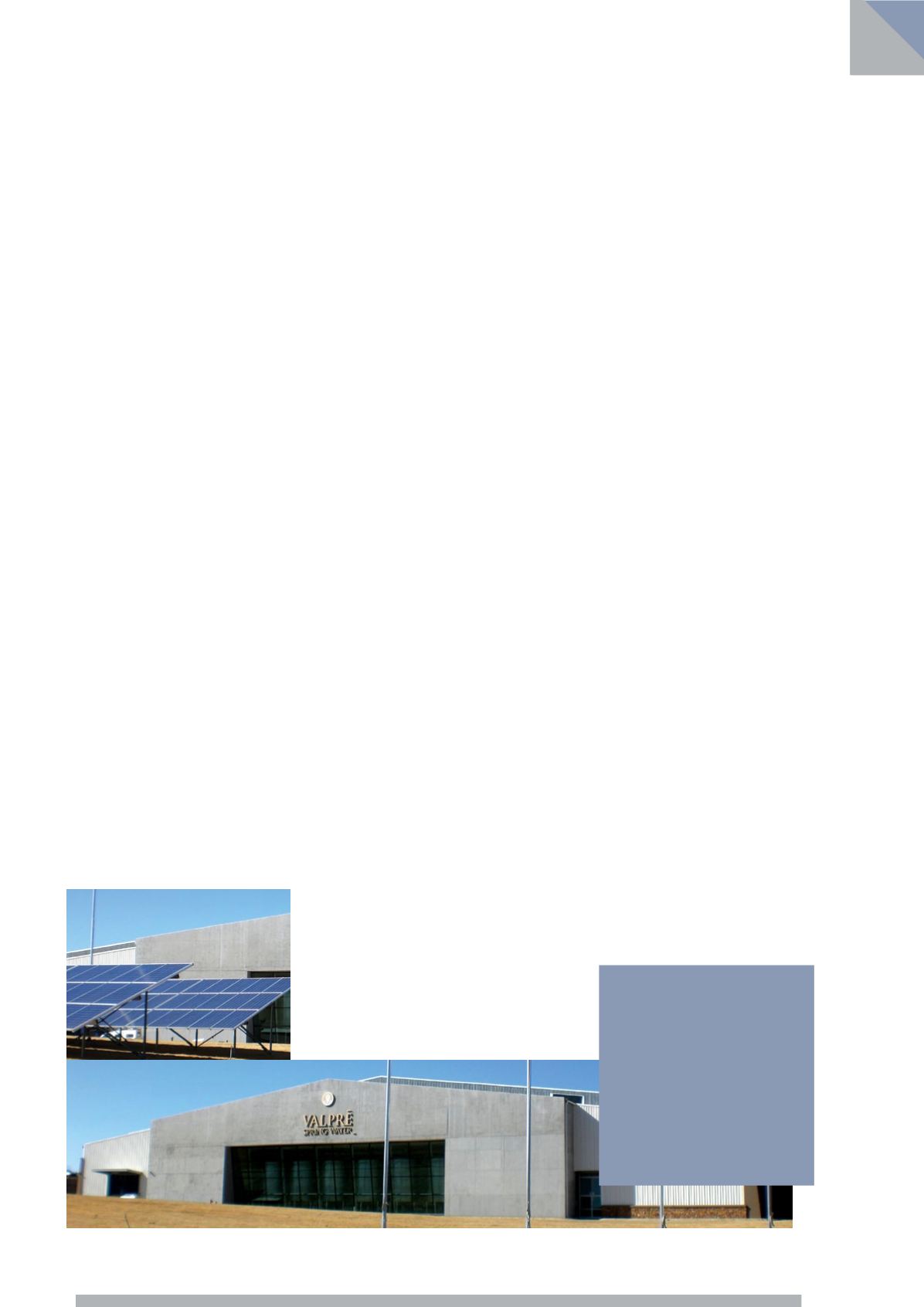
and daylight sensors. The solar power plant
has been sized to generate enough power
to fulfil the administration offices’ needs,
which practically makes the office block a
net-zero building.
Having already obtained LEED Gold
accreditation for the facility’s administrative
block in July 2012, Valpré was then awarded
LEED Silver accreditation for its bottling plant
in May 2013. Puso says: “The administration
building is the first in Africa and one of
only 1 000 worldwide to receive LEED Gold
certification, which makes this project an
environmental breakthrough locally.”
Puso continues, “With the establishment
of the newHeidelberg plant, SMEC South Af-
rica has assistedValpré in ensuring that it will
reduce its carbon footprint, lower itswater us-
age ratio, adopt energy efficient lighting and
production technologies, and boost it solid
waste recovery”.The solidwaste recovery area
consists of sorting and packaging equipment
that sorts waste at the source. The recovered
waste items are paper, plastics, metal and
organic material. The sorted waste is then
collected by approved recycling companies
for further processing.
Although the project has been hailed
an overwhelming success, Wentzel admits
that SMEC South Africa faced a number of
challenges.“We initially received some objec-
tion to building a large bottling plant from
the local community. However once they
fully understood the benefits that this project
brought to them, they bought into the idea.”
Wentzel has only praise for the first
class professional team involved in this
project, from Casper Durand of Coca Cola
South Africa for being a visionary client, to
all the SMEC staff who played their part.
Also of note was Peter Opthoff from the con-
tractorWBHO, Luis Prazeres of PPS Architects,
LEED consultant Mike Barker of Building
Physics, quantity surveyor Anthon Botha
from Pentad, fire engineer Leon Potgeiter
from IFESA and Patrick Kohler, mechanical
engineer from Spoormaker.
Wentzel believes that an increasing
number of operations in South Africa will
be aiming for LEED certification, as a result
of increased awareness through public and
legislative pressure to embrace sustainable
development principles. "As local businesses
continue to set higher sustainability targets,
I am confident that SMEC South Africa has
placed itself in a strong position to be se-
lected as a professional services provider for
future ventures, after successfully assisting
Coca Cola in becoming the first company in
Africa to achieve LEED Gold and Silver certi-
fication," he concludes.
●
Greenest bottling plant in Africa
Global consultancy firm SMEC South Africa has played a fundamental role
in ensuring that Coca Cola has become the first company in Africa to obtain
internationally recognised Leadership in Energy and Environmental Design
(LEED) Gold and Silver certification at its Valpré Water Bottling facility in
Heidelberg, Gauteng.
LEED projects have been
successfully established in 135
countries. LEED-certified buildings
are designed to lower operating
costs and increase asset value,
reduce waste sent to landfills,
conserve energy and water and
reduce harmful greenhouse gas
emissions, in addition to being
healthier and safer for occupants.
For more information visit


