42
CONSTRUCTION WORLD
JUNE
2014
PROJECTS AND CONTRACTS
A consortium comprising Murray &
Roberts Construction and Consoli-
dated Power Projects was respon-
sible for the provision of civils and
electrical infrastructure respectively.
The wind farm is owned by a consortium
comprising Globeleq, Mainstream Renew-
able Power, the IDEAS Fund managed by Old
Mutual Investment Group, Thebe Investment
Corporation, a community trust and local
engineering firms, Enzani Technologies and
Usizo Engineering. It involves the erection
of 60 turbines on a 3 700 ha site that was
selected due to the good wind conditions,
its relatively flat topography, minimal envi-
ronmental constraints and its proximity to a
132 kV Eskom grid line.
The wind farmproject has allowedMurray
>
WIND FARM HANDOVER
The 138 MW Jeffreys Bay Wind Farm was scheduled for handover
at the end of April 2014. This project forms the first phase of
Government’s plan to promote investment in 17 800 MW of
renewable generation capacity by 2030.
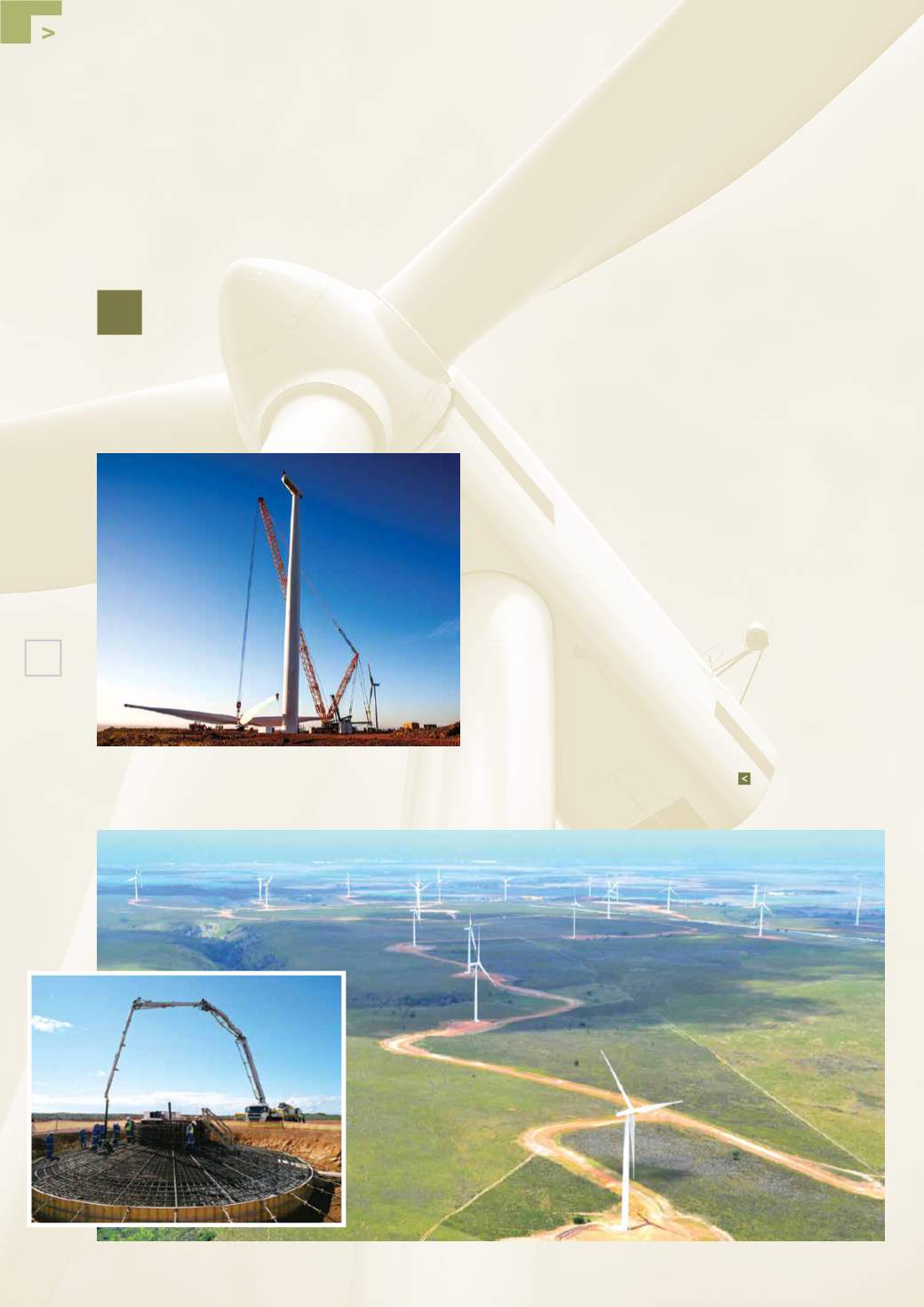
Work is nearing completion on the 138 MW Jeffreys Bay Wind Farm.
INSET: Murray & Roberts Construction’s scope of work for the
project included the construction of 60 concrete foundations for
the wind turbines.
An aerial overview of the Jeffreys Bay Wind Farm.
& Roberts construction
to showcase its capabil-
ities in tackling logisti-
cally difficult undertak-
ings within extremely
tight timeframes. Joe
Nell, project manager
for the consortium,
explains that Murray
& Roberts Construc-
tion’s scope of work for
the project included
the
construction
of
50 km of gravel road, 60
concrete
foundations
for the wind turbines,
route
modifications
on the N2 highway
and the building of a
350 m
2
operations and
maintenance building,
together with the trenching for the installa-
tion of 200 km MV cabling to the substation.
Apart from the stringent time constraints,
one of the largest challenges encountered
by the Murray & Roberts Construction team
was the very rocky terrain. With most of the
rock being close to the surface, the team was
forced, in most instances, to make use of
hydraulic hammers mounted on excavators.
Due to the sheer weight of the turbine
and its components, careful consideration
was given to the concrete mix used for the
turbine foundations.
Each turbine has a capacity of 2.3 MW and
a rotor diameter of 101 metres. The nacelle
weighs in at 86 t and the tower comprises
three sections. Each turbine foundation
required approximately 330 m
3
of concrete,
most of which was produced in an on-site
batching plant.
The project called for a total of
290 000 m
3
of earthworks and 26 000 m
3
of
concrete, together with 2 700 tons of steel-
work. The majority of the road building
materials was sourced on site, with the
aggregate for the concrete and bedding being
sourced commercially.
Nell points out that the civils and elec-
trical infrastructure project consortium was
allotted ten milestone dates which were all
met timeously and efficiently.
“The success of the project can be
attributed to the finite planning of each
step in the process, the ability to remain
flexible in the face of adversity, and the
strong level of teamwork and participation by
all stakeholders.”


