48
CONSTRUCTION WORLD
JUNE
2014
ROADS AND BRIDGES
All new asphalt plants being
produced by Comar are already
compliant with the stringent 2015
National Ambient Air Quality
Standards for Particulate Matter (dust), that
will see the present acceptable dust aspect
of 120 µg/m
3
being reduced to 40 µg/m
3
from
1 January 2015.
“In addition to ensuring that the plants
we’re producing comfortably meet legislated
requirements for the foreseeable future, we
are striving to assist the operators of existing
asphalt plants, those purchased from us and
from other suppliers, to upgrade their plants
to meet the imminent new limits by retro-
ardship and RAP offers an extremely valuable
source of pre-processed road building mate-
rials. This practice aligns with a global trend
supporting and promoting the use of recycled
highway materials in pavement construction
in an effort to preserve the natural environ-
ment and reduce waste. The use of RAP has
grown widely in recent years, diminishing
the use of virgin materials and helping to
preserve landfill space.
“In the local market RAP has come to
the fore on static asphalt plants, but there
are few companies incorporating this mate-
rial at high percentages on mobile plants.
Comar has successfully developed three twin
drum mobile plants capable of running at
40% RAP, achieving huge savings on bitumen
costs. These three mobile plants are currently
deployed in Margate, Umzinto and Mandini in
KwaZulu-Natal.”
This achievement follows in the wake of
Comar’s extensive involvement a few years
ago in the ‘Warm Mix trials’ initiated by the
eThekwini Municipality, where up to 50%
RA was introduced using Comar technology
on a static plant. Working in collaboration
with one of its customers, Comar came up
with a feasible design for a mobile plant
incorporating a 40% RAP system. Following
successful trials, Comar secured an order for
a new 120 ton per hour mobile plant and later
to upgrade an existing mobile plant to similar
specifications for the same customer.
Ken Basson, director responsible for the
Plant & Engineering Division of B&E Inter-
national, says since Comar’s acquisition
by B&E International in 2012, major invest-
ment has gone into research and develop-
ment in general, but with a strong emphasis
on improving the environmental aspects
of Comar plant designs to ensure absolute
compliance with legislation, both now and
into the future.
“What we have in Comar is very exciting
and we’re proud to be building and improving
an already great company that will continue
to deliver top quality asphalt equipment into
the African market,” Basson concludes.
ENVIRONMENTALLY
COMPLIANT
asphalt plants
Comar Plant Design and
Manufacturing, part of
crushing, mining and
mineral processing entity
B&E International, leads
the African market in the
arena of manufacturing
environmentally friendly
asphalt plants.
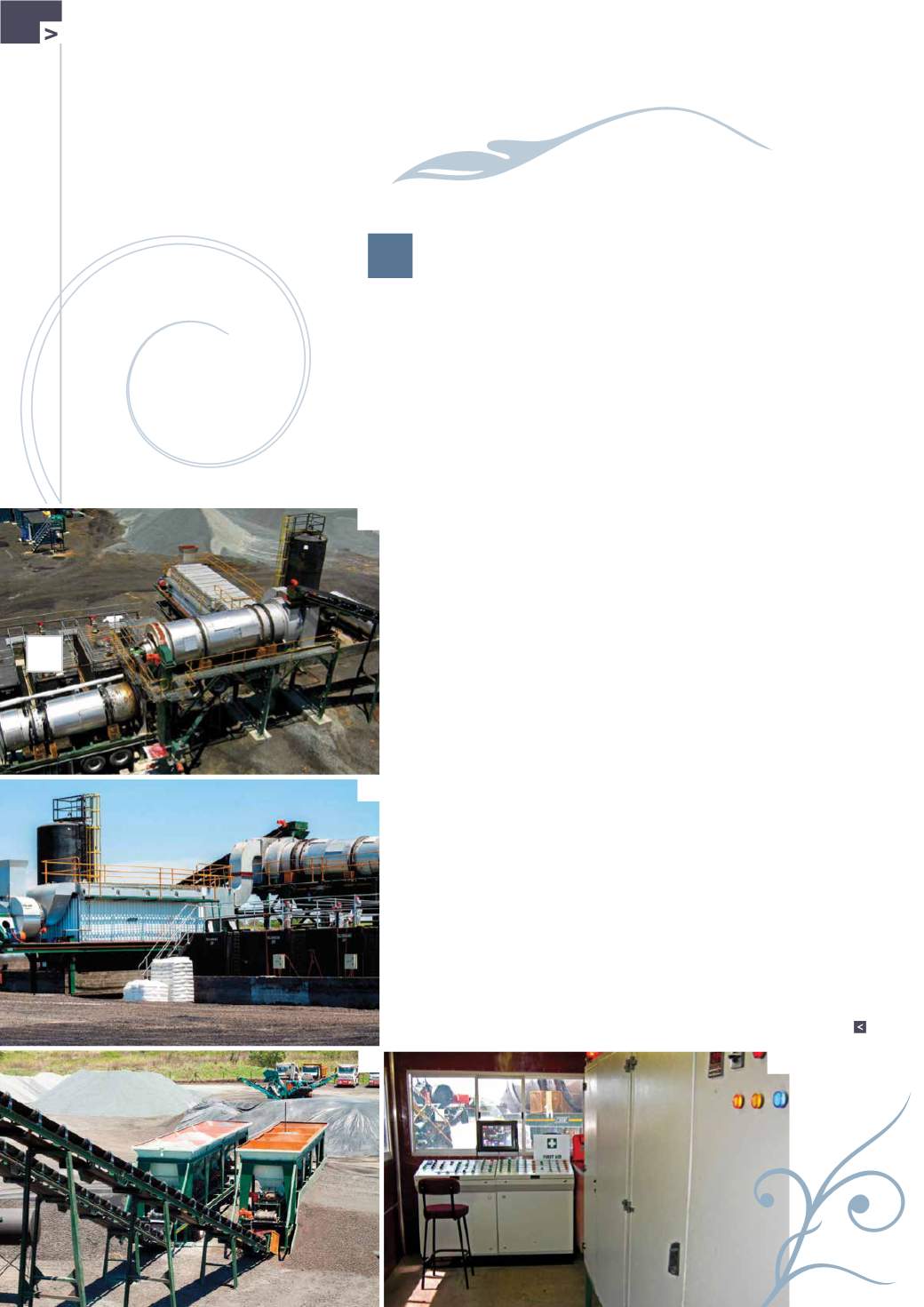
1. This Comar 100 tph mobile plant
currently using 40% RAP.
2. The Comar mobile bag use meets
the new 2015 environmental
emission requirements.
3. Comar mobile cold feed and RAP
bins.
4. Comar containerised control room
fully air-conditioned, housing all
electronic control equipment.
fitting improved dust suppression
systems,” Brian Henning, technical
manager at Comar, says.
Comar has also initiated a
strong drive to handle recycled
asphalt pavement (RAP) in its
asphalt mixtures. RAP is the term
given to removed or processed
materials containing asphalt and
aggregates. These materials are
generated when asphalt pavements
are removed for construction, resur-
facing, or to gain access to buried
utilities. When properly crushed
and screened, RAP consists of high
quality, well-graded aggregates
coated with asphalt cement.
“Recycling of obsolete asphalt
pavement makes both environ-
mental and economic sense,” says
Henning. “Comar is a company
committed to environmental stew-
1
2
3
4
>
48
CONSTRUCTION WORLD
JUNE
2014


