52
CONSTRUCTION WORLD
JUNE
2014
ROADS AND BRIDGES
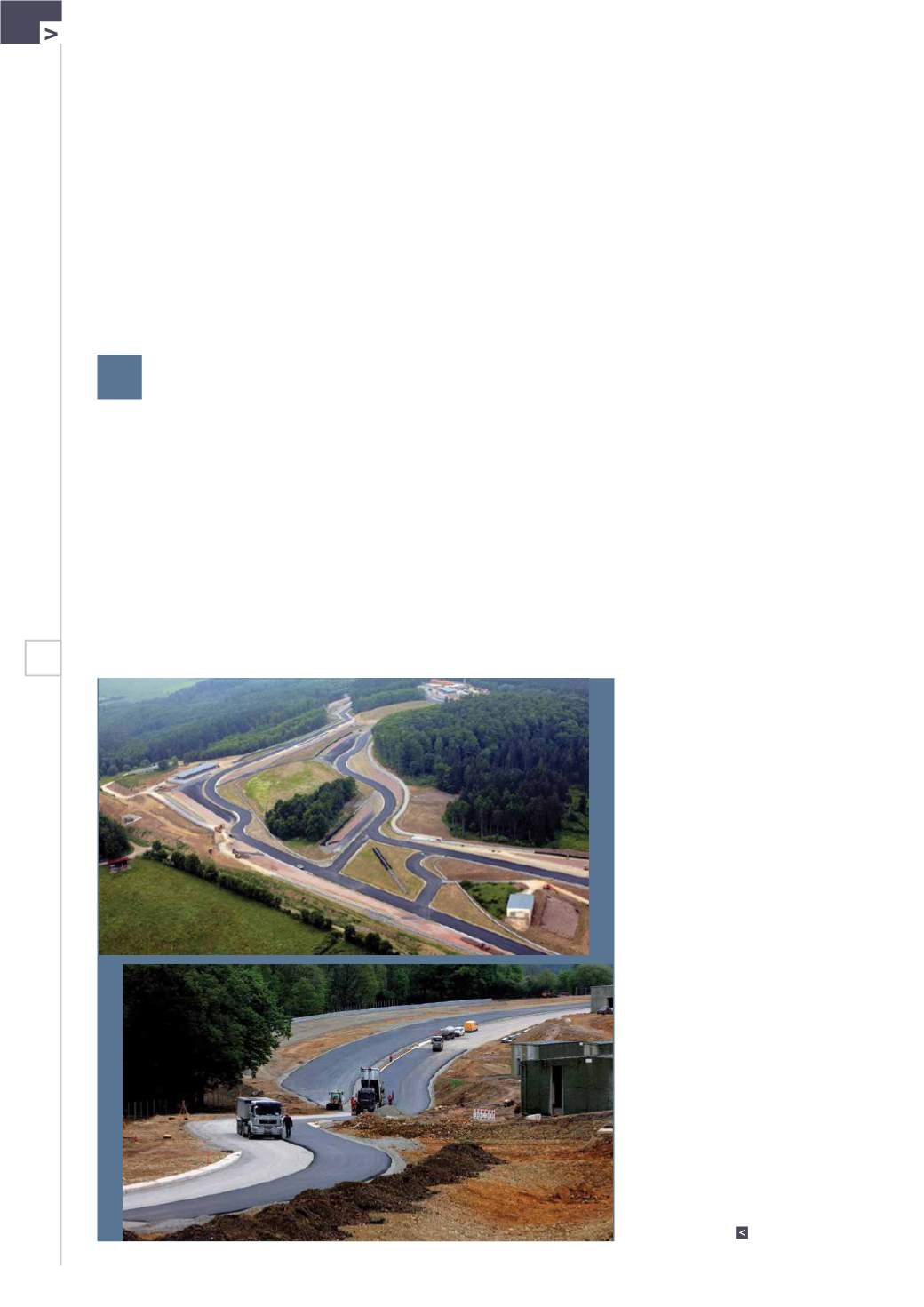
If all goes to plan, the Bilster Berg
Drive Resort will open for busi-
ness here later this year and offer
an ideal setting for presentations, driver
training and test drives.
The 4,2 km long circuit of this first
German drive resort comprises a shorter
western loop with clubhouse (and a
building for seminars and conferences) plus
a longer, faster eastern loop with pit lanes
and pit halls (for sporting events).
Drivers can complete preparatory training
in driving safety on the skid pan. Away from
the asphalt, an off-road area with a circular
trail provides the opportunity to demon-
strate and test out SUVs. Even automotive
manufacturer designers and engineers get
numbers will illustrate the dimensions of this
task: the whole project at Bilster Berg totals
USD 412-million) in investment volume. The
earth moving alone amounted to around
500 000 m
2
of soil. All those involved were
therefore focusedon theprecisemanagement
of the work schedule and costs. “A contem-
porary technical standard for earthworks
of such complexity requires earth-moving
machines with GNSS control systems“,
explains the site manager in charge, Stefan
Krimpmann. “All our principal machines were
equipped with them.” A grader with GNSS and
LPS control for earthworks and fine grading,
three hydraulic excavators with 3DXi dual
GNSS systems and four caterpillar-tracked
vehicles with the 3D-MC2 GNSS control
system from Topcon – this equipment helped
the company to fulfil its task.
Asphalt paving in three
dimensions
The earth-moving works were already
completed in the previous year – even earlier
than originally planned. The 10-12 m wide
asphalt track was also in place, winding
through the natural country park. Prior
to this, however, the asphalt engineering
experts from Johann Bunte Bauunterneh-
mung had faced a challenge. They had to
transform the complex spatial design data
into an asphalt track which met the high
demands of the Bilster Berg Drive Resort. Two
conventional asphalt pavers were used to lay
the hot-mix asphalt. However, certain details
were beyond the normal standards because
the circuit includes a 70m height difference in
the terrain and a total of 200 m in a complete
lap. The paver had to be fed using wheel
loaders instead of the normal dump truck on
some particularly steep sections. Something
special was also chosen for positioning the
machines – a combined LPS / GNSS system
made by Topcon.
The decision to use this was made jointly
by Bunte and its Topcon distribution partner
IBS. Lars Nowoitnick, advisory sales engineer
at IBS, explains the details: “The 3D-LPS local
positioning system gives the paver its exact
current height to a few millimetres. The extra
GNSS module provides the spatial orienta-
tion of the paver in the site model.“
Sporty driving experience
The asphalt track with its numerous long
and tight bends, steep sections and gradi-
ents, summits and dips will provide a sporty
driving experience for ambitious drivers
and professional racing drivers alike. But
even less experienced car enthusiasts can
sit at the wheel and step on the gas without
having to worry.
>
SPEED AND PRECISION
In the green heart of Germany a new test and presentation track
will soon offer all fans and professionals a lot of fun with their
cars. The asphalt track and off-road area were built at a brisk
pace and with high precision. Car experts and professionals
are already looking forward to a special experience in one of
Germany’s beautiful natural areas, the Teutoburg Forest.
their money‘s worth at Bilster Berg. Here they
have the opportunity to carry out research
and development in peace away from prying
eyes, test their mystery models and make
technical improvements to prototypes.
Precision earthworks for
natural circuit
The demanding circuit was laid out like
a classic natural track. Its designers took
advice from the legendary German rally
driver Walter Röhrl and carefully designed
the track to fit into the natural topography.
Next, the contracted civil engineering
company, Johann Bunte Bauunternehmung
from Papenburg was required to implement
the design data on the actual site. A few


