45
CONSTRUCTION WORLD
MARCH
2014
viability of some of the new high-speed
passenger lines. “Internationally high-
speed passenger railways have also gener-
ally been controversial.”
A second lesson
So, apart from a dedicated high-speed
passenger railway what other modern
railway options should South Africa be
looking at in China?
Evans says the well-deserved atten-
tion being paid to China’s impressive high-
speed dedicated passenger railway system
has tended to push other important rail
developments there into the shadows.
“Looking specifically at the Durban-
Gauteng corridor, the development of
high-standard mixed-traffic (passenger
and freight) high-capacity railways in China
warrants serious attention too.”
Most of China’s older key double
-track mixed-traffic mainlines were steadily
up-graded from 1995 to allow for 160-250
km/h passenger and 120 km/h freight train
operation on the same lines. These stand-
ards have also been adopted for important
new high-capacity mixed-traffic mainlines.
Another important and more recent
development for certain key corridors is
the adoption of increased vertical clear-
ance standards, to allow for the movement
of high-profile freight traffic, in particular
double-stack container trains and possibly
also multi-deck motor vehicle trains.
Several new lines to these standards
were recently opened to traffic and several
more are under construction. China’s inten-
EQUIPMENT
tion is to create a 10 000 km network of
such lines linking major production centres
to the key import/export ports and interna-
tional borders.
Evans believes this type of line – freight
and passenger with clearance provision
for double-stack container trains – merits
close examination as a possible model for
the proposed new Durban to Gauteng line.
“Anyone travelling on the N3 freeway
between Johannesburg and Durban must
notice the large numbers of trucks trans-
porting containers and transporting new
motor vehicles. Studies predict that the
movement of containers on this corridor is
going to grow significantly over time – by
as much as 400% over the next 25 years.”
“For technical reasons, double-stack
container trains cannot be operated on the
existing railway in this corridor.
“Construction of a new line to allow for
this would be of a much higher standard,
shorter and should cut the
cost of container movement
significantly; helping to boost
the country’s trade competi-
tiveness and cut the costs of
doing business.”
At present the operation of
double-stack container trains
is common-place, and is being
expanded, in North America
(the USA, Canada and Mexico).
Comparable trains run across
Australia between Perth and
Adelaide and in Saudi Arabia.
India is developing several
high-standard freight rail lines for double-
stack container train operation and China
is developing a network of around 10 000
km for such operations. Essentially, these
trains require a standard-gauge line with a
vertical clearance for bridges, tunnels, etc.,
of about three metres higher than most
existing railways allow.
An unclear plan
Evans says the present plan for rail in the
Durban-Gauteng corridor is not clear.
“Several government sources appear to
favour a dedicated passenger high-speed
standard-gauge railway. On the other
hand, there have been recent calls for a
high-standard freight line that can accom-
modate double-stack container trains.
Proponents of the freight line proposal
suggest that passenger transport could be
left mostly to the airlines and roads. China
is showing that, with some compromises,
it is possible to build a high-standard
modern railway that can handle both forms
of traffic”.
Using the Chinese model described, a
new Durban-Gauteng high-standard mixed-
traffic line could provide for rail services
that would include the following:
• 200-250 km/h electric multiple
unit passenger trains offering
services that would appeal to the
business community and more
affluent travellers;
• 120-160 km/h air-conditioned
conventional locomotive-hauled
passenger services with several
standards of accommodation that
would appeal to the less affluent,
tourists and local holiday makers;
• 100-120 km/h double-stack container
and triple-deck automotive trains; and
• other freight trains carrying high-value
or time-critical merchandise that can
travel at 120-160 km/h.
To Evans, a high-standard mixed-traffic
mainline rather than a passenger or
freight-only line along the Durban-Gauteng
“If one considers that switching
containers from road to rail would
help to reduce road accidents in this
corridor, lower energy requirements
and also contribute towards
containing carbon emissions growth,
then the appeal of such a railway
solution is clear,” says Evans.
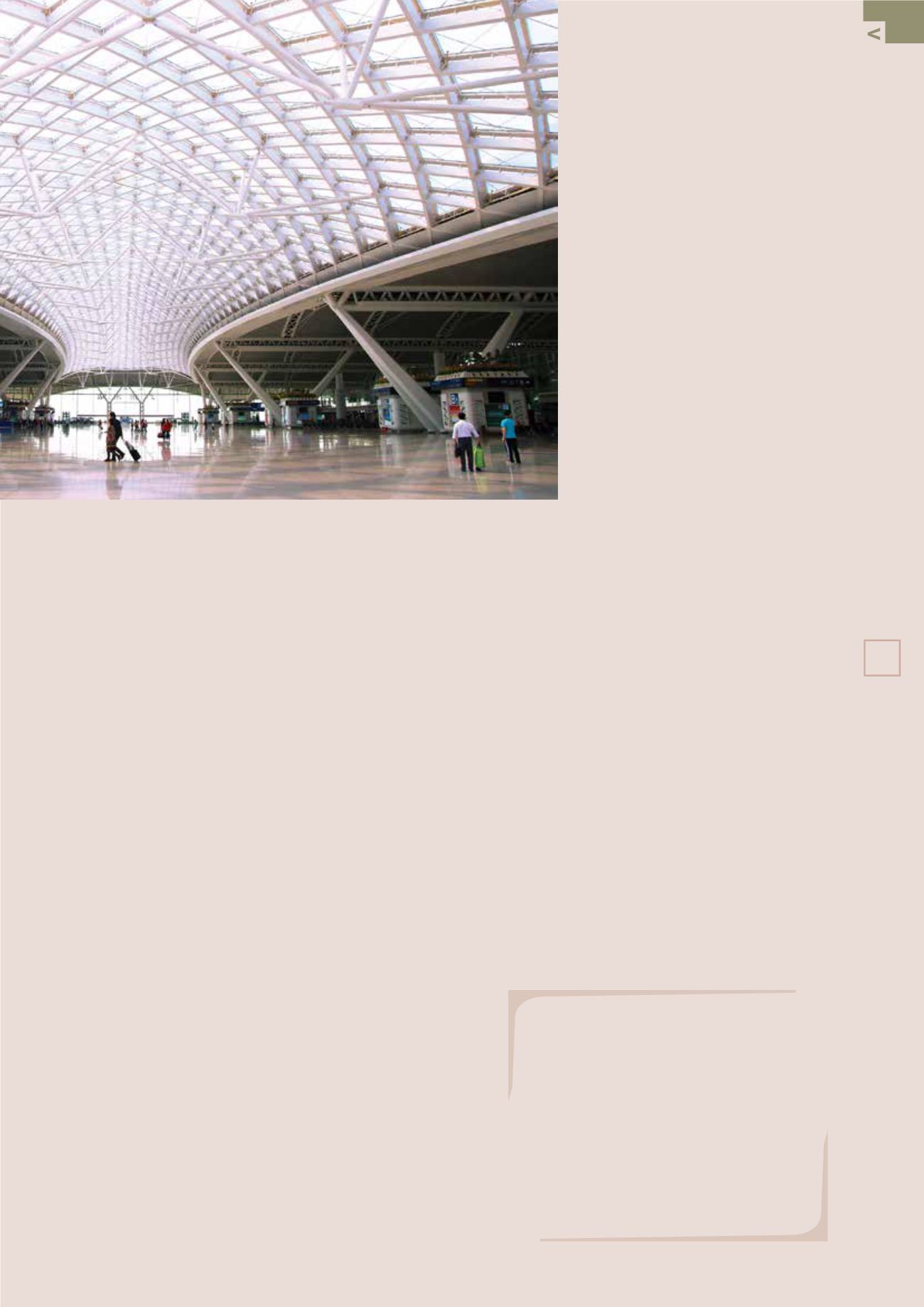
The station serves 200 000 passengers per day. (Photo: courtesy
)
Continued on page 45


